Author: Joe

  • Aquarium driftwood

    Aquarium driftwood

    Aquarium driftwood comes in two broad kinds: light, branching woods such as spider wood and manzanita that float at first, and dense woods such as mopani that sink straight away. Any of them can tint the water and grow a harmless white film. Light wood sinks once it has soaked up enough water.

    The main types

    These are the woods most often sold for aquascaping, and what the sources say about each.

    WoodLookSinks?Source
    Spider woodPale, fine branching rootsFloats at firstOur spider wood page
    ManzanitaBranching shrub wood from western North AmericaAfter about 4 to 7 days’ soakingTannin Aquatics
    TalawaBranchy but straight-lined; two-tone from sandblastingFloats at firstAquasabi
    Moorwood (bog wood)Dark brown, smooth, often slightly shinyFloats if bought dry, sinks if bought wetAquasabi
    MopaniGnarled, two-tone, little branchingUsually straight awayAquasabi
    MekongStraight and narrow, with deep furrowsStraight awayAquasabi
    MalaysianDark brown and craggyUsually straight away (sellers differ)Buce Plant, Tannin Aquatics

    Aquasabi’s advice for any layout is to stick to one kind: it says a single wood type looks much more harmonious. The light, branching woods suit fine detail, and Terrarium Tribe suggests saving the heavy woods such as mopani for the centrepiece.

    Malaysian driftwood

    Malaysian driftwood is the classic dark aquarium wood, rich brown and craggy. Terrarium Tribe describes it as dark hardwood from “a variety of trees all native to Malaysia”. No reliable source names the species, so treat any listing that does with caution.

    Most sellers, including Buce Plant and Bulk Reef Supply, call it dense and say it usually sinks without a pre-soak. Tannin Aquatics sells a lighter, porous grade that needs soaking to sink, so check the description of the piece you buy. Expect tannins: Tannin Aquatics calls it “loaded with tannins”. Terrarium Tribe rates it the only wood that comes close to mopani for toughness.

    How to prepare driftwood

    • Rinse and scrub with a soft brush to remove dirt and debris, as Tannin Aquatics suggests. Don’t use bleach: Aquarium Science warns it can stay in the wood in a form water conditioner can’t neutralise.
    • Soak it in a separate container. Aquasabi’s classic method is a few weeks in water, changed from time to time, in an open container so gas can escape. Tannin Aquatics says there is no real shortcut: the wood has to waterlog to sink.
    • Or soak it in the tank. Aquasabi suggests weighting it down, wedging it between stones, or fixing it with glue, silicone or cable ties. ADA’s advice is a stone on top for about a week.
    • Check every piece. Aquasabi says to make sure each piece stays down before you use it in a layout, or a floating root can wreck the scape when you fill the tank.

    Dense woods such as mopani and Mekong can skip most of the soak, though a pre-soak still draws out some of the tannins.

    Should you boil driftwood?

    The sources disagree more on this than on anything else about wood.

    SourceView on boiling
    Buce Plant (shop)Boil 1 to 2 hours to help release tannins
    LiveAquaria (shop)Boiling 1 to 2 hours first may shorten the soak to 48 to 72 hours
    Tannin AquaticsSpeeds manzanita up by a day or two at most; hardly worth the trouble
    ADAEven boiling can’t get the tannins out completely
    AquasabiNever boil or scald moorwood, which may rot later
    Aquarium ScienceDon’t boil wood: it only reaches surface tannins, softens the wood, invites water mold and doesn’t make wood sink

    Soaking does everything boiling claims to, more slowly and without the risks. Skip the pot unless the piece is small and you’re short of time, and never boil moorwood. Aquarium Science also warns against baking wood in an oven, which is a fire risk.

    Brown water from tannins

    Driftwood releases tannins and other humic substances that tint the water tea-brown, and Aquasabi says the denser woods are the most likely to do it. It is harmless. ADA says the amount that leaches naturally does no harm to the tank’s life, and Aquarium Science says tannic acid lowers pH only very slightly, from about 7.4 to 7.3.

    If you’d rather have clear water, ADA says repeated water changes clear it gradually, and Aquarium Science says activated carbon and tannin-removing resin media both absorb it. Don’t expect it to stop for good: Aquarium Science says wood that releases tannin will do so for years. Some keepers want the tint, and a blackwater biotope is built around it.

    The white fuzz on new wood

    A white, slimy or cottony film often grows on new driftwood in its first weeks. The sources can’t agree what it is: Aquasabi says bacteria, ADA and Tannin Aquatics call it a fungus, and Aquarium Science says it is water mold. They all agree it is harmless and temporary.

    Aquasabi says it feeds on sugars left in the wood and vanishes once they are used up, and that snails, shrimp and some fish eat it. You can siphon it off or brush it away. Aquarium Science says it typically lasts four or five weeks and won’t spread to fish. Its one warning: if the mold persists, the wood smells bad or starts to fall apart, the wood is too soft and should come out.

    Can you use wood you found yourself?

    Aquarium Science says yes, with care. Its test is to smell the wood: dead wood, wet or dry, with no smell of sap or chemicals is fine, while fresh pine, fresh cedar and strongly scented eucalyptus are not. It also says to smell shop-bought wood, because some suppliers oil it and the oil has killed fish. Tannin Aquatics takes the cautious line: the wood must be dry with no live wood or sap, and it is better to buy from sellers of aquarium-safe wood.

    Aquarium Science also dismisses the idea that only hardwoods are safe, saying a wood’s hardness has little to do with how long it lasts. Wood from a stream can carry hydra or planaria, which it says matters mainly in shrimp tanks.

    Planting on driftwood

    Aquasabi says most epiphytes grow onto wood over time: mosses, ferns, Anubias and Bucephalandra. Moss is also useful for hiding a cut edge or an awkward spot, and both Java moss and Java fern attach this way. Porous lava rock beside the wood gives the same plants another surface, and Aquasabi says black lava works very well with driftwood.


    Aquarium driftwood questions

    How long does driftwood take to sink?

    It depends on the wood. Dense woods such as mopani and Mekong sink straight away. Light woods need to waterlog: Tannin Aquatics says manzanita takes about 4 to 7 days, and Aquasabi’s classic soak runs to a few weeks.

    Should you boil driftwood before putting it in an aquarium?

    Sources disagree. Shops recommend 1 to 2 hours to release tannins, while Aquarium Science says boiling softens wood and doesn’t help it sink, and Aquasabi says never to boil moorwood. Soaking is the safer route.

    Is the white fuzz on driftwood harmful?

    No. Aquasabi, ADA, Tannin Aquatics and Aquarium Science all call it harmless and temporary, though they disagree on whether it is bacteria, fungus or water mold. Snails and shrimp eat it, and it usually clears within weeks.

    Sources: Aquasabi, Preparing driftwood; Aquasabi, Types of hardscape; Aquasabi, Driftwood in a tank with invertebrates; ADA, Hardscape materials (via Aquasabi); Aquarium Science, Wood; Aquarium Science, Water mold; Tannin Aquatics, A few notes on wood in the aquarium; Tannin Aquatics, ‘Wood’ you? Well, yes, I will; Tannin Aquatics, ‘Wood’ you believe this; Tannin Aquatics, Manzanita; Terrarium Tribe, Wood for terrariums; Terrarium Tribe, Mopani wood guide; Buce Plant, Malaysian Driftwood (shop listing); Bulk Reef Supply, Malaysian Driftwood (shop listing); LiveAquaria, Malaysian Driftwood (shop listing); Tannin Aquatics, Malaysian Driftwood (shop listing).
  • Lava rock

    Lava rock

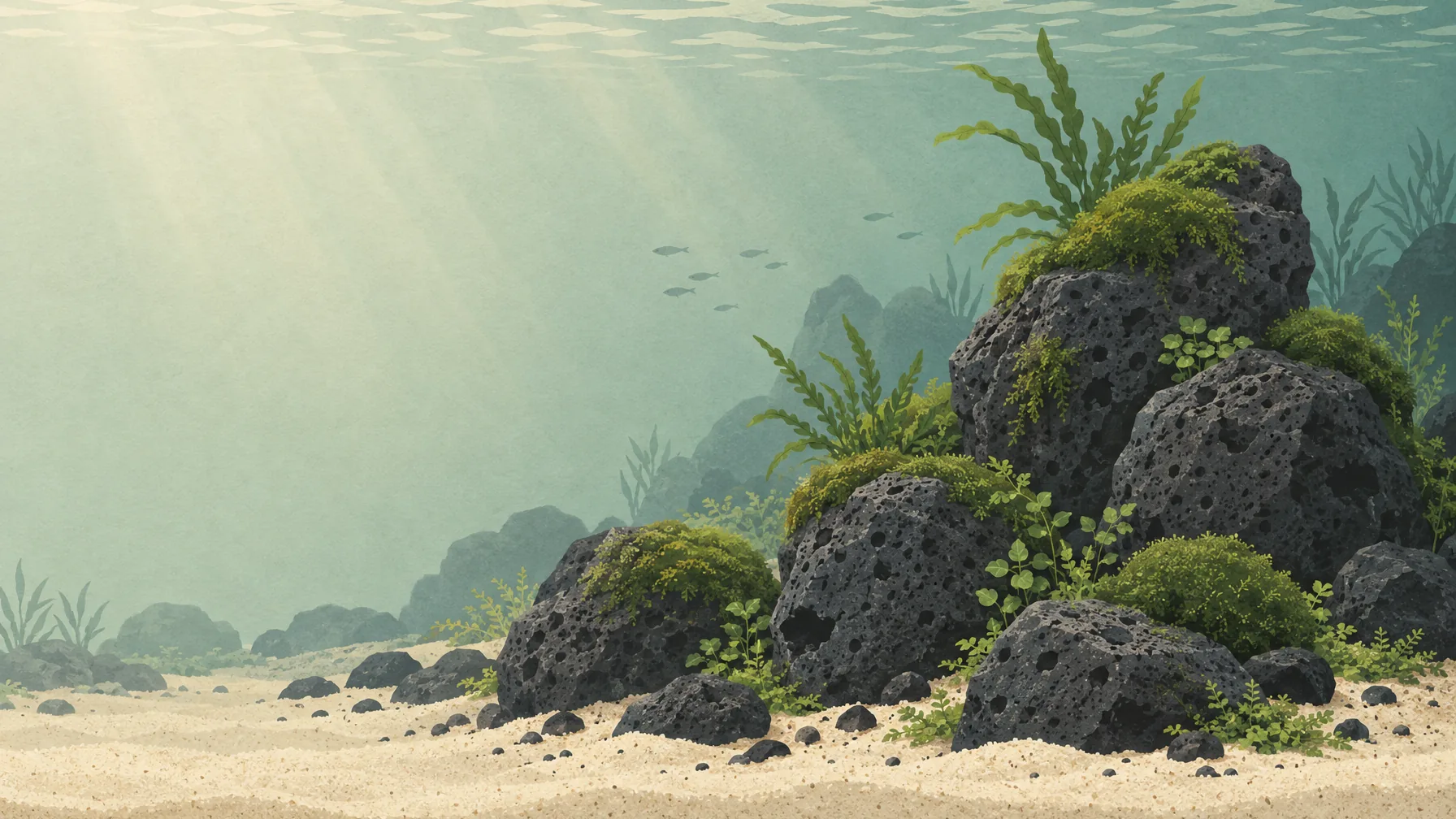
    Lava rock is light, porous volcanic stone, sold in black, red and dark brown grades for aquascaping. Its pores give plant roots a grip, which makes it a favourite base for mosses and ferns. Aquasabi classes it as water-neutral, though ADA rates its own KUMU lava stones as having a moderate effect on hardness.

    What lava rock is

    Aquasabi describes it as stone of volcanic origin with a porous texture that makes it very light. Aquarium Science puts it more bluntly: “Lava rock is just a porous natural ceramic product.”

    The light weight is the practical draw. Aquasabi says porous stones such as lava give more volume per kilo than dense stones, so large structures are possible, and you need considerably less of it by weight than of a heavy stone. Its rule of thumb for stone in general is your tank’s volume in litres divided by six, in kilograms. With lava you can come in under that.

    Does lava rock float?

    Sometimes, briefly. Aquasabi reports that some of its Island Lava floated on the surface for a short while before sinking, and Buce Plant, which sells lava, says smaller pieces may be slightly buoyant. Aquarium Science says it doesn’t float. Drop each piece in water before you build, and weight or wedge any that bob up.

    Does it change your water?

    Mostly no, with one exception worth knowing about.

    SourceWhat it says
    Aquasabi guideLava doesn’t influence water quality; it lists Black Lava among its water-neutral stones
    Aquasabi and Buce Plant listingsBlack, red and Icelandic lava are inert and don’t raise hardness
    ADA KUMU lava (Aquasabi listing)Black: moderate effect on GH and pH. Red: low effect on pH, moderate on GH

    So the ADA claim covers one product line, and Aquasabi’s own guide still calls lava neutral. If soft water matters to you, for shrimp or soft-water plants, soak-test the stone you actually buy. Our aquascaping rocks page explains how.

    Is it good filter media?

    The shops say yes and the one test says no. Buce Plant’s listing claims its millions of tiny holes give beneficial bacteria a huge surface, and ADA’s listing credits it with natural biofiltration. Aquarium Science tested half-inch lava rock and found it did poorly at oxidising ammonia, which it says surprised it, and it lists “lava rock is a great biological filtration media” among hobby myths. It also says garden-centre lava, typically two to three inches across, is far too big to work as filter media.

    Buy lava for the look and for planting. Treat any filtration benefit as unproven.

    The colours on sale

    GradeHow sellers describe it
    Black lavaVery dark, black to grey (Aquasabi, Buce Plant)
    Red lavaDeep brick red to burnt orange (Buce Plant)
    Icelandic lavaDeep, dark brown when submerged (Buce Plant)
    Galapagos rockDark, with some brown accents (Aquasabi)

    All of it looks darker wet, Buce Plant notes. Aquasabi says a classic Iwagumi can be built from black lava, whose dark colour contrasts with the grey stones more commonly used.

    Planting on lava rock

    This is lava’s real strength. Aquasabi calls the porous structure ideal for ferns and mosses, and describes “Green Reef” scapes: tall lava structures covered in epiphytes such as Microsorum and Bolbitis ferns and moss, whose roots find a grip in the pores. It adds that lava is often used with driftwood roots, the stones covered in moss for forest-style scapes.

    Tropica grows plants on lava for sale, including Anubias, Bucephalandra, Cryptocoryne, Microsorum (Java fern) and Bogor moss. It says plants grown directly on wood and stone are far hardier than plants grown in pots.

    Preparing it

    Rinse every piece under running water. Aquasabi says this removes fine dust that would otherwise cloud a new tank, and its listing for WIO red lava adds that fine mechanical filtration may be needed for 24 to 48 hours. Don’t use cleaning agents. Aquarium Science sees no point in boiling or bleaching rock, since a new fish or plant brings in far more pathogens than any stone. If the water does cloud, our cloudy water page covers the causes.

    Lava breaks easily. Aquasabi says black lava crushes readily with a hammer and chisel, and to cover the stone with a cloth first so the shards don’t hurt anyone.


    Lava rock questions

    Does lava rock raise pH or hardness?

    Aquasabi says lava doesn’t influence water quality, and most sellers call it inert. The exception is ADA’s KUMU lava, which ADA rates as having a moderate effect on GH. Soak-test it if soft water matters to you.

    Does lava rock float in an aquarium?

    Occasionally, for a short while. Aquasabi saw some Island Lava float before sinking, and Buce Plant says small pieces may be slightly buoyant. Test each piece before you build.

    Is lava rock sharp enough to hurt fish?

    Aquarium Science says no. It says the edges of lava rock used in aquariums are far too dull to cut a fish, and that the rare glassy lava sharp enough to cut skin is only found near fresh eruptions.

    Sources: Aquasabi, Types of hardscape; Aquasabi, Choose your hardscape by weight; Aquasabi, Black Lava (shop listing); Aquasabi, ADA KUMU Black Lava Stone (shop listing); Aquasabi, ADA KUMU Red Lava Stone (shop listing); Aquasabi, WIO Wild Red Lava Stone (shop listing); Buce Plant, Black Lava Rock (shop listing); Buce Plant, Red Lava Rock (shop listing); Buce Plant, Icelandic Lava Stone (shop listing); Tropica, AquaDecor; Aquarium Science, Lava rock; Aquarium Science, Rocks; Aquarium Science, Falsehoods and myths.

  • Mopani wood

    Mopani wood

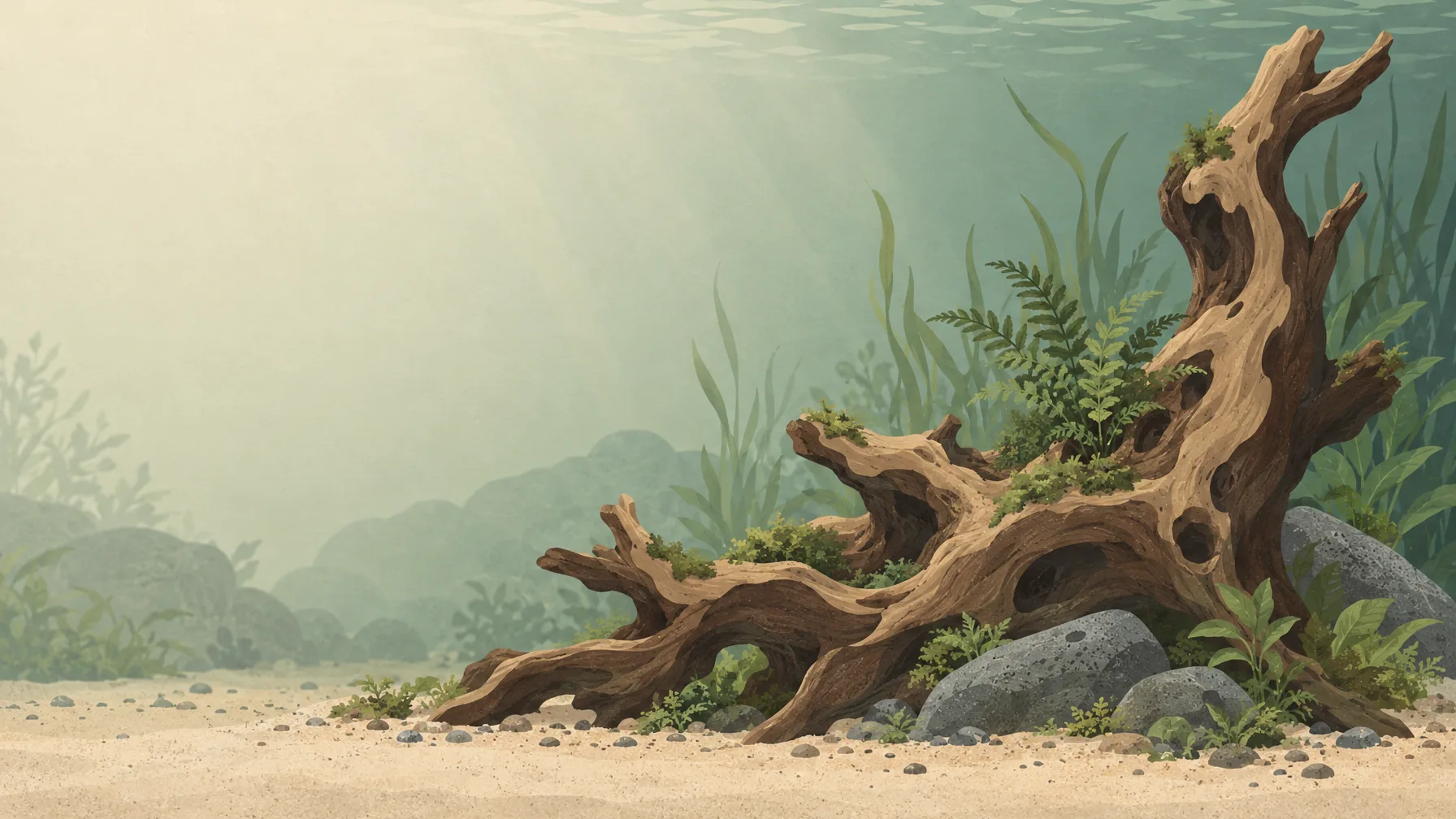
    Mopani wood is a dense, two-tone African hardwood that sinks almost straight away and lasts for years underwater. The catch is tannin: most sources say it stains water brown more than most aquarium woods, though Aquasabi says only slightly. Soaking it for a week or two before use takes the worst out.

    What mopani is

    Mopani comes from the mopane tree, Colophospermum mopane, which the Wood Database, a timber reference, places in southern Africa. Tannin Aquatics lists its range as South Africa, Zimbabwe, Mozambique, Botswana, Zambia, Namibia, Angola and Malawi, and says the tree occurs only in Africa, in hot, dry places on alkaline soils. Aquasabi and Terrarium Tribe both describe the aquarium pieces as root wood.

    It is very hard. The Wood Database calls mopane difficult to work, “mainly on account of its incredibly high density”, and Aquasabi classes it as a hardwood.

    The two-tone look

    Most pieces are two colours: Aquasabi describes yellow and brown, and Buce Plant, which also sells it, sandy tan and deep chocolate brown. Aquasabi says the two-coloured wood is partly sandblasted. The shape is gnarled and knotty, with little branching, which Tannin Aquatics says is the appeal: the texture and colour, more than the outline.

    That makes it a centrepiece wood. Terrarium Tribe puts it this way: use mopani’s weight for the centrepiece and leave the fine accents to lighter woods such as spider wood and manzanita.

    It sinks, usually

    Mopani’s density is the reason people buy it. Aquasabi calls it “instantly-sinking”, Buce Plant says it typically sinks immediately, and Terrarium Tribe says soaking it to make it sink is rarely necessary. Aquasabi’s own listing adds a caveat: its pieces aren’t pre-soaked, so the time to sink can vary. Check each piece stays down before you build around it.

    How much it stains the water

    This is where the sources split.

    SourceWhat it says about mopani’s tannins
    AquasabiCan stain the water slightly at first
    Buce PlantVery rich in tannins, giving a dark tea-coloured tint
    Tannin AquaticsReleases a lot, during curing and beyond. A roughly 10-inch piece browned a 20-gallon tank in a couple of days, even after a two-day soak
    Terrarium TribeAs far as driftwoods go, one of the worst for it

    The weight of opinion says to expect a noticeable tint. It is harmless: Terrarium Tribe calls the tint non-toxic, and Aquarium Science, writing about wood tannins in general, says they lower pH only very slightly, from about 7.4 to 7.3. Tannin Aquatics also warns that mopani keeps leaching for a long time, so a pre-soak reduces the tint rather than ending it.

    How to prepare mopani

    • Rinse and scrub. Tannin Aquatics suggests a good rinse and a light scrub with a soft brush to remove debris.
    • Soak it. Tannin Aquatics soaks mopani for a week or two to draw out the first burst of tannins, and changes the soak water every few days.
    • Clear what’s left. Small water changes plus activated carbon or a tannin-removing filter medium clear the water within a few days in most cases, according to Tannin Aquatics.

    Boiling is the shortcut people ask about, and the sources disagree. Buce Plant recommends 1 to 2 hours for clear water. Terrarium Tribe reports people doing several 2 to 3 hour boils and still finding it leaching, and Tannin Aquatics prefers to soak and wait. Aquarium Science advises against boiling any wood, saying it only reaches the surface tannins and softens the wood. Our aquarium driftwood guide sets out the whole boiling debate.

    Is it safe for shrimp?

    Yes, according to Aquasabi. Mopani picked up a reputation for killing shrimp, and Aquasabi traced it to the sandblasting: some suppliers used blasting media unsuitable for invertebrates, and tiny metal fragments were found in the crevices. It says manufacturers now cater for shrimp keepers and that “it’s safe to say that Mopani is shrimp-proof”.

    Two smaller points. Aquasabi says a bacterial film can appear on new mopani, and Tannin Aquatics says it occasionally gets a surface fungus, dealt with the same way as on manzanita. And plecos may pick at mopani, but Tannin Aquatics says they would rather chew something softer.

    How long it lasts

    Years. Tannin Aquatics says it lasts “years and years” in an aquarium, and Buce Plant says it breaks down much more slowly than other woods. As timber, the Wood Database rates mopane very durable and resistant to termites.

    Tannin Aquatics raises one concern: mopane is a commercial timber used for flooring and furniture, and there is concern about how sustainably it is harvested. The Wood Database notes that the species isn’t listed by CITES or on the IUCN Red List.

    Planting on mopani

    The knots and crevices hold epiphytes well. Aquasabi suggests moss or ferns, and Buce Plant calls it a long-lasting base for both. Tie or glue Java fern, Anubias, Bucephalandra or Java moss into the gaps and let them take hold.


    Mopani wood questions

    Does mopani wood sink?

    Usually straight away. Aquasabi calls it instantly sinking and Buce Plant says it typically sinks on arrival, because it is so dense. Aquasabi adds that its pieces aren’t pre-soaked, so the odd one may take longer.

    How long should you soak mopani wood?

    Tannin Aquatics suggests a week or two in fresh water, changing it every few days, to draw out the first burst of tannins. Expect some tint afterwards: it keeps leaching for a long time.

    Is mopani wood safe for shrimp?

    Aquasabi says yes. Old reports of shrimp deaths came from unsuitable sandblasting media leaving metal fragments in the wood, and it says manufacturers have long since fixed that.

    Sources: Aquasabi, Driftwood in a tank with invertebrates; Aquasabi, Mopani Wood (shop listing); Tannin Aquatics, ‘Wood’ you believe this; Tannin Aquatics, ‘Wood’ you? Well, yes, I will; Terrarium Tribe, Mopani wood guide; Buce Plant, Mopani Wood (shop listing); The Wood Database, Mopane; Aquarium Science, Wood.

  • Cloudy aquarium water

    Cloudy aquarium water

    Cloudy aquarium water has three common causes, and they need different fixes. Milky grey water with no visible particles is a bacterial bloom, which usually clears on its own in a new tank. Cloudiness straight after filling a new soil tank is soil dust. A haze after a water change that has gone by morning is just air.

    Which kind do you have?

    What you seeLikely causeWhat to do
    Milky light grey, no particles you can seeBacterial bloomLeave a cycling tank alone; find the cause in an established one
    Cloudy right after filling a new aqua soil tankSoil dustDrain it, refill slowly, filter off until clear
    Haze an hour after a water change, gone overnightDissolved air coming out as tiny bubblesNothing. It’s harmless
    Green tintFree-floating algae (green water)A different problem

    A bacterial bloom

    Aquasabi describes water that turns milky within a few days, with its clarity much reduced but no floating particles visible to the naked eye. That last point rules out dust and debris. Aquarium Science compares it to milk poured into the tank.

    It is most common in a new tank that is still cycling, according to both sources. In an older tank, Aquasabi points to seasonal heat or extra daylight. Aquarium Science traces it to food and waste releasing dissolved organic compounds that feed bacteria in the water, and ultimately to a filter that can’t keep up. That happens when the filter is less than three months old, has been replaced or scrubbed, has been hit by medication, or when the tank is overfed. It adds that bloom bacteria are rarely pathogenic.

    What to do, and where the sources disagree

    In a cycling tank, Aquarium Science says to leave it alone: changing water simply prolongs it, and it typically clears within a few weeks as the bacteria move from the water to the filter. If a lot of food has gone in, the advice reverses: get it out fast with several near-complete water changes.

    Aquasabi, which sells UV units, recommends running a UV-C clarifier temporarily on a slow, separate pump. It says the water clears within a few days, and that you should then change as much water as possible and not leave the unit running in a planted tank. Aquarium Science agrees UV clears it, often overnight, but calls it a stopgap that leaves the cause in place, and doesn’t recommend it.

    Soil dust in a new tank

    This one comes from aqua soil, and the source here is ADA writing about its own Amazonia soil. Cloudiness right after the first fill happens when the granules have dried out or crumbled into powder. ADA’s fix is to remove all the cloudy water and pour new water in slowly, repeating as needed, or to fill with one hose while draining with another.

    Keep the filter off until the water is clear. ADA warns that running it on cloudy soil water can feed a bacterial bloom or green water from the fine particles. To avoid the problem at set-up, let water trickle from a hose onto the hardscape rather than pouring from a bucket, and plant straight away. Our aquasoil page covers the rest of a soil set-up, and the Walstad method page covers ordinary soil.

    If the cloudiness never quite goes, ADA names two causes: a filter outlet stirring up the substrate or an intake set too low, and shrimp pecking at exposed soil. The particles fall away as plants grow over the substrate.

    Keeping it clear

    Most of the prevention is about the filter. Aquarium Science says not to clean biological filter media more than once every four months to a year, and then only with a light swish in a tub of water, never under the tap, because the brown gunk is the beneficial bacteria. Feed moderately, and keep the water well aerated so the filter bacteria can work.


    Cloudy water questions

    How long does a bacterial bloom last?

    Left alone in a cycling tank, Aquarium Science says the water typically clears in a few weeks. Aquasabi says a UV-C clarifier clears it within a few days, though Aquarium Science warns that it leaves the cause in place.

    Should I do a water change for cloudy water?

    It depends on the cause. For a bloom in a cycling tank, Aquarium Science says water changes only prolong it. For soil dust after filling, ADA says to drain the cloudy water. For excess food, change most of the water, several times.

    Is cloudy water harmful to fish?

    Usually not directly. Aquarium Science says bloom bacteria are rarely pathogenic. The bigger risk in a tank that is still cycling is ammonia, so test it if fish are in the tank.

    Sources: Aquasabi, Bacterial bloom; Aquasabi, Algae in the aquarium; Aquasabi, Green water; Aquasabi, UV-C clarifier; ADA, Aqua Soil Amazonia (via Aquasabi); Aquarium Science, Cloudy water.

  • Yellowing aquarium plant leaves

    Yellowing aquarium plant leaves

    Aquarium plants turning yellow usually lack a nutrient, and where the yellow appears narrows down which. Aquasabi says to rule out a CO2 shortage first, then look at older leaves for nitrogen, magnesium and potassium and at new growth for iron. New plants dropping the leaves they grew above water is a common false alarm.

    Check these first

    Not every yellow leaf is a deficiency. Aquarium Science points out that many plants are grown with their leaves in air, and those leaves typically die back once submerged and are replaced by new ones. That is normal in a new tank; our plant melt page covers it. Aquasabi adds that some pure white LEDs make bright greens look pale, which can pass for yellowing.

    Then rule out CO2. Aquasabi says most deficiency patterns, yellow leaves included, can also be caused by a carbon shortage, so it should be considered before any other nutrient. Tropica agrees that insufficient CO2 can leave plants stunted or discoloured.

    Old leaves or new growth?

    Where the yellow starts is the clue. Nutrients a plant can move are drawn into new growth, so their shortage shows in older leaves first. Nutrients it can’t move show in new growth first. The patterns below are Aquasabi’s.

    WhereWhat you seeLikely shortage
    Older leavesOverall yellowing; new leaves come in smaller, some species reddenNitrogen
    Older leavesPale or yellow, with the veins staying greenMagnesium
    Any leafSmall black dots that become holes edged in yellow or blackPotassium
    New shootsTips turning yellow to white, clearest on fast stem plantsIron
    Shoot tipsVery slow growth and shrinking tips, sometimes darker or violetPhosphorus (not yellowing)

    Aquasabi warns that these patterns overlap, so treat a diagnosis as a best guess and change one thing at a time. Aquarium Science pairs yellow new leaves with nitrogen instead, which contradicts both Aquasabi and the general rule above.

    How to fix it

    • CO2: check it with a drop checker, and replace the fluid every four to six weeks, as Aquasabi advises. Our CO2 injection page explains the colours.
    • Nitrogen or potassium: test and top up. Aquasabi gives optimal ranges of about 10 to 25 mg/l of nitrate and 5 to 10 mg/l of potassium, and warns that most nitrate tests are hard to read. If several macronutrients are short, it suggests a combined macro fertiliser.
    • Iron: add a little more complete iron fertiliser. Don’t overdo it: Aquasabi warns that too much can encourage red algae such as black beard algae.
    • Light: if only one group of plants is affected, Aquasabi says shading by other plants or decor is a common cause.

    Go gently with fertiliser. Tropica’s advice is to start below the recommended dose and raise it as the plants respond.

    Preventing it

    New plants arrive with nutrients from the nursery. Tropica uses no fertiliser, or only a little, for the first 3 to 4 weeks. Aquarium Science waits much longer, typically three to six months. After that, match fertiliser to light: Aquasabi says more light raises nutrient demand, and an imbalance follows if you don’t top up. Plants Tropica rates medium or advanced need added CO2; the plant ratings chart lets you check yours. And remove dead leaves, which Tropica says can feed nutrient imbalances and algae.


    Yellowing leaves questions

    Why are my aquarium plants turning yellow?

    Usually a nutrient shortage, though Aquasabi says to rule out a lack of CO2 first. Yellowing in older leaves points to nitrogen, magnesium or potassium, and yellowing in new shoots points to iron.

    Why are the new leaves on my aquarium plants yellow?

    Aquasabi links yellow-to-white new shoots to iron deficiency, clearest on fast-growing stem plants. Adding a little more complete iron fertiliser usually fixes it.

    Should I remove yellow leaves?

    Remove leaves that are dead or decaying. Tropica says decaying plant matter can contribute to nutrient imbalances and algae. On new plants, expect some leaves grown above water to die back before new underwater leaves replace them.

    Sources: Aquasabi, Deficiency symptoms in aquatic plants; Cornell University, Macronutrient mobility; Tropica, Care; Tropica, Fertiliser and CO2; Tropica, FAQ; Tropica, Starting a new aquarium; Aquarium Science, Planted aquariums in depth; Aquarium Science, Estimative index; Aquarium Science, Algae in low tech tanks.

  • Green spot algae

    Green spot algae

    Green spot algae are the small, hard green dots that appear on aquarium glass and on slow-growing leaves like Anubias. Aquasabi links them to phosphate that is either too low or too high, and a blade scraper and snails keep them in check. Some always turn up, so the aim is control rather than zero.

    How to recognise it

    Aquasabi describes flat, tiny green spots that start out looking like polka dots and are attached very strongly. Given the chance, they widen into coats. They grow mostly on the glass, but also on equipment, decor and long-lived leaves, especially Anubias.

    The test Aquasabi gives is how it comes off. Other green coats don’t start as distinct spots, and some wipe away with a finger. Green spot algae won’t: you need a blade. Aquarium Science disagrees on this point, saying it cleans off relatively easily and treating it as the same thing as green coat algae. Dark, bristly tufts on the same slow-growing leaves are black beard algae, which needs a different fix.

    What causes it

    Aquasabi finds it most often in strongly lit tanks, and says it usually appears when phosphate is too low or too high. It also notes that a shortage of phosphorus can cause spot algae to increase.

    Aquarium Science adds a complication. It says green spot algae will grow slowly with almost no nutrients, and that it can also thrive under heavy fertilising. Treat phosphate as the first thing to check, not the only one.

    How to fix it

    Start with a phosphate test, then act on the reading. These are Aquasabi’s figures:

    Phosphate readingWhat Aquasabi suggests
    At the lower limit of the testAdd phosphate with a fertiliser
    Around 0.1 to 1 mg/lThe recommended range for a planted tank
    Around 3 mg/l or aboveBring it down with large water changes, or a phosphate-binding filter medium for a while

    If you already dose phosphate, Aquasabi says to cut the dose to match your readings. Then scrape the glass clean with a blade. That way any new spots show you whether the change has worked.

    Snails do the rest. Aquasabi rates sun snails and nerite snails as the most efficient grazers for spot algae, rasping the hard coats off thoroughly.

    Keeping it under control

    Aquarium Science says green spot algae are found in every aquarium, so a few spots are normal. Aquasabi’s routine is to change around 50% of the water each week to stop nutrients building up, scrape the glass as part of weekly maintenance, and keep snails in the tank.


    Green spot algae questions

    Does green spot algae mean too much phosphate?

    Not necessarily. Aquasabi says it appears when phosphate is too low or too high, and that a phosphorus shortage can make it spread. Test before you dose anything.

    How do you remove green spot algae from glass?

    Scrape it off with a blade cleaner. Aquasabi says spot algae are always hard to remove, which is one way to tell them from softer green coats that wipe off.

    Do snails eat green spot algae?

    Yes. Aquasabi rates sun snails and nerite snails as the most efficient algae eaters for spot algae. They rasp the hard coats off thoroughly.

    Sources: Aquasabi, Green spot algae (GSA); Aquasabi, Algae in the aquarium; Aquasabi, Green algae coats; Aquasabi, Algae eaters; Aquasabi, Deficiency symptoms in aquatic plants; Aquarium Science, Green spot algae; Aquarium Science, Algae in high tech tanks.

  • Cyanobacteria (blue-green algae)

    Cyanobacteria (blue-green algae)

    Cyanobacteria, sold to hobbyists as blue-green algae or slime algae, are bacteria rather than algae. They form slimy dark green to near-black coats on plants, hardscape and substrate that lift off easily. The sources disagree on what causes them, so check nutrients, flow, temperature and feeding before you reach for any treatment.

    How to recognise it

    Aquasabi and Aquarium Science agree it isn’t an alga at all: cyanobacteria are bacteria that photosynthesise. In the tank they show up as dark green, blue-green or almost black coats that feel slimy. Aquarium Science adds that they can also be yellow-green, reddish brown or purple.

    Two quick tests help. It doesn’t attach firmly, so Aquasabi says small patches siphon straight off, unlike most true algae. Smell is less reliable: Aquasabi calls the foul, earthy odour characteristic, but Aquarium Science says it is very common for it to have no smell at all. A small patch where the substrate meets the front glass is normal, in Aquasabi’s view, and nothing to worry about. If what you have is green threads, see hair algae. Dark, bristly tufts that grip hard are black beard algae.

    What causes it

    There is no single agreed cause. Each source points somewhere different, and they overlap on only one thing: high phosphate.

    Suspected causeWho says so
    High phosphate, sometimes with low nitrateAquasabi; Aquarium Science lists high phosphate too
    Too few competing microbes, most often in a new tankAquasabi
    Overfeeding in fish tanksTropica
    Low flow, high temperature and low oxygenAquarium Science
    Old aqua soil that has crumbled and compactedADA

    Aquarium Science adds two caveats: some outbreaks happen with none of these present, and cyanobacteria are found almost everywhere, so you can’t keep them out of a tank entirely.

    How to get rid of it

    • Siphon it off during a water change. Small patches come away easily.
    • Feed less. Tropica says less intense feeding usually makes it disappear again.
    • Raise flow and oxygen, and lower the temperature. Aquarium Science’s fix is more water movement, a cooler tank, surface agitation, and large water changes to bring phosphate down. It says a 95% water change is harmless to fish.
    • Check the substrate. ADA says blue-green algae can grow in aqua soil that has crumbled and packed down, and the answer then is to rebuild the substrate. Our aquasoil page covers how soil breaks down.

    For a stronger infestation, Aquasabi recommends a blackout: siphon off as much as you can, switch off CO2 and liquid fertiliser, keep the tank well aerated, and keep it dark for no more than 7 days if it holds stem and carpet plants, or up to two weeks if it mostly holds shade plants.

    Treatments the sources argue about

    Three treatments come up, and each has a source against it. Aquasabi recommends bacteria products to restore the microbial balance, which Aquarium Science calls a myth. Aquasabi uses hydrogen peroxide as a last resort. Aquarium Science says never to use chemicals other than antibiotics on cyanobacteria, and warns that antibiotics only work for a while and can spike ammonia and nitrite in an established tank.

    Aquarium Science’s conclusion is the one to hold on to: any treatment gives only temporary respite, and the cyanobacteria come back unless you remove the cause.

    Keeping it away

    Change water regularly: Aquasabi recommends around 50% a week to stop nutrient spikes. Keep feeding moderate, keep the tank within the 20 to 26°C range Aquarium Science gives as ideal for plants and fish, and keep water moving across the substrate. In a soil tank, replace the soil once it has broken down.


    Blue-green algae questions

    Is blue-green algae actually algae?

    No. Both Aquasabi and Aquarium Science say it is a bacterium, cyanobacteria, that photosynthesises like a plant.

    Does a blackout kill blue-green algae?

    Aquasabi recommends a blackout for stronger infestations, with CO2 and fertiliser off and the tank well aerated, for no more than 7 days in a tank with stem and carpet plants. Remove as much as you can by siphon first.

    Why does blue-green algae keep coming back?

    Because the cause is still there. Aquarium Science says chemicals and antibiotics give only temporary respite. Look at phosphate, feeding, flow, oxygen and temperature, and at the state of the substrate.

    Sources: Aquasabi, Blue-green algae (BGA); Aquasabi, Algae in the aquarium; Aquasabi, Black-out treatment; Aquasabi, Treatment with hydrogen peroxide; ADA, Aqua Soil Amazonia (via Aquasabi); Tropica, Types of algae; Aquarium Science, Blue-green algae; Aquarium Science, Algae in high tech tanks.

  • Hair algae

    Hair algae

    Hair algae is the green, hair-like growth that coats plants and hardscape, most often in a tank only a few weeks old. Aquasabi separates true hair algae, which anchors firmly, from loose thread algae, while other sources use the names for the same thing. The fix is the same for both: balance light, CO2 and nutrients, and add grazers.

    Hair algae or thread algae?

    The names get mixed up, and it matters a little for removal. Aquarium Science uses “thread algae, hair algae or green hair algae” interchangeably and warns that identifying the exact species is a guess. Aquasabi splits them by how they attach, which is a useful test in your own tank.

     Hair algaeThread algae
    GrowthCarpet-like coats of short, dense filamentsLong, soft, loose threads in bushy cushions
    AttachmentAnchors its base tightlyDoesn’t attach, wraps around plants
    Spreads byGrowing over plants and decorFragments drifting in the current
    RemovalHard to pull off; cut infested leavesWind onto a rough skewer or siphon out

    One look-alike to rule out is Cladophora. Aquasabi describes it as short, rigid green filaments that branch in many places, with a smell like mushrooms. Two other growths get mistaken for it: a dark, slimy film that siphons straight off is cyanobacteria, and hard green dots on the glass are green spot algae.

    What causes it

    The most common trigger is a new tank. Aquasabi says hair algae appear mainly during the cycling phase, and that thread-like green algae usually follow the diatoms 3 to 4 weeks after set-up.

    In an established tank it points to an imbalance. Aquasabi names a shortage of CO2 or nutrients, nitrogen in particular, along with lighting that is too strong or left on too long. A new, brighter light or extra daylight can set off a sudden outbreak, and so can slack maintenance. Tropica adds heat: temperatures above about 26°C almost always cause algae problems, and thread algae especially likes warmth. Its general rule for any algae is that overfeeding comes first.

    How to get rid of it

    • Remove what you can: cut off lightly infested leaves, wind thread algae onto a rough skewer, and siphon out loose nests during a water change.
    • Fix the imbalance: check CO2 with a drop checker, which Aquasabi says to refill every four to six weeks, and top up nitrogen if plants have stalled. Our CO2 injection page covers reading one.
    • Add grazers: Aquasabi calls the Amano shrimp the most efficient shrimp for filamentous algae, and Tropica suggests a large population of them for a while during an outbreak.
    • Change more water: Tropica suggests 30% every second day for a period.
    • Plant more: if the tank is sparsely planted, Aquasabi recommends adding healthy, fast-growing plants to compete.

    A heavy infestation may need a blackout. Aquasabi turns off CO2 and stops liquid fertiliser, keeps the tank dark for up to two weeks if it mostly holds shade plants such as mosses, ferns, Anubias and Cryptocoryne, and no more than 7 days if it holds stem and carpet plants, then does a large water change. Tropica’s blackout, given for green water, is much shorter at 2 to 3 days. Start with the shorter one.

    Chemicals are the last resort

    The sources split here. Aquasabi spot-treats small patches with hydrogen peroxide and treats the whole tank with an algicide only as a last resort, warning that algicides can upset the tank’s microbial balance and harm some plants, and that at least one kills nerite snails. Tropica generally recommends not removing thread algae with chemicals, and Aquarium Science doesn’t recommend chemicals at all. If you go that way, follow the source’s own dosing exactly, and fix the cause first or it comes back.

    Keeping it away

    Plant heavily from the first day, with plenty of fast-growing stem plants. Keep the lights short in a new tank: Tropica starts at 6 hours a day for the first 2 to 3 weeks before moving to 8 to 10, and recommends never more than 10 hours, on a timer. Aquasabi adds that more light always needs more nutrients to match. For weekly water changes, Aquasabi recommends at least 50% and Tropica about 25% once a tank is established. Our lighting page covers choosing a level to begin with.


    Hair algae questions

    Do Amano shrimp eat hair algae?

    Yes, the softer kinds. Aquasabi calls the Amano shrimp the most efficient shrimp for filamentous algae, and says ramshorn snails and most dwarf shrimp also eat softer hair algae.

    Why does a new tank get hair algae?

    Because the tank’s biology hasn’t settled yet. Aquasabi says hair algae appear mainly during the cycling phase and usually clear on their own once nutrients are balanced and enough algae eaters are in the tank.

    How long should a blackout for hair algae last?

    Sources differ. Tropica suggests 2 to 3 days. Aquasabi allows up to two weeks in a tank of shade plants but no more than 7 days if it holds stem and carpet plants. Either way, do a large water change afterwards, because the dying algae pollute the water.

    Sources: Aquasabi, Hair algae; Aquasabi, Green thread algae; Aquasabi, Algae in the aquarium; Aquasabi, Cladophora; Aquasabi, Black-out treatment; Aquasabi, Treatment with hydrogen peroxide; Aquasabi, Algae eaters; Aquasabi, Fertilization during the cycling phase; Tropica, Types of algae; Tropica, Algae control; Tropica, Preventing algae; Tropica, Starting a new aquarium; Aquarium Science, Thread algae; Aquarium Science, Controlling aquarium algae.

  • Aquarium plant ratings chart

    Aquarium plant ratings chart

    This chart puts Tropica’s own light, CO2, difficulty and growth ratings for 18 common aquascaping plants in one place, each row linked to the Tropica page it comes from. 13 of the 18 are rated easy and 13 have a low CO2 demand. Sort any column, or filter to the plants that suit your tank.

    How to read the ratings

    Every rating is Tropica’s, on Tropica’s scale: light and CO2 demand are low, medium or high, difficulty is easy, medium or advanced, and growth is slow, medium or fast. They are categories rather than measurements, and this table keeps them that way. Where Tropica rates a named cultivar rather than the species, the plant’s own page says which.

    Tropica leaves some fields blank. Those cells read “Not rated” and name the second source AquaLexicon uses instead, such as Aquasabi for Cryptocoryne wendtii.

    PlantTypeLight demandCO2 demandDifficultyGrowthSource
    Anubias nana
    Anubias barteri var. nana
    EpiphyteLowLowEasySlowTropica
    Java fern
    Leptochilus pteropus
    EpiphyteLowLowEasySlowTropica
    Bucephalandra
    Bucephalandra sp.
    EpiphyteLowLowEasySlowTropica
    Java moss
    Taxiphyllum barbieri
    MossLowLowEasyMediumTropica
    Christmas moss
    Vesicularia montagnei
    MossMediumLowMediumMediumTropica
    Cryptocoryne wendtii
    Cryptocoryne wendtii
    RosetteNot rated by Tropica (Aquasabi: low)Not rated by Tropica (Aquasabi: no)EasyMediumTropica
    Amazon sword
    Echinodorus grisebachii
    RosetteLowLowEasyNot ratedTropica
    Vallisneria
    Vallisneria spiralis 'Tiger', V. americana 'Natans', V. 'Gigantea'
    StolonLowLowEasyHigh ('Natans'); not rated ('Tiger', 'Gigantea')Tropica
    Dwarf hairgrass
    Eleocharis acicularis
    CarpetLowLowEasyMediumTropica
    Monte Carlo
    Micranthemum tweediei 'Monte Carlo'
    CarpetMediumMediumMediumMediumTropica
    Dwarf baby tears (HC Cuba)
    Hemianthus callitrichoides 'Cuba'
    CarpetHighHighAdvancedMediumTropica
    Glossostigma
    Glossostigma elatinoides
    CarpetHighHighAdvancedNot ratedTropica
    Staurogyne repens
    Staurogyne repens
    StemLowLowEasyMediumTropica
    Rotala
    Rotala rotundifolia
    StemLowLowEasyMediumTropica
    Ludwigia repens
    Ludwigia repens
    StemMediumLowEasyMediumTropica
    Bacopa caroliniana
    Bacopa caroliniana
    StemLowLowEasySlowTropica
    Alternanthera reineckii
    Alternanthera reineckii
    StemMediumMediumMediumMediumTropica
    Amazon frogbit
    Limnobium laevigatum
    FloatingLowLowEasyMediumTropica
    Tropica’s ratings, checked 13 September to 15 October 2026. Where Tropica gives no rating the cell names the source used instead.

    What the chart shows

    CO2 is the dividing line. Only Dwarf baby tears (HC Cuba) and Glossostigma are rated high for CO2, and every one of them is a carpet plant. If you run a tank without CO2 injection, filtering to low CO2 leaves you most of the list, including one carpet: dwarf hairgrass.

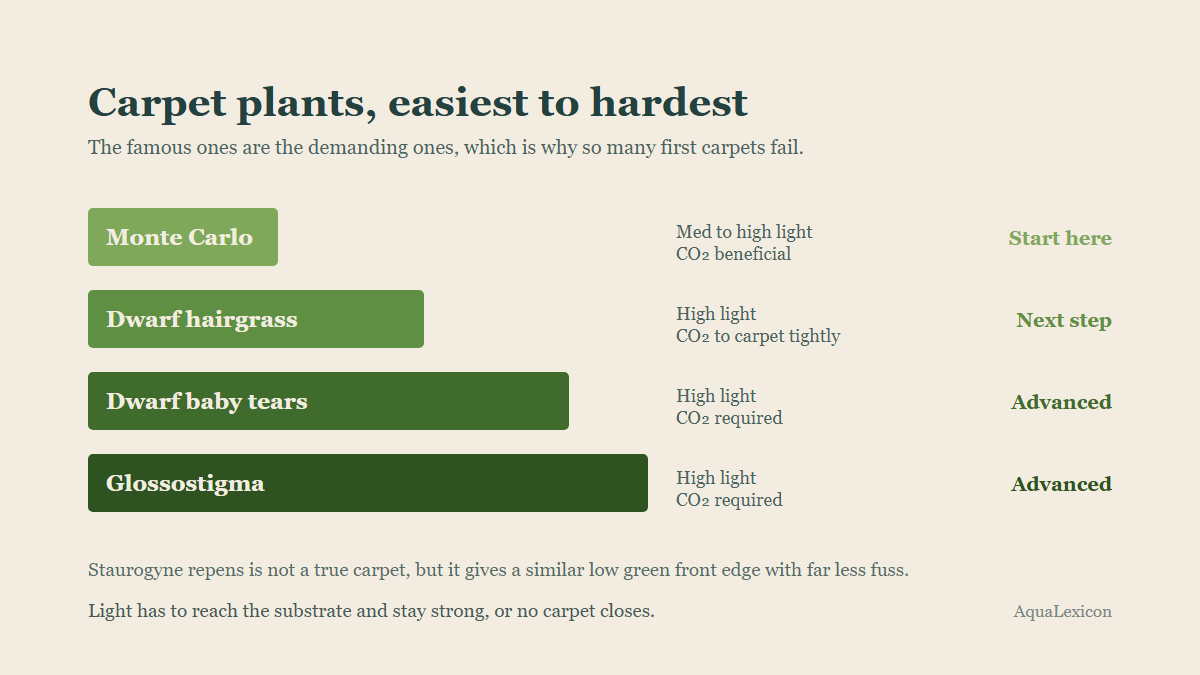
    The rhizome plants, Anubias, Java fern and Bucephalandra, are all rated easy and slow-growing, which is why they suit a low-light, low-maintenance layout like the Walstad method. The mosses split: Java moss is easy, Christmas moss medium. The carpet plants guide explains why the 4 carpets here spread so widely from easy to advanced.

    Using this chart

    You’re welcome to cite or link to this chart. Each rating links to its Tropica source, and the table is rebuilt from AquaLexicon’s reference file whenever a rating is re-checked, so the date under it tells you how current it is.


    Aquarium plant chart questions

    Which aquarium plants don’t need CO2?

    13 of the 18 plants in this chart have a low CO2 demand in Tropica’s ratings, including Java fern, Java moss, Vallisneria, dwarf hairgrass and Amazon sword. Filter the CO2 column to low to see them all.

    What are the easiest aquarium plants?

    Tropica rates 13 of the 18 plants here easy. Java fern, Bucephalandra, Java moss, Vallisneria, Amazon sword and dwarf hairgrass are among them, and all six have a low light demand too.

    Where do these plant ratings come from?

    From Tropica, the Danish grower, whose plant pages rate each plant for light demand, CO2 demand, difficulty and growth. Each row links to the page it was read from. Where Tropica leaves a field blank, the cell names the second source used instead.

    Sources: Tropica plant pages, linked in each row; Aquasabi, Cryptocoryne wendtii ‘Green’.

  • Monte Carlo vs HC Cuba

    Monte Carlo vs HC Cuba

    Monte Carlo is the carpet to start with and HC Cuba is the one to work up to. Tropica rates Monte Carlo medium for light, CO2 and difficulty, and HC Cuba high, high and advanced. Tropica’s HC Cuba page even recommends Monte Carlo as the less demanding alternative. Both grow to about 3 to 5 cm.

    Side by side

     Monte CarloHC Cuba
    Sold asMicranthemum tweediei ‘Monte Carlo’Micranthemum callitrichoides ‘Cuba’, also sold as Hemianthus callitrichoides or dwarf baby tears
    LeavesCompact, round, light greenMillimetre-sized and round
    Light demandMediumHigh
    CO2 demandMediumHigh
    DifficultyMediumAdvanced
    Height3 to 5+ cm3 to 5+ cm
    OriginArgentinaCuba, west of Havana

    Tropica’s own advice

    The clearest line comes from Tropica’s HC Cuba page. It lists what HC needs to thrive, which is enough light, added CO2, water circulation and fertiliser, then says that if these conditions are hard to create, you may use Monte Carlo as an alternative, because it is less demanding.

    The same page also calls HC Cuba “not a difficult plant” while its difficulty icon reads Advanced. Go by the ratings and the list of conditions. Those are what decide whether it carpets or fails.

    What HC Cuba needs

    Tropica calls it one of the smallest aquarium plants in the world. Plant it in small clumps a few centimetres apart and, given those conditions, it spreads quickly and covers the bottom. Trim it regularly: Tropica warns that otherwise the lower parts do not get enough light, which causes root death. Our dwarf baby tears page goes into more detail.

    What Monte Carlo needs

    Monte Carlo can grow in light shadow, Tropica says, but it still needs good light and added CO2 to develop optimally and become really compact. It is the easier plant, not an effortless one. For a carpet without CO2, dwarf hairgrass is the option.


    Monte Carlo vs HC Cuba questions

    Can you grow HC Cuba without CO2?

    Not reliably. Tropica rates its CO2 demand as high and lists added CO2 among the conditions it needs to thrive. If you cannot add CO2, Tropica points you to Monte Carlo instead.

    Is Monte Carlo easier than HC Cuba?

    Yes. Tropica rates Monte Carlo medium for difficulty and HC Cuba advanced, and describes Monte Carlo as less demanding.

    How do you plant HC Cuba?

    In small clumps a few centimetres apart, which Tropica says lets it spread and cover the bottom like a carpet. Trim it regularly so light keeps reaching the lower parts.

    Sources: Tropica, Micranthemum tweediei ‘Monte Carlo’; Tropica, Micranthemum callitrichoides ‘Cuba’.

  • Anubias vs Bucephalandra

    Anubias vs Bucephalandra

    Anubias and Bucephalandra are the two easiest plants to tie onto wood or rock, and both grow slowly from a rhizome. Tropica rates both easy. Choose Anubias for a shady spot or a tank with plant-eating fish, and Bucephalandra for its narrow, dark leaves, which can show a blue metallic sheen underwater.

    Side by side

     Anubias nanaBucephalandra ‘Kedagang’
    Sold asAnubias barteri var. nanaBucephalandra diabolica ‘Kedagang’
    OriginCameroonBorneo
    Light demandNot rated by Tropica (Flowgrow: low to high)Low
    CO2 demandNot rated by Tropica (Flowgrow: with or without)Low
    DifficultyEasyEasy
    GrowthSlowSlow
    Size5 to 10 cm tallLeaves 1 to 2 cm wide, up to 6 cm long

    Both live on hardscape

    Neither plant wants its rhizome buried. Tropica says Anubias does best planted on a stone or tree root, held with fishing line until it gains a hold, and that if it goes in the substrate the rhizome must not be covered because it tends to rot. Bucephalandra is a rhizome plant too, and it is used the same way.

    Leaves and colour

    This is where they part. Tropica describes ‘Kedagang’ as having long, narrow, dark green leaves with white dots, red rhizomes, and a blue metallic shade that may appear on the leaves underwater. Tropica describes Anubias nana as a small, attractive plant and notes that it flowers frequently under water.

    Slow growth has a cost

    Both are slow, and both pay for it. Tropica says Anubias leaves survive for several years, which gives slow-growing algae the chance to become established on them. Bucephalandra is one of the plants Aquasabi names as most affected by leaf loss after planting, while it adjusts to a new tank. Our plant melt page covers what to do.

    Which to choose

    Anubias for shade and for tanks with herbivores. Tropica says it will thrive in shady places where other plants will not, and that herbivorous fish do not eat it. Bucephalandra for colour and detail in a low-light tank, if you can wait out a slow, sometimes messy start.


    Anubias vs Bucephalandra questions

    Is Anubias or Bucephalandra easier?

    Tropica rates both easy. Anubias is the more forgiving at the start, because Bucephalandra is one of the plants Aquasabi names as most prone to losing leaves while it settles into a new tank.

    Do Anubias and Bucephalandra need CO2?

    No. Tropica rates Bucephalandra ‘Kedagang’ low for CO2, and Flowgrow says Anubias nana grows with or without added CO2, though it may benefit from it.

    Which is better with plant-eating fish?

    Anubias. Tropica says herbivorous fish do not eat it. Tropica’s Bucephalandra page says nothing either way.

    Sources: Tropica, Anubias barteri var. nana; Flowgrow, Anubias barteri var. nana; Tropica, Bucephalandra diabolica ‘Kedagang’; Aquasabi, Appearance of in-vitro plants.

  • Dwarf hairgrass vs Monte Carlo

    Dwarf hairgrass vs Monte Carlo

    Dwarf hairgrass is the easier carpet and Monte Carlo is the lower, rounder one. Tropica rates hairgrass easy with a low demand for light and CO2, and Monte Carlo medium on all three, saying it needs good light and added CO2 to become really compact. Hairgrass also grows taller, as a carpet of 6 to 15 cm.

    Side by side

     Dwarf hairgrassMonte Carlo
    Sold asEleocharis acicularisMicranthemum tweediei ‘Monte Carlo’
    LeavesFine bladesCompact, round, light green, on creeping stalks
    Light demandLowMedium
    CO2 demandLowMedium
    DifficultyEasyMedium
    HeightA carpet of 6 to 15 cm3 to 5+ cm
    OriginCosmopolitanArgentina

    What each needs

    Tropica says dwarf hairgrass thrives in almost all conditions in an aquarium, though an open space without shading from other plants is still preferable. That makes it the carpet you can grow in a low-tech tank.

    Monte Carlo can grow in light shadow, Tropica says, but it requires good light and added CO2 to develop optimally and become really compact. Without them it still grows, just less compact. Our CO2 injection page covers what adding it involves.

    Keeping each one low

    Hairgrass spreads by its roots, which Tropica says colonise the surroundings after planting. If the carpet grows too tall, you can cut it back carefully to the height you want. Monte Carlo stays low by nature, at 3 to 5+ cm, and Tropica describes it as creating a fast-growing carpet at the front of the tank, although its spec table rates the growth rate as medium.

    Which to choose

    No CO2 injection means hairgrass, and so does a first carpet. Pick Monte Carlo if you already inject CO2, have good light, and want a lower, softer lawn of round leaves. The carpet plants guide ranks both against the harder options.


    Dwarf hairgrass vs Monte Carlo questions

    Can you grow dwarf hairgrass or Monte Carlo without CO2?

    Hairgrass, yes: Tropica rates its CO2 demand as low. Monte Carlo will survive, but Tropica says it requires added CO2, along with good light, to develop optimally and become really compact.

    Which is easier for beginners, dwarf hairgrass or Monte Carlo?

    Dwarf hairgrass. Tropica rates it easy and says it thrives in almost all conditions. Monte Carlo is rated medium for difficulty, light and CO2.

    Which carpet stays lower?

    Monte Carlo, at 3 to 5+ cm in Tropica’s figures. Hairgrass forms a carpet of 6 to 15 cm, which Tropica says you can cut back if it grows too tall.

    Sources: Tropica, Eleocharis acicularis; Tropica, Micranthemum tweediei ‘Monte Carlo’.

  • Java moss vs Christmas moss

    Java moss vs Christmas moss

    Java moss is the easy one and Christmas moss is the neat one. Tropica rates Java moss easy with a low demand for light, and Christmas moss medium for both difficulty and light, adding that it grows more slowly. Both attach to wood and rock, both have a low CO2 demand, and both need trimming to keep their shape.

    Side by side

     Java mossChristmas moss
    Sold asTaxiphyllum barbieri ‘Bogor Moss’Vesicularia montagnei ‘Christmas Moss’
    Light demandLowMedium
    CO2 demandLowLow
    DifficultyEasyMedium
    Thickness3 to 10 cm1 to 3 cm tall
    OriginSouth-East AsiaBrazil

    The shape is the real difference

    Christmas moss is named for its side branches. Tropica says their structure distinguishes it from ordinary Vesicularia dubyana and looks like fir tree branches, which gives a layered, orderly look on a branch. Java moss grows willingly on any surface and builds up thicker, which Tropica says makes it ideal for decorating stones and tree roots or hiding installations in the tank.

    What each asks of you

    Tropica describes Java moss as a hardy plant that makes few demands on the water or light. Christmas moss is more demanding than ordinary Java moss and grows more slowly, in Tropica’s words, and its light demand is rated a step higher.

    One inconsistency to know about: Tropica’s spec tables rate both mosses medium for growth rate, while its description of Christmas moss says it grows more slowly. Plan on the slower pace.

    Attaching and trimming

    The method is the same for both. Tropica suggests fishing line or cotton thread to hold Java moss until it has gained a hold, and says Christmas moss attaches readily to roots and stones. Spread either one thinly on spider wood or the crevices of dragon stone.

    Then keep cutting. Tropica says Java moss can be pruned with scissors if its growth becomes too luxuriant, and that Christmas moss needs pruning as it spreads to keep its shape attractive.

    Which to buy

    Java moss if it is your first moss, your light is modest, or you want cover fast. Christmas moss if the moss is a feature of the layout and your light is at least medium. It rewards the extra care with a neater shape.


    Java moss vs Christmas moss questions

    Which is easier, Java moss or Christmas moss?

    Java moss. Tropica rates it easy with a low light demand and calls it hardy. Christmas moss is rated medium for difficulty and light, and Tropica says it is more demanding than Java moss.

    Is Java moss or Christmas moss better for shrimp?

    Neither Tropica page rates them for shrimp. Java moss grows thicker, at 3 to 10 cm, and Tropica calls it a wonderful hiding place for young fish in breeding aquariums, so it gives more cover.

    Does Christmas moss need CO2?

    No. Tropica rates the CO2 demand of both mosses as low. Light is where they differ: medium for Christmas moss, low for Java moss.

    Sources: Tropica, Taxiphyllum barbieri ‘Bogor Moss’; Tropica, Vesicularia montagnei ‘Christmas Moss’.

  • Dragon stone vs Seiryu stone

    Dragon stone vs Seiryu stone

    Dragon stone and Seiryu stone are the two rocks most aquascapes are built from, and your water makes the choice. Dragon stone is inert. Seiryu is limestone-based and may harden the water a bit, more so in a tank running CO2. The looks split just as clearly: warm, pitted clay against sharp grey peaks.

    Side by side

     Dragon stone (Ohko)Seiryu stone
    Made ofClay-based sedimentary rockLimestone-based rock
    Effect on waterWater-neutralMay harden the water a bit
    SurfacePitted, full of holes and crevicesSharp and angular, pale veins in grey
    HandlingCrushes into fragments quite easilyCompact, but workable with hammer and chisel
    SuitsSoft water, shrimp, cave-like textureHard-water fish, mountain-style layouts

    Water is the difference that matters

    Aquasabi classes dragon stone as water-neutral, and Buce Plant says it is inert and will not influence water parameters. Seiryu is the opposite case. Aquasabi says it contains a little lime and may harden the water a bit, and Horizon Aquatics says it may slightly raise pH, KH and GH.

    CO2 injection makes the gap wider. In Aquasabi’s article with aquascaper Oliver Knott, calcareous stones tend to harden the water far more when a CO2 system is running, because the carbonic acid dissolves the lime. The remedy he gives is regular, large water changes with soft water.

    So the rule is simple. For soft-water fish, shrimp or a high-tech tank, dragon stone removes a variable. Seiryu suits hard-water livestock, or a keeper happy to manage a slow rise in hardness.

    Look and layout

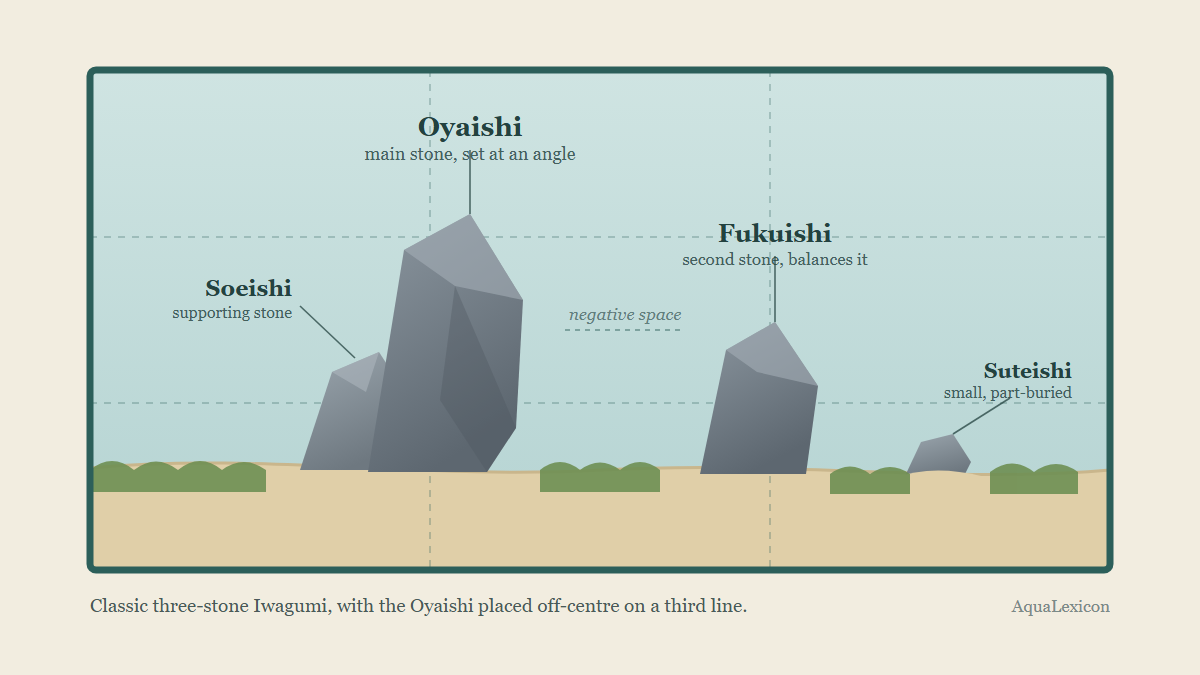
    Seiryu’s jagged grey rock reads as a mountain range at tank scale, which is why it became the classic stone of the Iwagumi layout. Dragon stone’s holes and overhangs read as caves instead, and its crevices hold moss and small epiphytes, which suits a Nature Aquarium.

    Whichever you pick, use one. Aquasabi warns that if you use various types of stone, the whole picture will lose its harmonious effect.

    Handling and preparation

    Dragon stone is the easier rock to shape and the harder one to clean. Aquasabi says it can be crushed into fragments quite easily, and Buce Plant says it breaks into smaller pieces with a chisel and hammer, though it is relatively brittle. It also holds loam in its crevices, which Aquasabi says to remove with a sharp object before a thorough rinse.

    Seiryu is harder to break. Aquasabi calls it quite a compact stone, though still workable with hammer and chisel, and Terrarium Tribe describes it as extremely hard and heavy. On weight, Aquasabi’s bulk-weight table puts the two rocks in the same group, so the same size of layout takes about the same kilos of either.

    Not sure which you have?

    Looks can mislead. Horizon Aquatics says dark Seiryu is ordinary Seiryu that has been acid-washed, and it looks nothing like the pale original. An acid test settles it: carbonate rock fizzes and clay rock does not. The aquascaping rocks guide covers that test and the two-week soak test that confirms it.


    Dragon stone vs Seiryu stone questions

    Which is better for shrimp, dragon stone or Seiryu stone?

    Dragon stone. It is inert, so it leaves the water stable, while Seiryu may slightly raise pH, KH and GH. Shrimp tanks are where a water-neutral rock does the most good.

    Can you mix dragon stone and Seiryu stone?

    You can, but Aquasabi advises against it on looks alone: mixing types of stone costs a layout its harmonious effect. Pick one and use it throughout.

    Does dragon stone raise pH like Seiryu?

    No. Dragon stone is clay-based and water-neutral. Seiryu is the one that may nudge pH, KH and GH upwards, and more so in a CO2-injected tank.

    Sources: Aquasabi, Types of hardscape; Aquasabi, Oliver Knott on water-hardening stones; Buce Plant, Dragon Stone (Ohko); Aquasabi, Choose your hardscape by weight; Horizon Aquatics, Dark Seiryu stone vs Seiryu stone; Terrarium Tribe, Seiryu stone hardscape guide.

  • Christmas moss

    Christmas moss

    Christmas moss is the moss people choose when Java moss looks too shaggy. Tropica sells it as Vesicularia montagnei ‘Christmas Moss’, rates it medium for light and difficulty and low for CO2, and puts it at 1 to 3 cm tall. It is slower and fussier than Java moss.

    Why it looks like a fir branch

    The name comes from the shape. Tropica describes its side branch structure as what distinguishes it from ordinary Vesicularia dubyana, and says it looks like fir tree branches. That regular, layered growth is why it reads as deliberate on a branch where Java moss reads as a green tangle.

    More demanding than Java moss

    Tropica is direct about this: it is more demanding than ordinary Java moss and grows more slowly. That shows in the ratings, where Java moss is easy with a low light demand and Christmas moss is medium for both.

    What it needs

    RequirementChristmas moss
    Light demandMedium
    CO2 demandLow
    DifficultyMedium
    Growth rateMedium
    PlacementMoss, attach to wood or rock

    Attaching and trimming it

    Tropica says it attaches readily to roots and stones, so tie or glue a thin layer onto the surface you want covered and let it take hold. The branching structure of spider wood suits it, and so do the crevices in dragon stone.

    Then keep cutting. Tropica says that as it spreads in the water it needs pruning to keep its shape attractive, which is the same rule that keeps any moss from shading out its own base.


    Christmas moss questions

    Christmas moss or Java moss?

    Java moss to start with. Tropica rates it easy with a low light demand, while Christmas moss is medium for both and grows more slowly. Christmas moss is the better-looking one once you can keep it.

    Does Christmas moss need CO2?

    No. Tropica rates its CO2 demand as low. Its light demand is medium, which is the rating that separates it from Java moss.

    How do you attach Christmas moss?

    Spread a thin layer over wood or rock and hold it there with cotton thread, fishing line or gel glue until it grips. Tropica says it attaches readily to roots and stones.

    Sources: Tropica, Vesicularia montagnei ‘Christmas Moss’; Tropica, Taxiphyllum barbieri (Java moss).

  • Glossostigma elatinoides

    Glossostigma elatinoides

    Glossostigma elatinoides makes the finest carpet in aquascaping and asks the most in return. Tropica calls it one of the smallest aquarium plants at 2 to 3 cm tall, rates it advanced, and puts both its light and CO2 demand at high. In a dim tank it grows upwards instead of flat.

    The smallest plant in the tank

    Tropica describes it as much in demand in Japanese-inspired aquariums, which is where most people meet it: the bright green lawn under the stones of an Iwagumi layout. At 2 to 3 cm tall it makes the stones look bigger, which is the whole trick.

    What it needs

    RequirementGlossostigma elatinoides
    Light demandHigh
    CO2 demandHigh
    DifficultyAdvanced
    Growth rateNot rated by Tropica
    PlacementCarpet, foreground

    Tropica calls it a difficult plant demanding a lot of light, says it grows upwards if light is poor, and warns you to make sure larger plants do not overshadow it. They also say CO2 addition and soft water promote its growth. A carpet that grows upward is the plant telling you the light is not reaching the substrate.

    How to plant it

    Tropica’s instruction is to split the pot into small clumps, roughly an eighth of a pot each, and place them at intervals of a few centimetres so the plants grow together more quickly. Spacing them is what turns separate clumps into a lawn.

    Choose it on purpose

    Our carpet plants guide ranks the usual choices by what they demand. Dwarf hairgrass is the forgiving starting point at low light and low CO2, Monte Carlo sits in the middle, and Glossostigma is at the far end with dwarf baby tears. Pick it because you want the finest carpet and have the CO2 and light to match.

    One inconsistency worth flagging: Tropica’s own page gives Australia in its origin field while the description opens by calling it Glossostigma elatinoides from New Zealand.


    Glossostigma questions

    Does Glossostigma need CO2?

    Yes, in practice. Tropica rates its CO2 demand as high and says CO2 addition and soft water promote its growth. Without added CO2 and strong light you will not get a flat carpet.

    Why is my Glossostigma growing upwards?

    Not enough light at the substrate. Tropica says it grows upwards if light is poor and warns against letting larger plants overshadow it.

    Is Glossostigma good for beginners?

    No. Tropica rates it advanced and calls it a difficult plant demanding a lot of light. Dwarf hairgrass, which Tropica rates easy with low light and CO2 demand, is the better first carpet.

    Sources: Tropica, Glossostigma elatinoides.

  • Alternanthera reineckii

    Alternanthera reineckii

    Alternanthera reineckii is the red plant most planted tanks end up with. Tropica sells it as three cultivars rather than the plain species, and rates all of them medium for light, CO2 and difficulty. The colour is the point, and the colour is what the conditions decide.

    Three cultivars, three sizes

    Tropica lists no plain Alternanthera reineckii. Which one you buy changes how big it gets and where it belongs in the tank.

    CultivarHeight (Tropica)What Tropica says
    ‘Mini’5 to 10+ cmCompact, slower growing, for small tanks or the foreground of a larger scape
    ‘Pink’20 to 30+ cm, stems 25 to 50 cmPink leaf undersides, strongest planted in groups
    ‘Rosanervig’5 to 20+ cmVibrant pink leaves with light nerves, compact, for the mid-section or the front when cut well

    What it needs

    RequirementAlternanthera reineckii
    Light demandMedium
    CO2 demandMedium
    DifficultyMedium
    Growth rateMedium
    PlacementStem, midground

    This is the first plant in this batch that asks for something. Tropica’s line on the genus is that good light and fertiliser conditions, as well as CO2 additive, are material for growth and colour development. For ‘Mini’ they say high light intensity and the addition of CO2 improves the plant’s growth and overall appearance.

    Getting the colour

    For ‘Pink’, Tropica says good light encourages the leaves to turn red, and that the pink undersides give an effective contrast to the green plants around them, particularly in groups. One stem on its own is wasted. A block of it against green is what people are copying when they build a Dutch layout.

    Propagating it

    Tropica’s method for ‘Pink’ is to nip off the terminal bud and plant it in the substrate. That also makes the mother plant bushier, because more side shoots form. It is the same trim and replant cycle as Rotala, and it is how one pot becomes a group.


    Alternanthera reineckii questions

    Does Alternanthera reineckii need CO2?

    Tropica rates its CO2 demand as medium and says CO2 addition is material for growth and colour development. It will grow without, but this is not a plant that shows its best in a tank with no added carbon.

    Which Alternanthera reineckii suits a small tank?

    ‘Mini’. Tropica gives it a height of 5 to 10+ cm and describes it as compact and slower growing, suitable for small aquariums or as a foreground plant in larger aquascapes.

    How do you get Alternanthera reineckii to turn red?

    Light, first. Tropica says good light encourages the leaves of ‘Pink’ to turn red, and adds that good light and fertiliser, together with added CO2, are material for colour development across the genus.

    Sources: Tropica, Alternanthera reineckii ‘Pink’; Tropica, Alternanthera reineckii ‘Mini’; Tropica, Alternanthera reineckii ‘Rosanervig’.

  • Bacopa caroliniana

    Bacopa caroliniana

    Bacopa caroliniana is the stem plant that does not run away from you. Tropica rates it easy, with a low demand for light and CO2, and rates its growth slow. That last rating is the reason to choose it, because most stem plants need cutting back every week or two.

    A stem plant that stays put

    Tropica says Bacopa caroliniana originates from the US and has been used as an aquarium plant for many years. Its stems become 10 to 30 cm long and 3 to 4 cm wide, branching willingly from the bottom. It has few demands, which Tropica calls very convenient for beginners, and its slow growth rate makes it one of the few stem plants that do not need much attention.

    One oddity in Tropica’s own listings: four of their five entries give a height of 20 to 30+ cm while one gives 10 to 30+ cm. The description’s 10 to 30 cm stems is the figure to plan around.

    What it needs

    RequirementBacopa caroliniana
    Light demandLow
    CO2 demandLow
    DifficultyEasy
    Growth rateSlow
    PlacementStem, midground to background

    Low demands and slow growth make it a natural fit for a low-tech setup, including the Walstad method, where the whole point is a tank that mostly runs itself.

    Planting and propagating

    Tropica says it is most decorative planted in small groups, like most stem plants, and is easy to propagate by cuttings: take a side shoot and plant it in the bottom. For a bunch tied to an anchor, their instructions are to remove the anchor, split it into separate plants, strip the leaves from the lowest 5 cm, and plant each stem with some distance between them.

    Give the stems room and they branch from the base, which fills the group out without any help from you.

    It smells

    A detail nobody warns you about. Tropica notes that if either the stem or the leaves are damaged, a strong scent is emitted. You will notice it when you trim.


    Bacopa caroliniana questions

    Does Bacopa caroliniana need CO2?

    No. Tropica rates its CO2 demand as low and its light demand as low, which is why it turns up in so many low-tech tanks.

    How fast does Bacopa caroliniana grow?

    Slowly, and that is the appeal. Tropica rates its growth rate slow and calls it one of the few stem plants that do not need much attention.

    How do you propagate Bacopa caroliniana?

    By cuttings. Tropica’s method is to take a side shoot and plant it in the substrate. The plant branches willingly from the bottom, so the parent thickens up as well.

    Sources: Tropica, Bacopa caroliniana; Tropica, Bacopa caroliniana (bunch); Tropica, Bacopa caroliniana (mini-pot).

  • Ludwigia repens

    Ludwigia repens

    Ludwigia repens is the red stem plant to start with. Tropica rates the ‘Rubin’ variety easy, with a medium demand for light and a low demand for CO2, so the colour does not depend on a pressurised system. Light is what decides how red it goes.

    Tropica rates the ‘Rubin’ variety

    Worth knowing before you shop. Tropica lists no plain Ludwigia repens, only the variety ‘Rubin’, so the figures on this page are theirs for that plant. Tropica describes it as a variety of Ludwigia repens from North America with striking dark red leaves and stalk, with stems from 20 to 50 cm and 4 to 6 cm wide.

    Light makes the red

    Tropica says the plant has few demands, but that if light is insufficient the lower leaves tend to fall off, and that in strong light the colour becomes more intense. Bare lower stems are the first sign that your light is not reaching far enough down.

    What it needs

    RequirementLudwigia repens ‘Rubin’
    Light demandMedium
    CO2 demandLow
    DifficultyEasy
    Growth rateMedium
    PlacementStem, background

    Plant it in groups and keep cutting

    Tropica’s advice is to plant it in large groups to enhance the decorative effect and to prune regularly to encourage bushy growth. That is the same trim-and-replant cycle Rotala runs on, and the discipline behind the Dutch style, where rows of contrasting colour carry the layout.

    A red group reads strongest against plain green neighbours, so give it space rather than scattering single stems through the tank.


    Ludwigia repens questions

    Does Ludwigia repens need CO2?

    No. Tropica rates the CO2 demand of ‘Rubin’ as low. Added CO2 is not what makes it red, light is.

    Why are the lower leaves falling off my Ludwigia?

    Usually light. Tropica says that if light is insufficient, the lower leaves tend to fall off. Thinning the stems above so light reaches down, or raising the light level, is the fix.

    How do you make Ludwigia repens red?

    Give it stronger light. Tropica says the colour becomes more intense in strong light, and rates the plant’s own light demand as medium.

    Sources: Tropica, Ludwigia repens ‘Rubin’.

  • Staurogyne repens

    Staurogyne repens

    Staurogyne repens is the low, bushy green plant people use along the front of a tank when a true carpet feels like too much work. Tropica rates it easy, with a low demand for light and CO2, and puts its height at 3 to 10 cm. Trim it and it creeps sideways.

    A compact plant from the Amazon

    Tropica describes Staurogyne repens as a fresh green, compact and hardy plant for the foreground, found in the River Rio Cristalino in the southern Amazonas. Its nearest relative in the hobby is Hygrophila, but it is far more compact, growing low and bushy at 5 to 10 cm with small green leaves.

    Make it creep instead of climb

    This is the part that decides how it looks. Tropica’s instruction is to cut off the longest upright shoots when you plant it. New horizontally creeping shoots then form from the base and gradually colonise the gravel.

    Light decides the rest. Tropica says that at low light the growth will be more upright and much less side shoots will be formed. It survives in a dim tank, but it spreads in a bright one, so treat your lighting as the difference between a mat and a row of small upright stems.

    What it needs

    RequirementStaurogyne repens
    Light demandLow
    CO2 demandLow
    DifficultyEasy
    Growth rateMedium
    PlacementStem, foreground

    It roots into the substrate, so it does better in a nutrient aquasoil or with root tabs than in bare gravel.

    Where it fits

    Think of it as the forgiving alternative to a true carpet. The plants on our carpet plants page mostly want strong light and added CO2, and dwarf hairgrass is the easiest of those. Staurogyne asks for less than any of them and gives you a low green edge rather than a lawn.


    Staurogyne repens questions

    Is Staurogyne repens a carpet plant?

    Not really. Tropica calls it a compact, low and bushy foreground plant of 5 to 10 cm, and its creeping shoots colonise the gravel over time. It makes a low green mass at the front rather than the flat lawn a true carpet plant gives you.

    Does Staurogyne repens need CO2?

    No. Tropica rates its CO2 demand as low, along with its light demand, which is why it suits low-tech tanks.

    Why is my Staurogyne repens growing upwards?

    Most likely not enough light. Tropica says that in low light the growth is more upright and far fewer side shoots form. Cutting the tallest shoots also pushes it to throw out creeping ones.

    Sources: Tropica, Staurogyne repens.

  • Vallisneria

    Vallisneria

    Vallisneria is the tall, ribbon-leaved background plant that spreads by runners. Tropica rates all three it sells as easy, with a low demand for light and CO2, which makes it a low-tech plant. Size is the thing to plan for. The giant form grows leaves long enough to lie across the surface.

    Three types of Vallisneria

    Shops sell several Vallisneria under names that say nothing about how big they get. Tropica lists three, and the gap between the smallest and the largest is the whole decision.

    TypeLeaves (Tropica)What it suits
    Vallisneria spiralis ‘Tiger’30 to 50 cm long, 1 to 2 cm wideSmall aquariums
    Vallisneria americana ‘Natans’50 to 100 cm long, 1 cm wideFine, narrow leaves that shade little
    Vallisneria ‘Gigantea’50 to 150 cm long, 2 cm wideLarge aquariums only

    Tropica gives Asia as the origin of all three, including Vallisneria americana ‘Natans’, whose name suggests the Americas.

    What it needs

    RequirementVallisneria
    Light demandLow
    CO2 demandLow
    DifficultyEasy
    Growth rateHigh for ‘Natans’, not rated for the other two
    PlacementStolon, background

    Tropica calls ‘Tiger’ an excellent plant for beginners that grows in virtually all light and water conditions, and ‘Natans’ a hardy plant for beginners. Neither needs added CO2, which is why Vallisneria turns up so often in low-tech tanks and in the Walstad method.

    It spreads by runners

    Vallisneria sends out runners with new plants along them, which is how a few plants become a back wall. Tropica says ‘Tiger’ forms runners easily and is thus easy to propagate, and that ‘Gigantea’ propagates through runners that are prolific if the bottom is nutritious.

    That gives you a choice at setup. A nutrient aquasoil gets it spreading faster, and plain gravel slows it down. Either way, pull up the runners you do not want while they are small, and give away or bin the rest.

    Mind the light it takes

    The giant form is the one that causes trouble. Tropica says its leaves grow so long in most aquariums that they float on the surface, so the plant needs pruning to stop it taking too much light from plants growing beneath. That is the same problem floating plants create, except this one starts at the substrate.

    The two smaller types are kinder to their neighbours. Tropica describes ‘Tiger’ as having narrow leaves that do not overshadow smaller plants, and ‘Natans’ as having fine, narrow leaves that do not overshadow other plants much.

    Where it fits in a layout

    Vallisneria is a background plant. Its height and its habit of filling space suit the jungle style, where overgrowth is the point, and it does the same job as an Amazon sword with a very different shape: ribbons instead of broad blades.

    One more point in its favour for a stocked tank. Tropica says the leaves of ‘Gigantea’ are tough and strong, so they are not normally eaten by herbivorous fish.


    Vallisneria questions

    Does Vallisneria need CO2?

    No. Tropica rates the CO2 demand of all three types as low, along with their light demand, which is what makes Vallisneria a standard choice for a low-tech planted tank.

    How tall does Vallisneria get?

    It depends which one you buy. Tropica gives ‘Tiger’ leaves of 30 to 50 cm, ‘Natans’ 50 to 100 cm, and ‘Gigantea’ 50 to 150 cm. In most tanks the giant form’s leaves reach the surface and lie along it.

    Is Vallisneria good for beginners?

    Yes. Tropica calls ‘Tiger’ an excellent plant for beginners, growing in virtually all light and water conditions, and describes ‘Natans’ as hardy and suitable for beginners. Buy for the size of your tank and thin the runners, and it asks very little else.

    Sources: Tropica, Vallisneria spiralis 'Tiger'; Tropica, Vallisneria americana 'Natans'; Tropica, Vallisneria 'Gigantea'.

  • Amazon Sword

    Amazon Sword

    The Amazon sword is the classic large background plant for a planted aquarium. It grows tall, broad leaves from a central rosette, and Tropica rates it easy, with a low demand for light and CO2. The one thing that pays off is a well-fed substrate, because it takes up nutrients through its roots.

    Feed it through the roots

    Echinodorus grisebachii feeds heavily through its roots. Aquasabi notes that Echinodorus species actively absorb nutrients through their roots, and Tropica says a nutritious bottom promotes growth, so put the nutrients where the roots are.

    Use root tabs or fertiliser sticks pushed into the substrate near the plant, or grow it in a nutrient aquasoil that supplies them directly. If the older leaves start to yellow, our yellowing leaves page covers which nutrient is likely short.

    A cross-section of aquarium substrate showing a coarse base layer, nutrient-rich soil, and an optional sand cap, with plant roots reaching down.

    Give it room

    RequirementAmazon sword
    Light demandLow
    CO2 demandLow
    DifficultyEasy
    Growth rateNot rated by Tropica
    PlacementRosette, background

    This is a big plant. Put it at the back and give it space. Tropica recommends it for quite large aquariums and warns that it needs pruning to stop it depriving the plants underneath of light.

    Its size and loose habit make it a natural fit for the jungle style, where overgrowth is the point, and for a South American biotope, since it belongs to that region.


    Amazon sword questions

    Do Amazon swords need root tabs?

    In inert gravel or sand, yes. It is a heavy root feeder, so it needs nutrients at the roots. In a nutrient aquasoil the substrate already supplies them.

    Does an Amazon sword need CO2?

    No. Tropica rates its CO2 demand as low, and says it does well even in poorly lit aquariums because it grows towards the light. A well-fed substrate matters more to this plant.

    How big does an Amazon sword get?

    Tropica gives ‘Bleherae’, the classic form, a height of 20 to 50 cm, which makes it a background plant in most tanks and too big for a small one. Plan its position on the assumption it will fill the space.

    Sources: Tropica, Echinodorus grisebachii 'Bleherae'; Aquasabi, ADA Substrate Fertilizers.

  • Anubias

    Anubias

    Anubias is the plant to start with if you have killed everything else. Tropica rates every Anubias it sells easy, with a low CO2 demand and, for all but one variety, a low light demand. It doesn’t need added CO2, and it attaches to wood and rock instead of rooting in substrate. The trade-off is slow growth.

    What it is

    Anubias is an epiphyte, meaning it grows attached to surfaces rather than planted in the substrate. Thick, dark, leathery leaves rise from a horizontal stem called a rhizome. The variety you’ll see most is Anubias nana, Anubias barteri var. nana, which Flowgrow calls one of the most widely spread aquarium plants in Europe, Asia and the US. It is compact enough for the foreground and middle of a tank, and Tropica says herbivorous fish don’t eat it.

    RequirementAnubias nana
    LightLow (Tropica)
    CO2Low (Tropica)
    DifficultyEasy (Tropica)
    Growth rateSlow (Tropica)
    PlacementEpiphyte, foreground to mid

    Does Anubias need CO2?

    No. Tropica rates the CO2 demand of every Anubias it sells as low, Flowgrow says nana grows with or without added CO2, and Aquasabi says it doesn’t need it. Added CO2 can still help: Flowgrow says it may benefit growth, and Buce Plant, which sells the plant, says it speeds up growth and makes the foliage denser.

    Aquarium Science goes further, listing Anubias among the plants that seem to live in all substrates with no fertiliser at all, even in very low light, as long as the rhizome isn’t buried. Our do you need CO2 page covers which plants do.

    How much light Anubias needs

    Not much. Tropica rates its Anubias low for light, except the white-patterned ‘Pinto’, which it rates medium, and says nana thrives in shady places where other plants won’t. Across its range, Tropica’s advice is to avoid high light and plant Anubias in a shady spot, such as under larger plants, to keep algae off the leaves.

    What too much light does

    Anubias survives it: Flowgrow says it grows under very low and strong light alike. The cost is algae on the leaves. Buce Plant says the leaves are prone to it under high light, and Flowgrow names spot algae as the problem under strong light, controlled by good phosphate, iron and micronutrient supply or by moving the plant into shade. On ‘Pinto’, Tropica warns that excessive light can also damage the leaves. Our lighting page covers choosing a level.

    Never bury the rhizome

    This is the one rule that matters. Tropica is explicit: if it is planted on the bottom, the rhizome must not be covered, because it tends to rot. On its Anubias gracilis page it goes further: covered, the whole plant will rot and die.

    Tie it to rock or wood instead. Tropica gets its best results that way, holding the plant with fishing line until it gains a hold. Dragon stone works particularly well because its crevices give you somewhere to wedge the rhizome while it attaches.

    Two panels comparing a rhizome sitting on a rock, with healthy leaves, against a rhizome buried in the substrate, where it rots.

    What the rhizome does

    Aquasabi calls the rhizome the most important part of an Anubias. New leaves and roots sprout from its growing tip, and even without leaves or roots it can grow back into a complete plant, as long as it isn’t crushed or left to rot. Underwater, Aquasabi says, the roots act more as holdfasts that grip wood and stone than as a way of taking up nutrients.

    Slow growth cuts both ways

    Tropica rates every Anubias slow-growing. That is why it needs so little, and also why algae finds it. Tropica explains that the leaves survive for several years, which gives slow-growing algae the chance to become established on them. Its broad, dark leaves are a favourite site for black beard algae, and Aquasabi says green spot algae turns up especially on long-lived Anubias leaves.

    Removing badly affected old leaves is usually the right move, and Flowgrow lists removing old leaves among the things that help growth. Cut them off at the rhizome with plant scissors. Aquasabi says no new leaf grows from the leftover stalk, only from the rhizome’s tip and side shoots.

    Splitting Anubias

    To get more plants, cut the rhizome into two or more pieces with sharp scissors, as Flowgrow and Aquasabi describe. Each piece grows on as a plant of its own, Buce Plant says. Tropica suggests dividing a clump once it gets too dense and placing the new plants elsewhere in the tank.

    Varieties

    Tropica sells a range of Anubias, which differ mostly in size and leaf shape.

    VarietyHeightWhat sets it apart
    ‘Mini Coin’Among the smallestEach leaf smaller than a little fingernail
    ‘Petite’Under 5 cmVery small leaves
    Nana5 to 10 cmTropica’s small, attractive all-rounder
    ‘Pinto’Not givenWhite-patterned leaves; medium light
    ‘Coffeifolia’15 to 25 cmLeaves arch between the ribs; new leaves red-brown
    Var. barteri25 to 45 cmAlso suits terrariums and paludariums

    It pairs naturally with Java fern and Bucephalandra, which share the same rhizome habit and the same undemanding conditions. Our Anubias vs Bucephalandra page compares the two.


    Anubias questions

    Does Anubias need CO2?

    No. Tropica rates the CO2 demand of every Anubias it sells as low, and Flowgrow says it grows with or without added CO2. Added CO2 can still speed up its growth.

    How much light does Anubias need?

    Little. Tropica rates its Anubias low for light, except ‘Pinto’ at medium, and advises a shady spot to keep algae off the leaves. It survives strong light, but Flowgrow says spot algae becomes a problem.

    Why are my Anubias leaves turning yellow or covered in algae?

    Older leaves attract algae because they last so long: Tropica notes they survive for several years. Tropica advises planting Anubias in shade to keep algae off the leaves, so strong light is the first thing to check. For yellowing, our yellowing leaves page covers the nutrient side.

    Can Anubias be planted in gravel?

    Only if the rhizome stays above the surface. You can wedge the roots into gravel, but the rhizome itself must be exposed or it will rot. Attaching it to hardscape is simpler and more reliable.

    Sources: Tropica, Anubias barteri var. nana; Tropica, Anubias barteri nana (on lava stone); Tropica, Anubias barteri var. glabra; Tropica, Anubias barteri var. barteri; Tropica, Anubias barteri ‘Petite’; Tropica, Anubias barteri ‘Mini Coin’; Tropica, Anubias barteri ‘Coffeifolia’; Tropica, Anubias barteri var. nana ‘Pinto’; Tropica, Anubias gracilis; Flowgrow, Anubias barteri var. nana; Aquasabi, Anubias barteri var. nana (shop listing); Aquasabi, How to trim and divide aquatic plants; Aquasabi, Green spot algae; Buce Plant, Anubias Nana (shop listing); Buce Plant, All about Anubias; Aquarium Science, Plants and the new hobbyist.

  • Black Beard Algae

    Black Beard Algae

    Black beard algae is the dark, bristly growth that grips plant edges, wood and equipment in planted tanks. It is a red alga, sold and discussed under the names black beard or brush algae. It is stubborn rather than dangerous, and it almost always points to something specific being off in the tank.

    What it actually is

    Black beard algae covers species in the genera Audouinella and Rhodochorton. It attaches hard to surfaces rather than drifting, which is why wiping does so little and why it tends to colonise the slowest-growing leaves first. Older Anubias leaves are a classic site. If the growth is green and soft rather than dark and bristly, it is more likely hair algae. Hard green dots are green spot algae, and a dark, slimy film that lifts off easily is cyanobacteria.

    Why you have it

    There are three well-documented causes, and they point at different tanks.

    • Organic pollution: in tanks with a heavy fish stock and few or no plants, the black variant is common. The cause there is high organic pollution from overfeeding combined with too few water changes.
    • CO2 shortage: where CO2 is short, these algae can take the carbon they need from hydrogen carbonate, and they do it far more easily than higher aquatic plants can. That is the mechanism behind the usual advice that unstable or insufficient CO2 brings on black beard algae. Your plants stall, the algae does not.
    • Nutrient imbalance: in properly planted tanks it often appears when micronutrients are out of balance, iron in particular.

    Work out which tank you have before you treat anything. A heavily stocked, lightly planted tank has an organic waste problem. A high-tech planted tank creeping with it has a carbon or nutrient problem.

    Three columns matching a tank type to a cause of black beard algae and its fix: heavy fish stocking means organic pollution, unstable CO2 means a carbon shortage, and a healthy planted tank points at nutrient imbalance.

    Getting rid of it

    Liquid carbon is the usual first move. Dose per the manufacturer’s instructions and the algae should turn whitish or pink within a few days, which is the sign it is dying rather than a trick of the light.

    If that does not clear it, treat the affected spots directly rather than the whole tank. Spot dosing an algicide or hydrogen peroxide onto the growth is the targeted version of the same approach, and it works on patches that whole-tank dosing leaves behind.

    Neither is a fix on its own. If the underlying cause is still there, it comes back. Sort the feeding and water changes, or stabilise the CO2, and the treatment gets to stay ahead of it.


    Black beard algae questions

    Is black beard algae harmful to fish?

    No. It does not harm fish or shrimp. The damage it does is to plants, by covering leaves and blocking the light they need, and to your patience.

    Why does black beard algae keep coming back?

    Because treating the growth does nothing about the cause. If the tank still has excess organic waste, unstable CO2 or a micronutrient imbalance, new growth follows the old. Fix the condition first and treat second.

    Should I throw away plants covered in black beard algae?

    Usually not. Badly affected old leaves are worth removing, since slow-growing plants rarely recover a heavily colonised leaf, but the plant itself normally recovers once conditions improve and it pushes new growth.

    Sources: Aquasabi, Black beard algae (BBA).

  • Bucephalandra

    Bucephalandra

    Bucephalandra is a slow-growing rhizome plant from Borneo, grown for its dark leaves, which can take on a blue metallic shade underwater. It attaches to hardscape rather than rooting in substrate, and Tropica rates it easy, with a low demand for light and CO2, once it is past the leaf loss many new plants go through.

    Varieties and naming

    Plants are sold as Bucephalandra sp. followed by a trade name, because the genus contains a great many forms and the naming in the hobby is not settled. Buy by appearance and by the seller’s variety name rather than expecting a stable binomial.

    Expect it to melt

    Aquasabi describes the first weeks in a new tank as a period of slow or stagnant growth, with possible loss of adult leaves, especially in Cryptocorynes and Bucephalandra. A plant that looks like it is dying usually is not, and new leaves adapted to life underwater follow.

    The mistake is reacting to it. People pull the plant out, move it, or throw it away during the very phase it needs to be left alone. Leave the rhizome attached, keep conditions steady, and wait. This is the same behaviour Cryptocoryne wendtii shows, and there is more on it in the plant melt guide.

    Two panels comparing a rhizome sitting on a rock, with healthy leaves, against a rhizome buried in the substrate, where it rots.

    Light, CO₂ and attachment

    RequirementBucephalandra
    Light demandLow
    CO2 demandLow
    DifficultyEasy
    Growth rateSlow
    PlacementEpiphyte, foreground to mid

    Attach it to rock or wood and keep the rhizome above the surface, exactly as with Anubias and Java fern. Tropica rates its CO2 demand as low, so it does not need injection.


    Bucephalandra questions

    Why is my Bucephalandra melting?

    Losing adult leaves while it acclimatises is normal, and Aquasabi names Bucephalandra as one of the plants most prone to it. Leave it attached and new leaves adapted to submerged life will follow.

    Does Bucephalandra need CO2?

    No. Tropica rates its CO2 demand as low. It grows slowly either way.

    Bucephalandra or Anubias?

    Both are slow-growing rhizome plants for wood and rock. Tropica says Anubias thrives even in shady spots. Bucephalandra offers narrow, dark leaves with a metallic sheen, at the cost of possible leaf loss when it arrives.

    Sources: Tropica, Bucephalandra diabolica 'Kedagang'; Aquasabi, Appearance of in-vitro plants.

  • CO2 Injection

    CO2 Injection

    Adding CO2 to an aquarium is the biggest single upgrade available to a planted tank, and the one that separates a low-tech setup from a high-tech one. Carbon is among the most essential nutrients aquatic plants take up, and the amount your fish produce does not stretch far once you have fast-growing plants.

    Why plants need added carbon

    Plants take up carbon as CO2, and it is one of the nutrients they need most. The aquarium’s inhabitants do produce some, but that supply will not suffice where a higher number of fast-growing plants is present. The plants run short long before anything else in the tank does. Aquasabi adds that most deficiency symptoms, yellow leaves included, can come from a carbon shortage, which our yellowing leaves page helps you tell apart.

    What happens next is the part worth understanding. Most aquarium plants do not thrive without CO2 fertilisation, but algae does. So a tank short on carbon does not simply grow its plants more slowly. It tilts the balance toward the organisms that cope better with the shortage, which is why black beard algae is so strongly associated with unstable or insufficient CO2. A CO2 shortage is also one of the causes of hair algae.

    Do you actually need it?

    Not for every tank. Plenty of hardy species grow perfectly well without it, and an entire approach, the Walstad method, is built on going without.

    Where it stops being optional is the demanding carpet plants. Tropica rates dwarf baby tears and Glossostigma as high CO2 demand, and says Monte Carlo needs added CO2 to become really compact. Dwarf hairgrass, by contrast, is rated low. The plant ratings chart shows the CO2 rating of every plant on the site.

    Measuring it with a drop checker

    A drop checker is the standard way to know where you are. It holds an indicator fluid that changes colour according to the CO2 in the water, and it reads as a simple traffic light.

    • Blue: too little CO2.
    • Green: the level is about right.
    • Yellow: too much.

    Two things to know before you trust it. The fluid needs several hours to react, so the colour you are looking at reflects the recent past rather than this minute, and you cannot use it to make instant adjustments. And the fluid needs replacing every four to six weeks for the checker to keep working properly. A drop checker filled a year ago is decoration.

    A drop checker lags behindA drop checker beside a gauge of the CO2 in the water. When the CO2 is turned up, the checker fluid takes several hours to change from blue to green, and later from green to yellow when the CO2 goes too high. Blue means too little CO2, green about right, and yellow too much.Drop checkerNowSeveral hours laterCO₂ in the waterToo muchAbout rightToo littleGreen: about right
    Illustration. Replace the fluid every four to six weeks.

    Kit

    Pressurised systems running from refillable cylinders are the most efficient option. They cost more to set up than the alternatives and then cost very little to run, which is the usual reason people move to one after a while rather than starting there.


    CO₂ questions

    Do you need CO2 for a planted tank?

    No, not for a low-tech tank of hardy plants. It becomes necessary for plants Tropica rates as high CO2 demand, such as HC Cuba and Glossostigma, and it matters for colour in plants like Alternanthera reineckii, where Tropica calls CO2 material for growth and colour development.

    Can CO2 harm fish?

    Too much can. That is exactly what the yellow reading on a drop checker is warning you about, and it is the reason to add a checker at the same time as the system rather than afterwards.

    Does adding CO2 affect my hardscape?

    It can. The carbonic acid that CO2 injection produces dissolves lime deposits faster, so a lime-bearing rock such as Seiryu stone will raise your water hardness more in a CO2-injected tank than in a low-tech one.

    Sources: Aquasabi, Refillable CO2 injection system; Aquasabi, Measuring the CO2 level; Tropica, CO2 plant care guide; Tropica, Micranthemum callitrichoides 'Cuba'; Tropica, Glossostigma elatinoides; Tropica, Micranthemum tweediei 'Monte Carlo'; Tropica, Eleocharis acicularis; Tropica, Alternanthera reineckii 'Rosanervig'.

  • Cryptocoryne wendtii

    Cryptocoryne wendtii

    Cryptocoryne wendtii is an easy rosette plant for the midground of a low-tech tank. Tropica says it thrives in almost all conditions, even in the shadow of larger plants, and Aquasabi lists it as low light with no added CO2. It roots into the substrate and often loses leaves when you first plant it.

    Crypt melt, and why not to panic

    Plant Cryptocoryne wendtii and the leaves may die back. This is crypt melt. Aquasabi describes it as part of acclimatisation: growth slows or stops and adult leaves may be lost, especially in Cryptocorynes, but a plant that looks like it is dying usually is not.

    What triggers it is the move into new conditions. New leaves, adapted to life underwater, follow.

    Leave the roots in the substrate. Digging the plant up because the leaves have gone only adds another change. Keep conditions stable and wait. There is more in the plant melt guide.

    What plant melt looks likeA newly planted rosette plant loses its old leaves, which should be removed. Growth then stalls while the roots stay in place, and new leaves adapted to life underwater grow from the base.Remove thedead leavesLeave the rootsin placePlantedLeaves meltGrowth stallsNew leaves
    Illustration. How long it takes depends on the species.

    Growing it

    RequirementCryptocoryne wendtii
    LightLow (Aquasabi)
    CO2Not required (Aquasabi)
    DifficultyEasy (Tropica)
    Growth rateMedium (Tropica)
    PlacementRosette, midground

    It is a rosette plant, so it roots properly into the substrate rather than attaching to hardscape. A nutrient substrate suits it. Aquasabi notes that Cryptocoryne actively absorb nutrients through their roots, and recommends a nutrient base layer such as ADA Power Sand because they need to spread their roots in bacteria-rich substrate.

    It is a shade plant in the sense that matters for lighting: it grows healthily in low light and does not need a strong fixture to do well. Tropica adds that, like most Sri Lankan Cryptocorynes, it grows well in hard water too. That makes it a good fit for the Walstad method and for any low-tech planted tank.


    Cryptocoryne questions

    Why did my Cryptocoryne wendtii melt after planting?

    It is acclimatising. Aquasabi says Cryptocorynes in particular may lose adult leaves while they get used to a new tank, and that a plant which appears to die usually is not. Leave the roots undisturbed and new leaves adapted to life underwater will follow.

    How long does crypt melt last?

    It varies. Aquasabi describes the acclimatisation period as slow to completely stagnant growth, so expect to wait rather than to see a quick recovery. Stable conditions matter more than any intervention.

    Does Cryptocoryne wendtii need CO2?

    No. Aquasabi lists it as not needing added CO2, and Tropica says it thrives in almost all conditions, which is why it is a staple of low-tech tanks.

    Sources: Tropica, Cryptocoryne wendtii 'Tropica'; Tropica, Cryptocoryne wendtii 'Green'; Aquasabi, Cryptocoryne wendtii 'Green'; Aquasabi, Appearance of in-vitro plants; Aquasabi, ADA Power Sand; Aquasabi, ADA Substrate Fertilizers; Aquasabi, Lighting basics.

  • Do you need CO2 for a planted tank?

    Do you need CO2 for a planted tank?

    No, you do not need CO2 for a planted tank. Plenty of hardy species grow well without it, and an entire method is built on going without. What CO2 changes is which plants are open to you: Tropica rates the finest carpets, such as HC Cuba and Glossostigma, as high CO2 demand, while hardy epiphytes and rosettes are rated low.

    What you can grow without it

    A good deal, and more than most beginners assume.

    • Anubias and Java fern. Tropica rates Java fern low for light and CO2, and Flowgrow says Anubias grows with or without added CO2.
    • Java moss, which Tropica calls a hardy plant that makes few demands on the water or light.
    • Cryptocoryne wendtii and Amazon sword, both undemanding rooted plants.
    • Floating plants such as Amazon frogbit, rated low for light and CO2.

    That list will fill a tank and look like a planted aquarium. The Walstad method and the jungle style are both designed around exactly these species. To check any plant’s CO2 rating, filter the plant ratings chart.

    Where it stops being optional

    The demanding carpet plants are the dividing line. Tropica rates dwarf baby tears and Glossostigma as high CO2 demand, and says Monte Carlo needs added CO2 to become really compact. Not every carpet is on that side: dwarf hairgrass is rated low for both light and CO2.

    Strong colour is the other case. Tropica says Alternanthera reineckii needs CO2, along with good light and fertiliser, for growth and colour development. Rotala rotundifolia is different: its CO2 demand is rated low, and good light is what brings out its red leaves.

    Two columns of Tropica CO2 ratings: plants with a low CO2 demand against plants rated medium or high, with the rule that no CO2 also means keeping light low.

    The catch nobody mentions

    Going without CO2 is fine. Running strong light without it is not.

    Most aquarium plants do not thrive without CO2 fertilisation, but algae does. Light drives demand for carbon, so a powerful fixture over a tank that cannot supply it hands the advantage to the organisms that cope better with the shortage. That is the mechanism behind black beard algae, which takes carbon from hydrogen carbonate far more easily than higher plants can. The hair algae page covers the other common result.

    So the honest answer is not simply “you do not need CO2”. It is that low-tech means low light as well, and the two go together. Match your lighting to the plants you are actually growing and a no-CO2 tank is stable and easy. Overlight it and you have bought yourself an algae problem instead of a shortcut.


    Related questions

    Is liquid carbon a substitute for CO2 injection?

    Not an equivalent one. Liquid carbon products are widely used and also work against some algae, but they do not replace injected CO2 for growing a demanding carpet. Treat them as a supplement rather than a swap.

    Will my plants die without CO2?

    The hardy ones will not. Demanding species chosen for a high-tech tank will struggle, grow leggy and eventually fail. The problem is nearly always the plant choice rather than the tank.

    Should a beginner start with CO2?

    Usually not. Learn how plants behave on something forgiving first. CO2 injection adds cost and one more variable to get wrong, and it is easier to add later than to unpick a tank you set up badly.

    Sources: Tropica, CO2 plant care guide; Tropica, Microsorum pteropus (Java fern); Flowgrow, Anubias barteri var. nana; Tropica, Taxiphyllum barbieri 'Bogor Moss'; Tropica, Limnobium laevigatum; Tropica, Eleocharis acicularis; Tropica, Rotala rotundifolia; Tropica, Micranthemum tweediei 'Monte Carlo'; Tropica, Micranthemum callitrichoides 'Cuba'; Tropica, Glossostigma elatinoides; Tropica, Alternanthera reineckii 'Rosanervig'; Aquasabi, Black beard algae (BBA).

  • Dragon Stone (Ohko)

    Dragon Stone (Ohko)

    Dragon stone, also sold as Ohko stone, is the pitted, clay-based rock in warm earthen browns that turns up in a huge number of planted aquariums. It is inert, so unlike Seiryu stone it will not push your water hardness around, and it breaks to size easily with a hammer and chisel.

    Ohko stone and dragon stone are the same rock

    The two names cause more confusion than the rock deserves. Aquasabi lists it as dragon stone with Ohko stone as the alternative name, and Buce Plant sells it as Dragon Stone (Ohko). Same rock, two shop labels, and the spelling “Okho” you will also see is simply a common slip.

    What dragon stone looks like

    Tan to reddish brown, deeply pitted, and full of hollows and crevices. The name comes from that scale-like surface. Those pockets are the reason people reach for it. They hold moss and small epiphytes, they read as caves and overhangs at aquarium scale, and they catch light in a way flat rock does not.

    Is dragon stone inert?

    Yes. Dragon stone is an argillaceous rock, meaning clay-based, and it does not influence water hardness. Aquasabi classes it as water-neutral, and Buce Plant describes it as inert. It sits with lava rock in the water-neutral group, which makes it the straightforward choice for soft-water scapes and shrimp tanks, where stable parameters do more for you than any particular rock shape.

    That is the practical difference between dragon stone and Seiryu, its usual alternative. Seiryu is limestone-based and slowly hardens the water. Dragon stone does not. If you are unsure which you have, the aquascaping rocks guide covers the acid and soak tests that tell them apart.

    The acid test for aquascaping rocksAcid drops fall on two stones. Seiryu stone fizzes with gas bubbles, which means it contains carbonate and raises hardness and pH. Dragon stone does not react, so no carbonate was detected, though that alone does not prove it is inert. A soak test in reverse-osmosis or distilled water then checks GH, KH and pH before the rock goes in, at 48 hours, one week and two weeks.Which rocks change your waterAn acid test shows carbonate in minutes. A soak test confirms it.Seiryu stoneLimestone-basedDragon stoneClay-based (Ohko)acidIt fizzes: carbonateRaises hardness and pH.acidNothing happens: no carbonate detectedStill not proof it is inert. Soak-test it.The sure check: a soak test in RO or distilled waterBeforeGH · KH · pH48 hoursGH · KH · pH1 weekGH · KH · pH2 weeksGH · KH · pHDrops of vinegar are often too weak to fizz on carbonate rock.AquaLexiconThe acid test for aquascaping rocksAcid drops fall on two stones. Seiryu stone fizzes with gas bubbles, which means it contains carbonate and raises hardness and pH. Dragon stone does not react, so no carbonate was detected, though that alone does not prove it is inert. A soak test in reverse-osmosis or distilled water then checks GH, KH and pH before the rock goes in, at 48 hours, one week and two weeks.Which rocks changeyour waterAn acid test shows carbonate in minutes.A soak test confirms it.Seiryu stoneLimestone-basedDragon stoneClay-based (Ohko)acidIt fizzes: carbonateRaises hardness and pH.acidNothing happens:no carbonate detectedStill not proof it is inert. Soak-test it.The sure check: a soak testin RO or distilled waterBeforeGH · KH · pH48 hoursGH · KH · pH1 weekGH · KH · pH2 weeksGH · KH · pHDrops of vinegar are often too weakto fizz on carbonate rock.
    Illustration. Acid test after Oliver Knott (Aquasabi); soak test after Gensou.

    Dragon stone compared with Seiryu stone

     Dragon stone (Ohko)Seiryu stone
    Effect on waterWater-neutral, does not influence hardnessLimestone-based, may harden the water a bit
    SurfacePitted and holey, full of crevicesSharp and angular, pale veins through grey
    HandlingCrushes into fragments quite easilyCompact, but workable with hammer and chisel
    SuitsSoft-water scapes, shrimp, cave-like textureHard-water fish, mountain-style layouts

    The water and handling rows come from Aquasabi, and the reason to care is in the first row. A CO2-injected tank dissolves lime faster, so a lime-bearing rock pushes hardness up more in a high-tech setup than in a low-tech one.

    Brittle and easy to break

    Buce Plant says its clay-like make-up leaves it relatively brittle compared with other stones, and Aquasabi says it can be crushed into fragments quite easily. That cuts both ways. A hammer and chisel will break a large piece into smaller ones when a layout needs them, but careless handling can also break a piece you wanted whole.

    Don’t expect it to be light, though. Aquasabi’s table of stones by bulk weight puts dragon stone in the same group as Seiryu, so the same size of layout takes about the same weight of either.

    Where does dragon stone come from?

    Retail listings are vague on this. Aquasabi and Buce Plant give no source country on their pages, and we haven’t found a reliable source that does, so treat any origin a listing gives with caution. What Aquasabi does give is the rock type: argillaceous, meaning clay-based.

    How to prepare dragon stone

    Dragon stone is notorious for holding loam deposits in its nooks and crannies, so cleaning is most of the job. Skip it and a new dragon stone aquarium starts life with that loam in the water.

    • Soak: start with the stones in a bucket of cold water.
    • Pick out the loam: work it out of the crevices with something thin and sharp. Aquasabi suggests a sharp object.
    • Rinse: rinse each stone thoroughly. Aquasabi says to remove all clay residues this way, and Buce Plant says rinsing removes natural dust and sediment.

    Do all of this before the stone goes into the scape, while every crevice is still easy to reach.

    Planting on it

    The texture suits epiphytes, which attach to surfaces rather than rooting in substrate. Anubias, Java fern, and Java moss all take to it, and the crevices give you somewhere to wedge a rhizome while it attaches. Just keep the rhizome above the surface rather than buried.


    Dragon stone questions

    Does dragon stone affect pH or water hardness?

    No. It is an inert, clay-based rock that does not influence water hardness, which is what makes it a safe default for soft-water tanks and shrimp.

    Do you need to boil dragon stone?

    None of the sources behind this page call for boiling it. What they all stress is cleaning: pick the loam out of the crevices and rinse the stone thoroughly before it goes in.

    Dragon stone or Seiryu stone?

    Dragon stone if you want a knobbly, cave-like rock with no effect on water chemistry that breaks to size easily. Seiryu if you want compact, mountainous grey rock and you are comfortable managing a slow rise in hardness. Use one or the other throughout a scape rather than mixing them.

    Sources: Aquasabi, Types of hardscape; Buce Plant, Dragon Stone (Ohko); Aquasabi, Choose your hardscape by weight; Aquasabi, Ohko Dragon Stone (shop listing); Aquarium Science, Rocks.

  • Floating Plants

    Floating Plants

    Floating aquarium plants sit on the surface with their roots hanging free, and they do two useful jobs at once. They take up nutrients from the water, which leaves less for algae, and they shade the tank below. Both help most in a new tank, and both need managing once the cover grows.

    Why put them in at all

    A new tank is at its most vulnerable to algae in the first few weeks, when the planting is sparse and nothing is competing for nutrients yet. Floaters are a common answer. They take up nutrients from the water and shade the tank from the day they go in. Hair algae is one that Aquasabi says appears mainly while a new tank is cycling.

    That makes them a natural fit for the Walstad method, where the whole approach depends on plants outcompeting algae rather than on equipment, and for the jungle style, where a surface canopy is part of the look.

    Amazon frogbit

    Amazon frogbit, Limnobium laevigatum, is the usual starting point. Leaves sit on the surface with long, fine roots beneath, which Tropica says give cover to gouramis and other surface fish. Tropica also notes that it grows much more slowly when nutrients run low, which makes it a useful indicator of what is available in the water.

    RequirementAmazon frogbit
    Light demandLow
    CO2 demandLow
    DifficultyEasy
    Growth rateMedium
    PlacementFloating
    When floating cover closes overFloating plants spread from partial cover until they close over the surface, blocking the light to the plants below, which dull. Scooping out handfuls brings the light back.Partial coverClosed overThinned out
    Illustration. Scoop out handfuls regularly.

    The shading cuts both ways

    Shade is the point, and it is also the catch. Tropica warns that it may become necessary to remove some frogbit so the plants beneath still get light, and a surface that started as partial cover can close over if you let it. Everything below then gets less light than you planned for.

    That matters most if you are growing anything demanding underneath. A carpet needs strong light reaching the substrate, and a floating canopy is directly at odds with that. Shade plants such as Anubias, Java fern and Cryptocoryne wendtii are the natural companions.

    Scoop out handfuls regularly. Treat it as a routine chore rather than a problem, in the same way you would trim a stem plant.


    Floating plant questions

    Do floating plants help with algae?

    Yes, in two ways. They take up nutrients, leaving less available to algae, and they shade the tank, reducing the light algae needs. They are most useful in the early weeks of a new tank.

    Will floating plants block too much light?

    They can. Left unchecked they form a solid mat and starve the plants below. Thin them regularly, and avoid pairing them with a carpet that needs strong light at the substrate.

    Do floating plants need CO2?

    No. Tropica rates Amazon frogbit low for both CO2 and light demand.

    Sources: Tropica, Limnobium laevigatum.

  • Java Fern

    Java Fern

    Java fern is one of the hardiest aquarium plants there is. Tropica calls it a hardy plant that grows in all conditions, and rates it easy, with a low demand for light and CO2. It attaches to wood and rock rather than rooting in the substrate.

    The name has changed

    Java fern has been reclassified as Leptochilus pteropus, having moved from Microsorum pteropus, and you will still see it sold under the older name, including by Tropica. Both refer to the same plant. Aquatic plant naming genuinely does move around, so the trade name is often the more reliable thing to shop by.

    Where to attach it

    RequirementJava fern
    Light demandLow
    CO2 demandLow
    DifficultyEasy
    Growth rateSlow
    PlacementEpiphyte, mid to background

    Attach it to wood or rock and leave it alone. The crevices in dragon stone are useful here, because they give the rhizome somewhere to wedge while it takes hold. Like Anubias, it grows from a rhizome, and burying that rhizome in the substrate will rot it. Tropica recommends attaching it with fishing line until it has gained a hold.

    Its taller, mid-to-background habit makes it a natural fit for Nature Aquarium layouts, where much of the planting is epiphytes lashed to the hardscape, and for the low-tech Walstad method.

    Two panels comparing a rhizome sitting on a rock, with healthy leaves, against a rhizome buried in the substrate, where it rots.

    Black spots under the leaves

    The black spots on the underside of mature leaves worry a lot of people. Tropica is clear about them: they are sporangia, the fern’s reproductive organs, and not a sign of disease.

    Leave spotted leaves in place. If you want more plants, Tropica’s advice is to split the horizontal rhizome.


    Java fern questions

    Does Java fern need to be planted in substrate?

    No, and it should not be. It is an epiphyte that attaches to wood and rock. Tropica warns that if it is planted in the bottom, the rhizome must not be covered, because it will rot.

    Is Java fern easy to care for?

    Yes. Tropica rates it easy, with a low demand for light and CO2, and calls it a hardy plant that grows in all conditions. The main way to fail with it is to bury the rhizome.

    Why is my Java fern growing so slowly?

    Because that is what it does. Tropica rates its growth as slow, so that is normal and no sign of a problem. It is also why the plant copes so well with conditions that would kill a fast-growing stem plant.

    Sources: Tropica, Microsorum pteropus (Java fern).

  • Java Moss

    Java Moss

    Java moss is one of the easiest aquarium plants you can grow. Tropica calls it a hardy plant that makes few demands on the water or light, and rates it easy with a low demand for light and CO2. It attaches to rock and wood and can be pruned to shape.

    Naming

    Java moss is Taxiphyllum barbieri, and it is often still sold as Vesicularia dubyana. The older name has stuck in the trade long after the classification moved on, so both point at the same plant on a shop shelf.

    Why thick moss browns underneathTwo pieces of wood with Java moss. On the left a thick clump grows at the top while its shaded base turns brown. On the right a thin layer tied on with thread lets light reach all of it and knits into a mat.The base browns offIt knits into a matPiled onSpread thin
    Illustration. Trim the top regularly so light gets through.

    Attaching and shaping it

    RequirementJava moss
    Light demandLow
    CO2 demandLow
    DifficultyEasy
    Growth rateMedium
    PlacementAttach to rock or wood

    Tie a thin layer onto the surface you want it to cover rather than piling it on. A thick clump shades its own base, and the buried portion browns off while the top grows. Spread it thin, secure it with thread or gel glue, and let it knit in.

    Trimming is what keeps it looking deliberate rather than shaggy. It takes a trim well and regrows from what you leave behind, which is how people get the neat mossed branches and moss walls you see in Nature Aquarium layouts. Spider wood is a natural host for it, and so is the pitted surface of Ohko stone.

    Java moss or Christmas moss

    Christmas moss, Vesicularia montagnei, is the other moss you will meet. Its side branches look like fir tree branches, which is where the name comes from. Tropica calls it more demanding than ordinary Java moss and slower growing, and rates it medium difficulty with a medium light demand, although its CO2 demand is still low.

    Java moss is the better first moss. Christmas moss is the better-looking one once you can keep it.


    Java moss questions

    How do you attach Java moss to wood or rock?

    Spread a thin layer over the surface and hold it in place with cotton thread, fishing line or gel glue. Tropica suggests fishing line or cotton thread to hold it until it has gained a hold.

    Why is my Java moss turning brown underneath?

    Usually because the layer is too thick. The top shades the bottom, and the lower portion dies off. Thin it out and trim the top regularly so light reaches through.

    Does Java moss need CO2?

    No. Tropica rates its CO2 demand as low, which is a large part of why it is a common first moss.

    Sources: Tropica, Taxiphyllum barbieri 'Bogor Moss'; Tropica, Vesicularia montagnei 'Christmas Moss'; Flowgrow, Taxiphyllum barbieri (Java moss).

  • Aquarium Plant Lighting

    Aquarium Plant Lighting

    Aquarium plant lighting is the single biggest factor in what you can grow. Match the light to the plants rather than the tank: undemanding ferns and mosses do well in low light, while carpets and red stem plants need considerably more. Get this wrong and no amount of fertiliser rescues it.

    How much light your plants need

    Tropica, which grows and classifies most of the plants sold in Europe, scales light to the same Easy, Medium and Advanced categories it uses for plant difficulty. Its guidance is that if you have chosen nothing but Easy plants, 10 to 20 lumen (0.25 to 0.5 watts) per litre is adequate. For Medium plants it recommends 20 to 40 lumen (0.5 to 1 watts) per litre, while Advanced plants require more than 40 lumens (1 watt) per litre.

    Treat those as bands, not targets. They are useful because they line up with how plants are actually sold, so you can read the difficulty label on a pot and know roughly what you are committing to before you buy.

    Three bars showing light requirements by plant difficulty: Easy 10 to 20 lumen per litre, Medium 20 to 40, Advanced more than 40.

    Shade plants and sun plants

    Aquatic plants split fairly neatly into two groups, and the split explains most beginner disappointments.

    • Shade plants: ferns and Cryptocoryne grow healthily in low light, and some of them actively do worse under high intensity. Anubias, Java fern and Cryptocoryne wendtii belong here.
    • Sun plants: stem plants photosynthesise strongly and grow faster under intense light. Rotala and the red-leaved species sit here, and they need the light to colour properly.

    More light is not simply better. Pushing a shade plant under a strong fixture is a reliable way to grow algae on it instead.

    Light has to reach the floor

    This is where carpet plants catch people out. A carpet only closes if strong light reaches all the way down to the substrate and stays there. Starve it and the plant stretches upward hunting for light, thins out, and never knits together.

    Depth matters more than most people expect, which is part of why a wider, shallower tank is easier to plant than a tall one.

    Light, CO2 and nutrients move together

    Raising light raises demand for everything else. Strong light over a tank without matching CO2 and nutrients does not give you faster plant growth, it gives you algae, because the plants cannot use the light they are being given. Light that is too intense, or left on too long, is one of the causes Aquasabi gives for hair algae. Plants short of nutrients under strong light can also yellow, which our yellowing leaves page covers.

    That is the reasoning behind the standard beginner advice to keep light moderate at first. A modest fixture over hardy plants is far more likely to succeed than a powerful one over a sparse new tank. The Walstad method takes this to its logical end and runs deliberately low-tech throughout.


    Lighting questions

    How many lumens per litre do aquarium plants need?

    Tropica’s guidance is 10 to 20 lumen per litre for Easy plants, 20 to 40 for Medium, and more than 40 for Advanced. Check the difficulty rating on the plants you are buying and work back from that.

    Can you have too much light in a planted tank?

    Easily. Light drives demand for carbon and nutrients, so a strong fixture over a tank that cannot meet that demand favours algae over plants. Some shade species also grow poorly under high intensity regardless of what else you supply.

    What about PAR?

    PAR measures the light plants can actually use for photosynthesis, so it describes what reaches a given point in the tank better than a lumen figure does. It is also hard to measure without a meter, which is why lumens per litre and plant difficulty ratings remain the practical way most aquascapers choose a light.

    Sources: Tropica, Light guide; Aquasabi, Lighting basics.

  • Plant melt

    Plant melt

    Aquarium plants melt when they drop their leaves in the weeks after planting. It looks like the plant is dying, and usually it isn’t. Most shop plants were grown out of water, and those leaves can’t survive submerged, so they die back while new underwater leaves replace them. Leave the roots in place and wait.

    Why aquarium plants melt

    Most plants come from the nursery in their emersed form, grown with their leaves in the air. Buce Plant explains why: grown that way, plants grow much faster, stay largely free of algae and survive shipping better. Aquasabi says they then have to adapt to life underwater, which takes quite a bit of time, and it isn’t unusual for a plant to lose all its old emersed leaves on the way.

    That leaf loss is the melt. Buce Plant says the emersed leaves aren’t adapted to survive underwater, so they slowly decompose while new submerged leaves grow to replace them.

    What plant melt looks likeA newly planted rosette plant loses its old leaves, which should be removed. Growth then stalls while the roots stay in place, and new leaves adapted to life underwater grow from the base.Remove thedead leavesLeave the rootsin placePlantedLeaves meltGrowth stallsNew leaves
    Illustration. How long it takes depends on the species.

    Tissue-culture plants

    Plants sold in cups from in-vitro culture behave a little differently. Aquasabi says they are generally somewhat more sensitive than potted emersed plants, but usually need only a few days to get used to a tank. Expect slow or stalled growth and perhaps the loss of adult leaves, especially in Cryptocoryne and Bucephalandra. Brown leaves already in a Cryptocoryne cup are normal, Aquasabi adds.

    Other things that cause melt

    The move to water is the usual cause, but not the only one. These are the others the sources name:

    • Rough handling. Buce Plant says damage in shipping, or fish chewing the leaves, can set it off.
    • An uncycled tank. Buce Plant warns that nutrient-rich aquasoil can leach ammonia into a new tank, and recommends planting into a cycled one.
    • Too little light or too few nutrients. Once a plant has made the switch, Buce Plant says melt can point to a nutrient shortage, and that too little light can cause it too.
    • Sudden changes. Horizon Aquatics says crypts are sensitive to sudden changes in pH, temperature, hardness and light. Buce Plant adds that a big switch in water chemistry, or very hot or cold water in a large water change, can trigger mass melt in a carpet.
    • Moving the plant. Buce Plant says a plant moved before it has rooted has to start again, and may melt while it does.

    Which plants melt

    PlantWhat the sources say
    CryptocoryneAlmost all species do it (Buce Plant), often within days of going into a new tank (Horizon). It is so common that it has its own name, crypt melt. Cryptocoryne parva is the exception: Buce Plant says it usually doesn’t melt like the others.
    BucephalandraTissue-culture plants may lose their adult leaves (Aquasabi).
    Monte Carlo and other carpetsSome melt at first is normal, and new growth replaces it if conditions are right (Buce Plant).
    HornwortSheds its needles after sudden changes, temperature swings or a move (Buce Plant). It grows only underwater, so it has no emersed leaves to lose.
    AnubiasTropica says Anubias grow so slowly they barely notice being submerged. If one loses leaves, check the rhizome isn’t buried: Tropica says that makes the whole plant rot and die.

    The one mistake that kills the plant

    Digging it up.

    A melting plant usually is not dying, so there is nothing to rescue. Horizon Aquatics says the roots often survive crypt melt and new leaves will sprout as long as they are healthy, and Buce Plant says a crypt with healthy roots that isn’t moved should show new growth within a few weeks. Pulling a melting Cryptocoryne wendtii out to inspect it, or moving it somewhere it might be happier, sets that back.

    The same applies to rhizome plants. Aquasabi says even a bare rhizome, with no leaves or roots left, can grow back into a whole plant if it is intact. Keep it attached to its wood or rock and wait.

    What to do while it melts

    • Remove the dead leaves. Horizon Aquatics says decaying leaves can cause ammonia spikes, and Buce Plant says rotting leaves add nitrate that can lead to algae.
    • Leave the roots and rhizome in place. This is the whole trick.
    • Keep conditions stable. Horizon advises avoiding further changes for a few weeks.
    • Wait. Aquasabi’s advice is not to give up on plants too early, because they usually bounce back.

    How to reduce it next time

    You can’t always stop melt, but Buce Plant gives several ways to cut it down:

    • Plant into a cycled tank, so ammonia from fresh soil isn’t added to the stress.
    • Trim off a few emersed leaves before planting, and remove the rest once plenty of submerged growth has appeared. With crypts, Buce Plant suggests cutting off all the emersed leaves, except on Cryptocoryne parva.
    • Don’t move plants once they are in.
    • Keep the routine steady: feeding, water changes and light hours.
    • Add CO2 if you can. Buce Plant says it shortens the transition, and helps melting crypts bounce back faster.

    Aquasabi adds two tips for a new tank: start with only a little fertiliser while the plants adapt, and plant at least one group of fast stem plants that are already in their submerged form, as an early warning of any deficiency.

    How long it lasts

    For potted plants, weeks. Aquasabi’s timeline for a new tank says plants should have taken on their submerged form, rooted and started growing visibly by week three. Buce Plant says crypts that keep healthy roots should show new growth within a few weeks. Tissue-culture plants are quicker, usually a few days according to Aquasabi.

    When it is not melt

    Melt happens shortly after planting and affects the existing leaves while new growth appears. If an established plant starts declining months in, that is a different problem and the place to look is light, nutrients or CO2 rather than transition. Our yellowing leaves page covers how to read the pattern.


    Questions about melting plants

    Why are my aquarium plants melting?

    Usually because they were grown out of water. Buce Plant says emersed-grown leaves aren’t adapted to life underwater, so they decay while new submerged leaves grow. Sudden changes in water, light or temperature, and moving a plant, can also set it off.

    How long does plant melt last?

    A few weeks for most potted plants. Aquasabi expects plants in a new tank to be growing visibly by week three, and Buce Plant says crypts with healthy roots show new growth within a few weeks.

    Will melted aquarium plants grow back?

    Usually. Horizon Aquatics says the roots often survive crypt melt and new leaves sprout while they are healthy, and Aquasabi says even a bare rhizome can regrow if it is intact.

    Should I remove a melting plant from the tank?

    No. Take off the dead leaves and leave the roots where they are. Moving a plant before it has rooted makes it start again, Buce Plant says.

    Can you prevent plant melt?

    You can reduce it. Buce Plant’s advice is to plant into a cycled tank, trim emersed leaves before planting (except on Cryptocoryne parva), leave plants where you put them and keep conditions stable.

    Sources: Aquasabi, Fertilization during the cycling phase; Aquasabi, Appearance of in-vitro plants; Aquasabi, How to trim and divide aquatic plants; Buce Plant, How to prevent aquarium plant melt; Buce Plant, How to prevent Cryptocoryne melt; Buce Plant, How to grow aquarium carpet plants; Buce Plant, Hornwort (shop listing); Horizon Aquatics, Cryptocoryne and crypt melt; Tropica, Anubias barteri ‘Coffeifolia’; Tropica, Anubias gracilis.

  • Rotala rotundifolia

    Rotala rotundifolia

    Rotala rotundifolia is the stem plant people grow when they want colour. Tropica calls it relatively undemanding and rates it easy, with a low demand for light and CO2, but it needs good light to produce red leaves. In lower light it stays green, just without the colour it is known for.

    Getting the colour

    Light is what brings out the red in Rotala rotundifolia. Tropica rates its CO2 demand as low, so the colour does not depend on injecting CO2.

    Green Rotala is not a failure. It is what the plant looks like in a low-tech tank, and it grows readily there. If the colour is the reason you want it, be honest about whether your tank can supply the conditions before buying it.

    Trim, replant, thickenA stem plant grows tall and is cut partway down. The top is replanted in the substrate and roots, while the base left behind branches below the cut into side shoots.CutGrows tallCutReplant topSide shoots
    Illustration. Trim often, or the lower leaves lose light.

    Trimming and propagating

    RequirementRotala rotundifolia
    Light demandLow (good light for red)
    CO2 demandLow
    DifficultyEasy
    Growth rateMedium
    PlacementStem, background

    Trim it regularly. Tropica notes that it forms side shoots willingly and becomes compact and bushy, which makes it hard for light to reach the lower leaves, so prune it frequently. Cut the stems and replant the tops, which is the standard way stem plants are propagated.

    That trim-and-replant cycle is the entire discipline of the Dutch style, where tiered rows of stem plants carry the whole composition and the tidiness is what gets judged.


    Rotala questions

    Why is my Rotala rotundifolia green and not red?

    Not enough light, most likely. Tropica says it needs good light to produce red leaves. It is healthy either way.

    Does Rotala need CO2?

    No. Tropica rates its CO2 demand as low. Good light is what it needs for red leaves.

    How do you propagate Rotala?

    Cut a stem and replant the top portion in the substrate. It roots readily, and the cut stem branches below the cut, so trimming thickens the stand as well as multiplying it.

    Sources: Tropica, Rotala rotundifolia.

  • Seiryu Stone

    Seiryu Stone

    Seiryu stone is the rugged grey rock, often shot through with white veins, that defines the classic Japanese aquascape and the Iwagumi layout in particular. It is limestone-based, so the one thing to know before buying it is that it will harden your water slightly.

    What Seiryu stone looks like

    Sharp, angular grey rock with deep crevices and pale veins running through it. Aquasabi calls it quite a compact stone, though still workable with hammer and chisel, where dragon stone crushes into fragments quite easily. Those jagged edges are why it reads as a mountain range in miniature, and why it became the default choice for the stone-led layouts Takashi Amano popularised. Buce Plant, which sells it, notes that the colour deepens when wet.

    Seiryu, Ryuoh and dark Seiryu

    The names cause more confusion than the rock. Most shops sell Seiryu and Ryuoh as one stone: Aquasabi lists “Ryuoh or Seiryu”, and Horizon Aquatics sells Seiryu “also known as ryuoh”. ADA, though, sells Ryuoh under its own name, and Terrarium Tribe reports that some in the trade believe the Seiryu sold outside Japan is really Ryuoh, a duller grey stone with fewer white veins. In the tank they behave alike: Aquasabi and ADA both say Ryuoh hardens the water. You may also see the names Seiryu-Seki and Mini Landscape Rock.

    Dark Seiryu is sold as a darker form of the same stone. Horizon Aquatics says it is natural Seiryu put through an acid wash, which dulls the bright calcite veins to leave a charcoal or slate-grey stone with the same sharp structure. Not every source agrees on how it is made: Aquasabi and Buce Plant describe their dark versions by colour alone, and Terrarium Tribe says it couldn’t find what black Seiryu is or where it comes from. Either way, Horizon and Buce Plant say the dark stone still raises pH and hardness slightly, so choosing it for the colour won’t get you a softer-water rock.

    It hardens your water

    This is the part that catches people out. Seiryu contains a little lime, and Aquasabi says it may harden the water a bit. Horizon Aquatics says the same of both standard and dark Seiryu: either may slightly raise pH, KH, and GH. In a low-tech tank, that is a small effect.

    There is also a ceiling. Aquarium Science says calcium carbonate, Seiryu included, dissolves only enough to bring water to about pH 7.6 to 7.9, no higher. It calls that a fine pH for adult fish, though a few blackwater species won’t spawn in it. Both hardness readings rise because of how the lime dissolves: Knott explains that it releases calcium, which raises GH, and carbonates, which raise KH. ADA adds that a lot of white on a stone doesn’t mean a bigger rise.

    CO2 injection changes the picture. The carbonic acid it produces dissolves the lime in the stone, which raises carbonate and total hardness further. In Aquasabi’s article with aquascaper Oliver Knott, calcareous stones “tend to significantly harden the water if a CO2 system is used”, while the influence may be smaller without it. ADA agrees, and says the rise is particularly marked with Ryuoh. Horizon Aquatics takes the opposite view, that the effect is usually minimal in planted tanks with CO2 and regular water changes.

    The standard counter is changing larger amounts of water frequently. Aquasabi recommends refilling with demineralised or reverse-osmosis water, and Knott adds that active soil helps pull minerals back out of the water. Aquasabi’s Seiryu listing puts the routine at about 50% of the water each week.

    The acid test for aquascaping rocksAcid drops fall on two stones. Seiryu stone fizzes with gas bubbles, which means it contains carbonate and raises hardness and pH. Dragon stone does not react, so no carbonate was detected, though that alone does not prove it is inert. A soak test in reverse-osmosis or distilled water then checks GH, KH and pH before the rock goes in, at 48 hours, one week and two weeks.Which rocks change your waterAn acid test shows carbonate in minutes. A soak test confirms it.Seiryu stoneLimestone-basedDragon stoneClay-based (Ohko)acidIt fizzes: carbonateRaises hardness and pH.acidNothing happens: no carbonate detectedStill not proof it is inert. Soak-test it.The sure check: a soak test in RO or distilled waterBeforeGH · KH · pH48 hoursGH · KH · pH1 weekGH · KH · pH2 weeksGH · KH · pHDrops of vinegar are often too weak to fizz on carbonate rock.AquaLexiconThe acid test for aquascaping rocksAcid drops fall on two stones. Seiryu stone fizzes with gas bubbles, which means it contains carbonate and raises hardness and pH. Dragon stone does not react, so no carbonate was detected, though that alone does not prove it is inert. A soak test in reverse-osmosis or distilled water then checks GH, KH and pH before the rock goes in, at 48 hours, one week and two weeks.Which rocks changeyour waterAn acid test shows carbonate in minutes.A soak test confirms it.Seiryu stoneLimestone-basedDragon stoneClay-based (Ohko)acidIt fizzes: carbonateRaises hardness and pH.acidNothing happens:no carbonate detectedStill not proof it is inert. Soak-test it.The sure check: a soak testin RO or distilled waterBeforeGH · KH · pH48 hoursGH · KH · pH1 weekGH · KH · pH2 weeksGH · KH · pHDrops of vinegar are often too weakto fizz on carbonate rock.
    Illustration. Acid test after Oliver Knott (Aquasabi); soak test after Gensou.

    Preparing and placing it

    Rinse it well under running water before it goes in. Aquasabi says this removes the fine dust that would otherwise cloud a new tank. There’s no need to boil or bleach it: Aquarium Science says rocks are fine as they are, even ones that fizz in acid.

    Seiryu is compact and hard to break. Aquasabi says it can still be worked with hammer and chisel, while Terrarium Tribe finds it extremely hard to break and advises buying the sizes you need. Terrarium Tribe also warns that a falling piece can crack the glass, so it suits upright stones better than stacks or caves. Its advice is to anchor each stone by burying its base slightly and packing substrate around it.

    For how much to buy, Aquasabi’s rule of thumb is your tank’s volume in litres divided by six, in kilograms. Seiryu needs no adjustment to that figure, where lighter lava would need less.

    Using it in an Iwagumi

    Seiryu is one of the stones Aquasabi names for an Iwagumi, a layout built from a single type of stone with no wood. Its guidance is to use an odd number of stones in different sizes: one large main stone (Oyaishi), a smaller secondary stone (Fukuishi) as its counterpoint, and small supporting stones (Soeishi and Suteishi). Let the lines in the stone’s texture guide where each one goes.

    ADA’s advice for Ryuoh is to follow the ridge line and keep the stones looking continuous, and to have plenty of sizes with a similar texture to choose from. Horizon Aquatics notes that dark Seiryu is often picked for the main stone, with lighter Seiryu around it.

    When to choose it, and when not to

    • Good fit: hard-water fish, tanks where you are buffering hardness deliberately, and anyone happy to keep up frequent water changes.
    • Think twice: soft-water species, shrimp tanks, and high-tech tanks running CO2, where stable, soft water matters more than the look of the rock.
    • The alternative: dragon stone is inert and gives you a knobbly, cave-like texture instead of sharp peaks.

    Whichever you pick, use one rock type throughout the scape. Aquasabi warns that mixing different types of stone costs a layout its harmonious effect. There is more on choosing rock in the aquascaping rocks guide.


    Seiryu stone questions

    Does Seiryu stone raise pH?

    Yes, slightly. Horizon Aquatics says Seiryu may slightly raise pH, KH, and GH, and Aquarium Science says calcium carbonate stone can’t push pH above about 7.6 to 7.9. Aquasabi and ADA say the effect is stronger if you inject CO2. Frequent, larger water changes with demineralised or reverse-osmosis water keep it manageable.

    Is Ryuoh stone the same as Seiryu stone?

    Most shops treat them as one. Aquasabi and Horizon Aquatics sell Seiryu and Ryuoh as the same stone, though ADA sells Ryuoh under its own name and Terrarium Tribe reports that some in the trade think they differ. Both harden the water.

    Is Seiryu stone safe for shrimp?

    It can be, but it isn’t the easy choice. Horizon Aquatics advises checking how the stone has affected your water before adding shrimp, because a higher KH affects Caridina shrimp. An inert stone such as dragon stone or lava rock is the simpler option.

    Sources: Aquasabi, Types of hardscape; Aquasabi, Choose your hardscape by weight; Aquasabi, Oliver Knott on water-hardening stones; Horizon Aquatics, Dark Seiryu stone vs Seiryu stone; Terrarium Tribe, Seiryu stone hardscape guide; Aquasabi, Seiryu Ryuoh (shop listing); Aquasabi, Hardscape; Aquasabi, Iwagumi; ADA, Hardscape materials (via Aquasabi); ADA, Layout materials: stones; Horizon Aquatics, Seiryu stone (shop listing); Aquarium Science, Rocks; Buce Plant, Boutique Seiryu Stone (shop listing); Buce Plant, Black Mountain Seiryu Stone (shop listing).

  • Spider Wood

    Spider Wood

    Spider wood is the pale, root-like driftwood that branches out into fine tendrils. It is sold as the root of Rhododendron, or azalea, shrubs, and it suits the Nature Aquarium look because its branching reads as tree roots or bare winter growth at tank scale.

    What spider wood is

    The trade name covers the roots of Rhododendron, the genus that includes azaleas, which is why you also see it sold as azalea root or redmoor root. Terrarium Tribe and Tannin Aquatics both identify it that way. Tannin Aquatics adds that the exact species and origins are kept “shrouded in a sort of deliberate mystery”, so treat any more precise claim on a product listing with some caution.

    It will float at first

    Spider wood is lightweight, so it will almost certainly float when it first goes in. That is normal and temporary.

    There are three ways round it. Soak it in a separate container until it takes on enough water to sink, which Terrarium Tribe warns can take weeks. Boil it, which helps it sink faster. Or weigh it down in the tank with a piece of dragon stone or another rock and let it waterlog in place.

    Why new spider wood floatsA piece of dry spider wood floats at the surface, slowly takes on water, and sinks once waterlogged, which can take weeks of soaking. Tannins tint the water, and a harmless white fuzz can appear on the wood before clearing on its own.Day oneCan take weeksTannins tintthe waterWaterlogged, it sinks
    Illustration. Boiling it helps it sink faster.

    How long to boil spider wood

    It depends what the boil is for. To clean the wood, Terrarium Tribe recommends 15 to 30 minutes, if you have a pot big enough to hold the piece. To draw tannins out before the wood goes in, Buce Plant recommends boiling for at least one to two hours.

    Tannins and tinted water

    Like other driftwood, spider wood releases tannins that tint the water amber or brown. Sources disagree on how much. Buce Plant says it releases fewer tannins than other aquarium driftwood, while Tannin Aquatics describes it as releasing a lot. Plan for some tint either way.

    Whether the tint is a problem is up to you. Aquasabi suggests filter media such as Seachem Purigen, or simply sitting it out while your regular water changes clear it. Soaking the wood outside the tank for a few days to weeks before use also reduces it. Some keepers want the tint, and a blackwater biotope is built around it.

    The white fuzz is harmless

    A white biofilm commonly develops in a new spider wood aquarium during the first few weeks, and it looks alarming. Buce Plant calls it harmless and says it disappears on its own. Shrimp and snails graze on it, so there is no need to pull the wood out and scrub it.

    Planting on it

    The fine branching is ideal for epiphytes, which attach to surfaces instead of rooting in substrate. Tie or glue Java fern, Anubias, or Java moss to the branches and let them take hold. Keep the rhizome above the surface rather than buried.


    Spider wood questions

    Does spider wood release tannins?

    Yes, though sources disagree on how much. Buce Plant says fewer than other aquarium driftwood, and Tannin Aquatics says a lot. Boiling it for an hour or two, or soaking it for a few days to weeks before use, takes some out first.

    How long should you boil spider wood?

    Terrarium Tribe recommends 15 to 30 minutes to clean it. If you also want to draw out tannins before it goes in, Buce Plant recommends at least one to two hours.

    Should I remove the white fuzz on my spider wood?

    No need. Buce Plant describes the white biofilm as harmless and common in the first few weeks, and says it disappears on its own. Shrimp and snails will graze it in the meantime.

    Sources: Buce Plant, Spiderwood; Terrarium Tribe, Spider wood guide; Tannin Aquatics, The tangle of Spider Wood; Aquasabi, Driftwood in a tank with invertebrates; Aquasabi, Types of hardscape.

  • Aquascaping tools

    Aquascaping tools

    Aquascaping tools are long-handled versions of things you already own, and that length is the entire point. Working through 40cm of water with kitchen scissors means a wet sleeve and a disturbed layout. Four items cover almost everything, and you do not need the rest to start.

    The four that matter

    • Pinsettes (long tweezers): for planting. Grip a stem near its base, push it into the substrate at an angle and release. Trying to plant a carpet with fingers is the fastest way to give up on carpets.
    • Scissors: for trimming. Straight blades for stems, curved for cutting a carpet flat without gouging it.
    • A spatula or sand flattener: for levelling substrate and shaping slopes before anything goes in.
    • An algae scraper: for the front glass. A blade for glass, plastic for acrylic, and never the other way round.

    Beyond that, a siphon for water changes is not an aquascaping tool exactly, but it is the one you will use most often.

    Straight, curved or angled

    Scissors come in all three and the difference is real rather than marketing. Straight blades suit stem plants you are cutting and replanting, which is the constant chore in a Dutch layout. Curved blades follow the contour of a carpet so you can trim it level. Angled ones reach into the back of a deep tank without you leaning over it.

    Start with straight. Add curved when you have a carpet worth trimming properly.

    Looking after them

    Rinse in fresh water and dry them properly after every session. Stainless steel will still spot if it is left wet, and a rusty hinge on a pair of scissors is a tool you will stop reaching for. That is the practical reason to buy decent ones once rather than cheap ones twice.

    New to all of this? The beginner’s guide covers what to spend on first, and tools are further down that list than most people expect.


    Questions about tools

    Do you really need aquascaping tools?

    For a simple low-tech tank, not really. Once you are planting small foreground species or trimming a carpet, long tweezers and proper scissors stop being a luxury and start being the difference between the job taking ten minutes or an hour.

    What is the difference between straight and curved scissors?

    Straight blades are for cutting stems to replant. Curved blades follow the shape of a carpet so you can trim it flat and even. Most people buy straight first.

    Are expensive aquascaping tools worth it?

    Up to a point. A decent pair of stainless scissors and tweezers will outlast several cheap sets, mostly because the hinges do not seize. Past that you are paying for finish rather than function.

  • Aquasoil & substrate

    Aquasoil & substrate

    Aquascaping substrate is more than something to anchor plants in. An active soil changes your water chemistry on purpose, an inert gravel leaves it alone, and which you choose decides whether your plants can feed themselves or need help. Get this right at setup, because changing it later means tearing the tank down.

    Active soil versus inert gravel

    Aquascaping soils are active substrates. Aquasabi explains that soil works as a cation exchanger: it releases hydrogen ions and removes the calcium and magnesium behind water hardness, lowering pH, total hardness and carbonate hardness. The result is soft, acidic water that suits most tropical fish, shrimp and plants. Soil also stores nutrients and releases them to plant roots when needed.

    Inert gravel and sand are water-neutral and supply no nutrients at all. Plants will grow in them, but root feeders have to be fed directly with root tabs pushed into the substrate.

    Building it in layers

    A cross-section of aquarium substrate showing three layers: a coarse base layer at the bottom, nutrient-rich aquascaping soil in the middle, and an optional sand cap on top.

    A nutrient base layer such as ADA Power Sand goes under the soil. Aquasabi says its porous volcanic granules leave gaps that roots grow into, and recommends it for plants that root deeply, naming Cryptocoryne and Echinodorus. A sand cap on top is optional and mostly cosmetic, keeping the soil where you put it and giving a clean front edge.

    Slope it deeper at the back. Taller plants root there, and the rise adds depth to the layout in the same way a focal point does.

    Which plants care most

    • Heavy root feeders: Amazon sword is an Echinodorus, which Aquasabi says actively absorb nutrients through their roots, so give it a nutrient soil or root tabs.
    • Rosette plants: Cryptocoryne wendtii roots into the substrate, and Aquasabi says Cryptocoryne need to spread their roots in bacteria-rich substrate.
    • Most other plants: Aquasabi notes that nutrient uptake improves for most plants below pH 7, which is where an acidic soil keeps the water.
    • Epiphytes: Anubias and Java fern never touch it. They attach to hardscape instead.

    The messy start

    A fresh nutrient soil releases a lot of ammonium straight after it goes in. Aquasabi’s guide to ADA Amazonia explains that ammonium is not toxic to fish and shrimp in itself, but turns into highly toxic ammonia above pH 7, so it advises planting straight away and adding fish and shrimp two to three weeks after planting. Cloudy water usually comes from granules that dried out or crumbled into powder, and the fix is to remove the cloudy water and refill slowly. ADA also says that once the granules crumble and the substrate becomes less permeable, blue-green algae may develop in it, and the answer then is to rebuild the substrate. The Walstad method accepts a similarly rough start with ordinary soil under gravel.


    Substrate questions

    Do you need aquasoil for a planted tank?

    No, but it makes life easier. Plants grow in inert gravel provided root feeders get root tabs. An active soil stores nutrients for the roots and softens the water, which Aquasabi says suits most tropical fish, shrimp and plants.

    Can you put sand on top of aquasoil?

    Yes, as a cap. It holds the soil in place and gives a tidy front edge. Keep it shallow so plant roots can still reach the nutrients underneath.

    Why is my new tank cloudy after adding soil?

    Usually because the soil granules dried out or crumbled into powder. Aquasabi’s advice for ADA Amazonia is to remove the cloudy water and pour new water in slowly. New soil also releases ammonium at first, so wait two to three weeks after planting before adding fish or shrimp.

    Sources: Aquasabi, Soil; Aquasabi, ADA Power Sand; Aquasabi, ADA Substrate Fertilizers; Aquasabi, ADA Aqua Soil Amazonia.

  • Focal point

    Focal point

    An aquascape focal point is the one element the layout is built around, usually the largest stone or the boldest piece of wood. Without one the eye wanders and never settles, which is why a tank full of good plants can still look like nothing in particular.

    One subject, not two

    The most common failure is having two elements of roughly equal weight. Two similar stones at similar heights compete, and the eye bounces between them without resting. That is the same as having no focal point at all.

    The fix is to commit. Make one clearly dominant and let everything else support it.

    A tank with one dominant stone circled on the left third and smaller supporting stones either side. Dashed lines sweep in from the open right-hand water toward the main stone.

    What makes something dominant

    • Size: the simplest lever. Make it noticeably bigger, not marginally.
    • Placement: off centre, on a third line. See the rule of thirds.
    • Angle: a stone set leaning rather than upright has direction, and direction points somewhere.
    • Isolation: open space around it stops it competing with anything.
    • Contrast: a red stem plant among green does the same job as a big stone.

    Supporting elements point at it

    In Iwagumi the smaller stones are named for their supporting role rather than treated as decoration. The Fukuishi balances the main stone, the Soeishi complements it, and neither is allowed to compete. Angling them so their lines run back toward the main stone is what makes a group of rocks read as one formation.

    The same applies to planting. A slope of substrate rising toward the subject, or taller plants set behind it, both push the eye where you want it.


    Questions about focal points

    Can a tank have more than one focal point?

    A large tank can carry a secondary point of interest, but it has to be clearly secondary. Two equal subjects cancel each other out.

    Can plants be the focal point instead of hardscape?

    Yes. The Dutch style uses no hardscape at all and builds its emphasis entirely from plant colour, height and texture. A single red species among greens draws the eye as firmly as any stone.

    Where should the focal point go?

    Off centre, roughly a third of the way across, and often a little above the midline. Dead centre is the one position that reliably weakens it.

  • Negative space

    Negative space

    Negative space in an aquascape is the open water and bare substrate you deliberately leave unplanted. It is not a gap waiting to be filled. Restraint is what gives the planted parts something to be measured against, and it is the hardest discipline for a beginner to accept.

    The instinct to fill

    Almost everyone plants too much at first. An empty corner looks unfinished, so it gets a plant, and then the next corner does too. The result is a tank that is full of interesting things and impossible to look at, because nothing is more important than anything else.

    Two tanks compared. The left is crowded with stones and plants across its whole width. The right has a single stone group on the left and open water and substrate to the right.

    What the empty part does

    • It creates scale. Open water above a low carpet makes a small tank read as a large landscape.
    • It isolates the subject. A focal point needs room around it, or it is just one object among many.
    • It gives fish somewhere to be. A shoal swimming through open water is part of the composition and needs the space to do it.

    The style that depends on it most

    Iwagumi is built almost entirely on this idea. A handful of stones, one carpeting plant, and a great deal of nothing. Take the empty space out of an Iwagumi and there is no style left, only some rocks.

    The opposite pole is the jungle style, which fills everything on purpose. That works because the overgrowth is the subject. What does not work is filling a tank by accident, one plant at a time, while intending something composed.

    Keeping it once you have it

    Plants grow. A layout with good open space in month one closes up by month four unless you trim it back deliberately. Maintaining negative space is an ongoing decision rather than something set at the start, and the rule of thirds is a useful check when you are deciding what to cut.


    Questions about open space

    How much of a tank should be empty?

    There is no fixed proportion, but if you cannot point at a clearly open area, there probably is not one. Minimalist styles leave most of the tank open; denser styles leave less, and the point is that it is a choice either way.

    Does an empty tank look unfinished to visitors?

    Usually the opposite. A composed layout with room to breathe reads as deliberate, where a densely filled one often reads as a collection of plants rather than a scene.

    Is bare substrate the same as negative space?

    It counts, and open water counts too. A stretch of clean sand in the foreground and an empty upper third are both doing the same job of giving the planted areas somewhere to sit against.

  • Rule of thirds

    Rule of thirds

    The rule of thirds in aquascaping means dividing the tank into three parts each way and placing your main stone or wood where those lines cross, rather than in the middle. It is borrowed from photography and painting, and it is the quickest way to stop a layout looking static.

    How it works

    Picture two vertical lines and two horizontal lines across the front glass, splitting the view into nine. The four points where those lines meet are where the eye naturally settles. Put your subject on one of them.

    A tank divided into thirds by dashed guides, with the main stone placed on the left vertical line where it meets a horizontal line, and open water filling the right side.

    Why centre is the weak spot

    A stone placed dead centre splits the tank into two equal halves. Neither half is more interesting than the other, so the eye has nowhere to travel and the layout reads as a diagram rather than a landscape.

    Off-centre placement creates an imbalance the eye wants to resolve, and resolving it is what makes someone look for longer. That is the whole mechanism.

    Where you will see it

    Iwagumi is the clearest example. The style uses an odd number of stones precisely so the arrangement can never fall into symmetry, and the Oyaishi, the main stone, sits about a third of the way across rather than in the middle.

    It works alongside two related ideas. Negative space is what fills the two thirds you have not planted, and the focal point is what the placement is trying to create.

    Treat it as a starting point

    It is a rule of thumb rather than a law, and plenty of good scapes ignore it. But it is a reliable default when a layout feels wrong and you cannot say why, and moving the main stone off centre fixes more compositions than any other single change.


    Composition questions

    Does the rule of thirds apply to planting as well as hardscape?

    Yes, though hardscape matters more because it sets the structure before anything is planted. Tall plants placed on a third line rather than centrally follow the same logic.

    What is the golden ratio in aquascaping?

    A slightly different proportion used for the same job, placing the focal point at roughly 0.618 of the width rather than a clean third. In a tank the two land close enough together that the practical advice is identical: off centre, and not by a small amount.

    Can you break the rule of thirds?

    Regularly. A deliberately symmetrical layout can work when the symmetry is the point. The rule is worth knowing so that breaking it is a decision rather than an accident.

  • Dwarf Baby Tears (HC Cuba)

    Dwarf Baby Tears (HC Cuba)

    Dwarf baby tears (Hemianthus callitrichoides ‘Cuba’), usually shortened to HC Cuba, is one of the smallest aquarium plants in the world, creeping over the bottom with millimetre-sized round leaves. Tropica rates it advanced, with a high demand for both light and CO₂, which makes it one of the most demanding carpets you can choose.

    What HC Cuba demands

    • Latin name: Hemianthus callitrichoides ‘Cuba’ (Tropica now lists it as Micranthemum callitrichoides ‘Cuba’)
    • Type: carpet / foreground
    • Light demand: high
    • CO₂ demand: high
    • Difficulty: advanced
    • Growth rate: medium

    Growing HC Cuba

    Plant it in small clumps a few centimetres apart and Tropica says it will spread rapidly and cover the bottom like a carpet. The conditions are the hard part: enough light, added CO₂, water circulation and fertiliser. Trim the carpet regularly, because Tropica warns that otherwise the lower parts do not get enough light, which causes root death.

    Carpet plants ranked easiest to hardest by Tropica's ratings: dwarf hairgrass, Monte Carlo, dwarf baby tears and Glossostigma, with the light and CO2 demand of each.

    Is it the right carpet for you?

    Be honest about your setup. HC Cuba is an advanced, high-tech plant. If you cannot give it strong light, CO₂ and fertiliser, Tropica itself suggests Monte Carlo as the less demanding alternative, and dwarf hairgrass, which it rates easy, is the grassy option. Come to HC once your tank is dialled in. The carpet plants guide lays out the full easy-to-hard order.


    HC Cuba questions

    Is dwarf baby tears hard to grow?

    By Tropica’s rating, yes: advanced, with high light and CO₂ demand. Tropica adds that the challenge lies in providing the good conditions it needs to thrive.

    Can you grow HC Cuba without CO₂?

    Not well. Tropica rates its CO₂ demand as high and lists added CO₂ among the conditions it needs to thrive.

    HC Cuba or Monte Carlo?

    HC Cuba gives the finer carpet but Tropica rates it advanced. Monte Carlo is rated medium and Tropica calls it less demanding, so it is the better starting point of the two.

    Sources: Tropica, Micranthemum callitrichoides 'Cuba'; Tropica, Micranthemum tweediei 'Monte Carlo'; Tropica, Eleocharis acicularis.

  • Dwarf Hairgrass

    Dwarf Hairgrass

    Dwarf hairgrass (Eleocharis acicularis) is a grassy carpet plant for the foreground. Tropica rates it easy, with a low demand for light and CO₂, and says it thrives in almost all conditions. Once planted, its roots colonise the surrounding substrate and it forms a carpet 6 to 15 cm tall.

    Conditions it wants

    • Latin name: Eleocharis acicularis
    • Type: carpet / foreground
    • Light demand: low
    • CO₂ demand: low
    • Difficulty: easy
    • Growth rate: medium

    Growing dwarf hairgrass

    Split it into small clumps and plant them spaced out across the substrate, and the roots fill the gaps. Give it open space: Tropica says an area without shading from other plants is still preferable, even though it copes with almost anything. If the carpet grows taller than you want, cut it back carefully to the height you prefer. It pairs naturally with an Iwagumi layout, where a single low carpet sets off the stones.

    Carpet plants ranked easiest to hardest by Tropica's ratings: dwarf hairgrass, Monte Carlo, dwarf baby tears and Glossostigma, with the light and CO2 demand of each.

    Keeping it low

    Tropica gives the carpet a height of 6 to 15 cm, so trim it if you want it shorter. Trimming is the main lever. Shade is the other, so keep taller plants from overhanging it. CO₂ is not required, since Tropica rates its demand as low.


    Dwarf hairgrass questions

    Does dwarf hairgrass need CO₂?

    No. Tropica rates its CO₂ demand as low and says it thrives in almost all conditions.

    Why is my dwarf hairgrass growing tall instead of spreading?

    Its normal carpet height is 6 to 15 cm, according to Tropica, so some height is expected. Cut it back carefully to the height you want, and keep taller plants from shading it.

    Dwarf hairgrass or Monte Carlo?

    Hairgrass gives a grassy texture, Monte Carlo a leafy one. By Tropica’s ratings hairgrass is the easier of the two: easy with low light and CO₂ demand, against medium for Monte Carlo. See the carpet plants guide to compare.

    Sources: Tropica, Eleocharis acicularis; Tropica, Micranthemum tweediei 'Monte Carlo'.

  • Monte Carlo

    Monte Carlo

    Monte Carlo (Micranthemum tweediei) is a low carpet plant from Argentina with compact, round, light green leaves on creeping stalks. Tropica rates it medium difficulty, with a medium demand for light and CO₂, which puts it between easy dwarf hairgrass and advanced HC Cuba.

    What it needs

    • Latin name: Micranthemum tweediei
    • Type: carpet / foreground
    • Light demand: medium
    • CO₂ demand: medium
    • Difficulty: medium
    • Growth rate: medium

    Growing Monte Carlo

    Plant small portions spaced out across the substrate rather than one clump. Tropica describes it as a fast-growing carpet for the front of the aquarium. Tropica also suggests it as the less demanding alternative to HC Cuba, although it is rated harder than dwarf hairgrass. For the full comparison, see our carpet plants guide.

    Carpet plants ranked easiest to hardest by Tropica's ratings: dwarf hairgrass, Monte Carlo, dwarf baby tears and Glossostigma, with the light and CO2 demand of each.

    Getting it to carpet

    The two levers are light and CO₂. Tropica says the plant can grow in light shadow, but that it requires good light and added CO₂ to develop optimally and become really compact. Without them, expect a looser carpet.


    Monte Carlo questions

    Is Monte Carlo good for beginners?

    It is a middle step. Tropica rates it medium difficulty, while dwarf hairgrass is rated easy, so hairgrass is the gentler first carpet. Monte Carlo is the less demanding choice if you are weighing it against HC Cuba.

    Does Monte Carlo need CO₂?

    For a compact carpet, yes. Tropica rates its demand as medium and says it needs added CO₂, along with good light, to become really compact.

    Monte Carlo or dwarf baby tears?

    Monte Carlo is less demanding. Dwarf baby tears (HC Cuba) gives a finer carpet but Tropica rates it advanced. Between the two, Monte Carlo is the safer choice, and dwarf hairgrass is easier still.

    Sources: Tropica, Micranthemum tweediei 'Monte Carlo'; Tropica, Micranthemum callitrichoides 'Cuba'; Tropica, Eleocharis acicularis.

  • Iwagumi

    Iwagumi

    Iwagumi is a minimalist Japanese aquascaping style built around an odd number of carefully placed stones, usually three, and typically a single carpeting plant. Popularised by Takashi Amano, it prizes open space, asymmetry and one clear focal point, creating a calm, natural-looking underwater landscape rather than a densely planted display.

    Where Iwagumi comes from

    The word iwagumi means “rock formation” in Japanese, and the style grew out of the Nature Aquarium movement led by Takashi Amano. It borrows directly from Japanese garden design and Zen aesthetics: restraint, balance and the suggestion of a much larger landscape inside a small space. Where a Dutch-style tank is a lush plant showcase, Iwagumi is the opposite. Stone is the star, and the planting is deliberately simple.

    The stones and their roles

    A classic Iwagumi uses an odd number of stones (three, five or seven) so the layout never falls into symmetry. In a three-stone arrangement each rock has a defined role:

    • Oyaishi: the main stone. The largest, set at an angle and placed off-centre as the composition’s single focal point.
    • Fukuishi: the second stone. Smaller than the Oyaishi, it sits to one side and balances it.
    • Soeishi: the supporting stone. Smaller again, it complements the two main stones rather than competing with them.
    • Suteishi: the “sacrificial” stone. The smallest, often partly buried, adding naturalness without drawing the eye.

    One more rule of thumb: use a single type of stone throughout, with Seiryu stone and dragon stone the common choices, so the formation reads as one natural outcrop rather than a collection of unrelated rocks.

    Cross-section of a three-stone Iwagumi layout with the Oyaishi, Fukuishi, Soeishi and Suteishi labelled, rule-of-thirds guides marked and the negative space called out.

    Composition principles

    • The rule of thirds: the Oyaishi sits about a third of the way across, never centred.
    • A single focal point: everything guides the eye to the main stone.
    • Negative space: open substrate and open water are part of the design, not gaps to fill.

    Plants for an Iwagumi

    Iwagumi almost always uses one carpeting species, kept low so the stones dominate. That choice decides how technical the tank is: Tropica’s ratings for the common carpets run from easy, with low light and CO₂ demand, to advanced, with high demand for both.

    Carpet plantLatin nameLight demandCO₂ demandDifficulty
    Dwarf hairgrassEleocharis acicularisLowLowEasy
    Monte CarloMicranthemum tweedieiMediumMediumMedium
    Dwarf baby tears (HC Cuba)Hemianthus callitrichoides ‘Cuba’HighHighAdvanced
    GlossostigmaGlossostigma elatinoidesHighHighAdvanced

    Dwarf hairgrass is the easiest starting point, then Monte Carlo. HC Cuba and Glossostigma give the finest carpet but are the most demanding.

    Livestock

    The open water above the carpet suits small, peaceful schooling fish and shrimp. Ember tetra (Hyphessobrycon amandae), chili rasbora (Boraras brigittae) and Amano shrimp (Caridina multidentata), which also grazes algae, are popular. Because compatibility depends on the full combination of tank size, temperament and water parameters, run any stocking list through a stocking calculator before you buy rather than assuming individual species will get along.

    Common mistakes

    • Using an even number of stones, or a symmetrical layout.
    • Mixing different rock types, which breaks the natural look.
    • Filling the open space instead of treating it as part of the design.
    • Choosing a demanding carpet without the strong light and CO₂ it needs to grow flat.

    Iwagumi questions

    How many stones do you need for an Iwagumi?

    An odd number, classically three: the Oyaishi (main), Fukuishi (second) and Soeishi (supporting). That keeps the arrangement asymmetrical. Larger tanks may use five or seven.
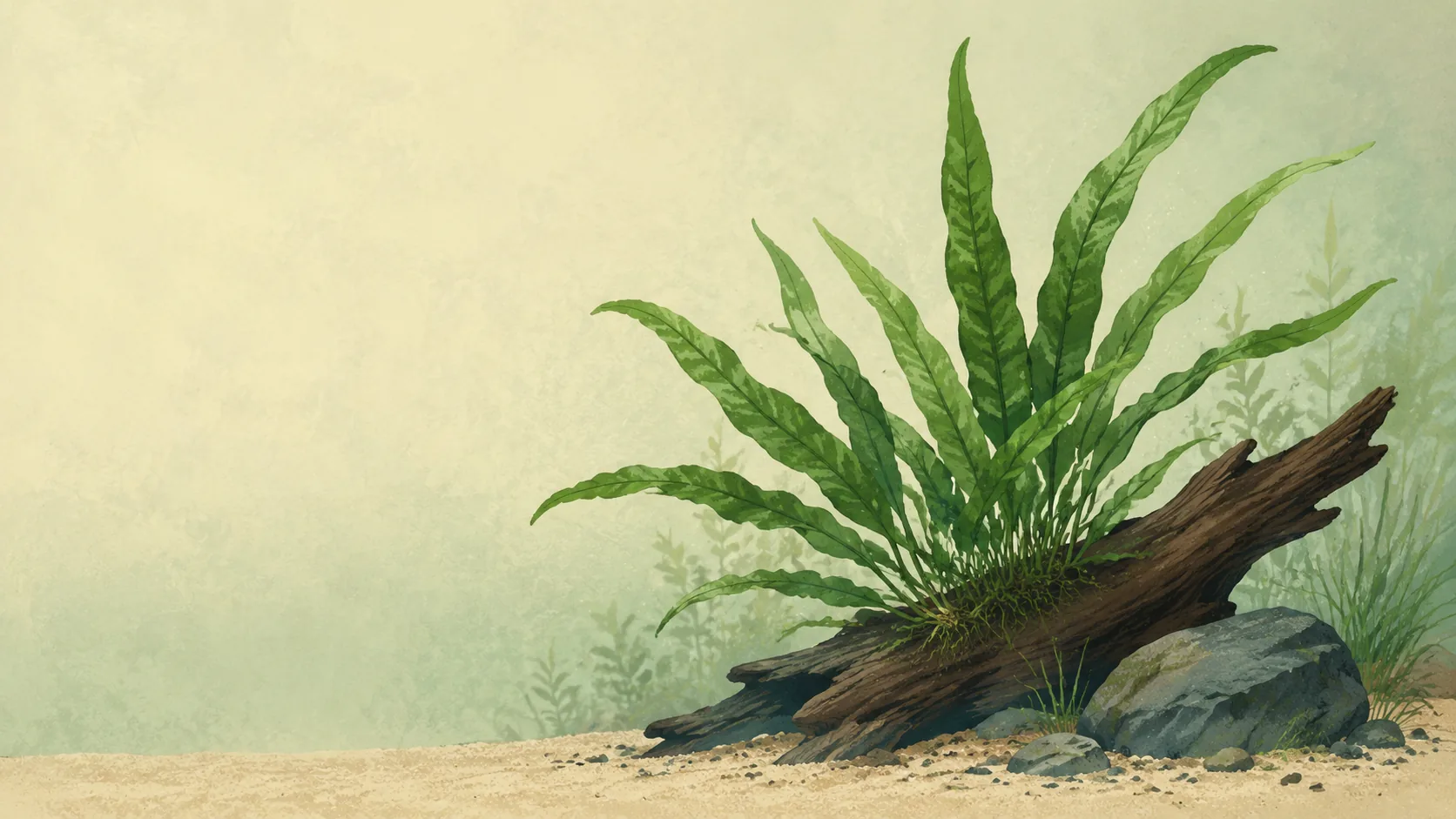
    Do you need CO₂ for an Iwagumi tank?

    It depends on the carpet. Tropica rates dwarf hairgrass as low CO₂ demand, so a low-tech Iwagumi is possible with it. Monte Carlo needs added CO₂ to become really compact, and HC Cuba and Glossostigma are rated high.

    What’s the difference between Iwagumi and the Nature Aquarium style?

    Iwagumi is a minimalist, stone-only sub-style within the broader Nature Aquarium approach. Nature Aquarium layouts can include driftwood and a wider variety of plants. Iwagumi is rocks plus, typically, a single carpet.

    Sources: Tropica, Eleocharis acicularis; Tropica, Micranthemum tweediei 'Monte Carlo'; Tropica, Micranthemum callitrichoides 'Cuba'; Tropica, Glossostigma elatinoides.

  • Aquascaping Rocks

    Aquascaping Rocks

    Aquascaping rocks fall into two groups: stones that leave your water alone, such as dragon stone and lava rock, and lime-bearing stones such as Seiryu that slowly harden it. Which group you need depends on your fish, shrimp and plants. Below are the common rocks compared, how much you need, and how to test a stone.

    What rock does to your water

    This is the bit beginners miss. Carbonate (limestone-type) rocks slowly dissolve and raise your water’s hardness and pH, while inert rocks leave it alone. Aquasabi splits aquascaping stone the same way: rocks like lava and dragon stone do not influence the water, while rugged stones such as Seiryu contain a little lime and may harden it a bit. That is fine for hard-water fish and a problem for soft-water shrimp and plants.

    The acid test for aquascaping rocksAcid drops fall on two stones. Seiryu stone fizzes with gas bubbles, which means it contains carbonate and raises hardness and pH. Dragon stone does not react, so no carbonate was detected, though that alone does not prove it is inert. A soak test in reverse-osmosis or distilled water then checks GH, KH and pH before the rock goes in, at 48 hours, one week and two weeks.Which rocks change your waterAn acid test shows carbonate in minutes. A soak test confirms it.Seiryu stoneLimestone-basedDragon stoneClay-based (Ohko)acidIt fizzes: carbonateRaises hardness and pH.acidNothing happens: no carbonate detectedStill not proof it is inert. Soak-test it.The sure check: a soak test in RO or distilled waterBeforeGH · KH · pH48 hoursGH · KH · pH1 weekGH · KH · pH2 weeksGH · KH · pHDrops of vinegar are often too weak to fizz on carbonate rock.AquaLexiconThe acid test for aquascaping rocksAcid drops fall on two stones. Seiryu stone fizzes with gas bubbles, which means it contains carbonate and raises hardness and pH. Dragon stone does not react, so no carbonate was detected, though that alone does not prove it is inert. A soak test in reverse-osmosis or distilled water then checks GH, KH and pH before the rock goes in, at 48 hours, one week and two weeks.Which rocks changeyour waterAn acid test shows carbonate in minutes.A soak test confirms it.Seiryu stoneLimestone-basedDragon stoneClay-based (Ohko)acidIt fizzes: carbonateRaises hardness and pH.acidNothing happens:no carbonate detectedStill not proof it is inert. Soak-test it.The sure check: a soak testin RO or distilled waterBeforeGH · KH · pH48 hoursGH · KH · pH1 weekGH · KH · pH2 weeksGH · KH · pHDrops of vinegar are often too weakto fizz on carbonate rock.
    Illustration. Acid test after Oliver Knott (Aquasabi); soak test after Gensou.

    The common aquascaping rocks compared

    Aquasabi rates each stone it sells for its effect on water and gives it a bulk-weight factor. The lower the factor, the more stone you get for each kilo.

    StoneLookEffect on waterBulk weight
    Black lavaDark and porousNeutral0.7
    Galapagos rock (lava)Porous and dark, with brown accentsNeutral0.9
    Tsingy rockLight grey, often oddly shapedMay harden slightly0.9
    Dragon stone (Ohko)Brown to reddish, deeply pittedNeutral1.0
    SeiryuGrey and rugged, sometimes white-veinedHardens slightly1.0
    Black pagodaDark grey with brown veins, often layeredHardens slightly1.0
    Black rockDeep black and brokenMay harden slightly1.0
    Elephant skin rockLighter grey, roundish and ruggedHardens slightly1.1
    Yangtse rockRoundish, in white, yellow, brown or greyNeutral1.2
    Frodo stoneGrey-brown with deep furrowsHardens slightly1.2

    A stone that hardens the water slightly does more of it in a tank running CO2. In Aquasabi’s article with aquascaper Oliver Knott, calcareous stones tend to harden the water far more once a CO2 system is running, because the carbonic acid dissolves the lime.

    The three you’ll see most

    • Seiryu stone: jagged grey rock with white veining. It’s limestone-based, so it raises hardness and pH. The classic Iwagumi stone, but best where hard water suits your livestock.
    • Dragon stone (Ohko): tan, knobbly and full of crevices. Water-neutral, and Aquasabi says it crushes into fragments quite easily, so it’s simple to break to size.
    • Lava rock: light, porous and dark, with a surface that mosses and ferns root into. Aquasabi calls it neutral, though ADA rates its own KUMU lava as having a moderate effect on hardness.

    Torn between the first two? Our dragon stone vs Seiryu page compares them on water, looks and handling.

    How much rock you need

    Aquasabi’s rule of thumb is your tank’s gross volume in litres divided by six, which gives the weight of stone in kilograms. Then multiply that by the stone’s bulk-weight factor from the table. Its own example: a 54 litre tank works out at 9 kg, which becomes nearly 11 kg of Frodo stone at 1.2, or 7.2 kg of Loa lava rock at 0.8.

    Buy more than the sum suggests if the tank will be heavily planted. Aquasabi says at least half of the hardscape will end up hidden behind plants, so start with bigger stones than look right on the first day. It also recommends keeping a spare stash of one kind of stone in several sizes, and making your own small shards with a hammer and chisel, with a cloth over the stone so nothing flies.

    How to test a rock

    The quick check is an acid test. In Aquasabi’s article with aquascaper Oliver Knott, he drips oak extract onto stones: calcareous rock reacts with clearly visible gas bubbles, and non-calcareous rock does not. Household vinegar is often suggested for the same job, but Aquarium Science warns that drops of vinegar are too weak an acid to fizz on carbonate rock, and recommends a stronger acid such as hydrochloric (pool) acid, which needs careful handling.

    The sure check is a soak test. Gensou’s method is to put the clean rock in reverse-osmosis or distilled water, measure GH, KH and pH before it goes in, and test again at 48 hours, one week and two weeks. It also covers what an acid test cannot: Gensou points out that a rock with no carbonate is still not guaranteed to be inert.

    Matching rock to your tank

    For a soft-water or shrimp tank, lean on a neutral stone such as dragon stone or lava rock, so you aren’t fighting rising hardness. If your fish are happy in harder water, or you’re buffering deliberately, Seiryu is fair game. On looks, jagged Seiryu reads as mountains in an Iwagumi, while chunky dragon stone suits caves, overhangs and texture. Whichever you choose, Aquasabi advises sticking to one kind of stone through a layout.

    Stone often shares a layout with wood. Aquasabi recommends black lava, elephant skin rock and Frodo stone alongside driftwood, and our aquarium driftwood guide covers the wood side.


    Questions about aquascaping rock

    Do aquascaping rocks change water parameters?

    Some do. Carbonate rocks like Seiryu raise hardness and pH as they dissolve. Inert rocks like dragon stone and lava rock do not. An acid test gives a quick answer, and a two-week soak test with GH and KH readings confirms it.

    How much rock do I need for my aquarium?

    Aquasabi’s rule of thumb is the tank’s gross volume in litres divided by six, in kilograms, then adjusted for the stone: less for light lava, more for dense stone. A 54 litre tank works out at about 9 kg.

    Which rock is best for beginners?

    Dragon stone. It’s inert, so it will not alter your water chemistry, and its texture is forgiving and easy to arrange into a natural-looking layout.

    Can you use rocks collected from outside?

    Cautiously. Unknown rocks can change your water in ways an acid test will not show. Gensou warns that rocks containing iron sulphides such as pyrite can release sulphuric acid and lower pH. Soak-test anything you collect, scrub and rinse it thoroughly, and avoid anything metallic, crumbly or from a polluted area.

    Sources: Aquasabi, Types of hardscape; Aquasabi, Oliver Knott on water-hardening stones; Aquasabi, Choose your hardscape by weight; Aquarium Science, Rocks; Gensou, How to test if aquarium rocks are safe.

  • Carpet Plants

    Carpet Plants

    Carpet plants are the low, spreading species that cover an aquarium floor in green, the lawn-like foreground that makes a scape look finished. They’re also where beginners most often come unstuck, because the famous ones are the hardest to grow. The trick is choosing a carpet that matches your setup, not the one in the photo.

    What makes a plant a “carpet”

    A carpet plant stays low and spreads sideways by runners, knitting into a continuous mat across the substrate. That horizontal habit is the easy part. The hard part is keeping light on the floor: Tropica warns that Glossostigma grows upwards if light is poor, and that Staurogyne grows more upright in low light. How much light and CO₂ a carpet needs varies a lot between species.

    The five, by Tropica’s ratings

    PlantLatin nameLight demandCO₂ demandDifficulty
    Dwarf hairgrassEleocharis acicularisLowLowEasy
    Staurogyne repensStaurogyne repensLowLowEasy
    Monte CarloMicranthemum tweedieiMediumMediumMedium
    Dwarf baby tears (HC Cuba)Hemianthus callitrichoides ‘Cuba’HighHighAdvanced
    GlossostigmaGlossostigma elatinoidesHighHighAdvanced
    Carpet plants ranked easiest to hardest by Tropica's ratings: dwarf hairgrass, Monte Carlo, dwarf baby tears and Glossostigma, with the light and CO2 demand of each.

    Start here

    If you want a realistic first carpet, dwarf hairgrass is the one Tropica’s ratings point to: easy, with a low demand for light and CO₂, and a plant Tropica says thrives in almost all conditions. It forms a grassy carpet and prefers open space without shading from other plants. Monte Carlo is the next step. Tropica rates it medium and says it needs good light and added CO₂ to become really compact. Our dwarf hairgrass vs Monte Carlo comparison sets those two side by side, and Monte Carlo vs HC Cuba covers the step after.

    Approach with caution

    Dwarf baby tears (HC Cuba) and Glossostigma give the finest carpets and are the two Tropica rates advanced, with a high demand for light and CO₂. Tropica calls Glossostigma a difficult plant demanding a lot of light, and says HC Cuba needs enough light, added CO₂, water circulation and fertiliser to thrive. They’re rewarding once you’ve got a tank dialled in, but they’re the wrong place to begin.

    The “carpet without the difficulty” option

    Staurogyne repens is a low, bushy foreground plant rather than a true carpet, but it gives a similar green front edge. Tropica rates it easy, with low light and CO₂ demand. Cut off the longest upright shoots when planting and new creeping shoots form from the base and gradually colonise the gravel.


    Carpet plant questions

    What’s the easiest carpet plant for beginners?

    By Tropica’s ratings, dwarf hairgrass. It is rated easy with a low demand for light and CO₂, while Monte Carlo is rated medium and HC Cuba and Glossostigma advanced.

    Can you grow carpet plants without CO₂?

    Some. Tropica rates dwarf hairgrass and Staurogyne repens as low CO₂ demand. Monte Carlo is medium and needs added CO₂ to become really compact, and HC Cuba and Glossostigma are rated high, so plan on CO₂ for those.

    Why won’t my carpet plant spread?

    Usually not enough light reaching the floor. Tropica notes that Glossostigma grows upwards when light is poor and that Staurogyne grows more upright in low light, and it advises keeping larger plants from overshadowing a carpet. For the demanding species, missing CO₂ is the other common cause.

    Sources: Tropica, Eleocharis acicularis; Tropica, Staurogyne repens; Tropica, Micranthemum tweediei 'Monte Carlo'; Tropica, Micranthemum callitrichoides 'Cuba'; Tropica, Glossostigma elatinoides.

  • Aquascaping Glossary (A–Z)

    Aquascaping Glossary (A–Z)

    This aquascaping glossary is an A–Z of the terms you will meet in the hobby, covering the styles, plants, hardscape and gear, each with a plain-English definition and a link to the full explainer. Start anywhere, or follow the links through to the pages that cover a term in depth. New entries are added as the library grows.

    A–Z of aquascaping terms

    Just starting out? Begin with what aquascaping is and the beginner’s guide.


    Using this glossary

    What are the most important aquascaping terms to learn first?

    Hardscape, substrate and carpet cover most early conversations. Hardscape is the rock and wood that sets the structure, substrate is what the plants root into, and a carpet is the low, spreading planting across the floor of the tank.

    Do I need to know the Latin plant names?

    Not to get started, but they help when you buy. Trade names vary between shops and some plants are sold under more than one name, so the Latin binomial is the reliable way to check you are getting the species you meant to buy.

    Where should a complete beginner start?

    Read what aquascaping is for the overview, then the beginner’s guide for the practical choices. Come back to this glossary whenever a term turns up that you have not met before.

    Sources: Tropica, Anubias barteri var. nana; Tropica, Cryptocoryne wendtii 'Green'; Tropica, Eleocharis acicularis; Tropica, Micranthemum tweediei 'Monte Carlo'; Tropica, Micranthemum callitrichoides 'Cuba'; Tropica, Rotala rotundifolia; Aquasabi, Appearance of in-vitro plants.

  • Aquascaping for Beginners

    Aquascaping for Beginners

    The easiest way to start aquascaping is to keep it low-tech: a modest tank, hardy plants that don’t need CO₂, and a simple light. Get a feel for how plants actually grow before chasing carpets and pressurised gas. This guide covers the choices that genuinely matter for a first planted tank, plus the beginner mistakes worth dodging.

    Start low-tech

    Resist the urge to buy everything at once. A low-tech setup (no CO₂, modest lighting, hardy plants) teaches you the fundamentals cheaply and forgives mistakes. You can always upgrade later. You can’t un-spend the money on gear you didn’t need. The jungle style and the Walstad method are both built for exactly this kind of relaxed, low-tech start.

    Pick forgiving plants

    Begin with hardy, low-light species that don’t need CO₂ and shrug off beginner errors:

    • Anubias: slow, tough, attaches to wood or rock, and almost impossible to kill.
    • Java fern: another hardy epiphyte that needs no substrate and little light.
    • Cryptocoryne wendtii: an undemanding rosette that Tropica says thrives in almost all conditions. It may lose leaves after planting before it settles.
    • Floating plants: they draw nutrients from the water and shade the tank, which helps while it finds its feet.

    Notice what’s not on that list: carpet plants. Tropica rates dwarf hairgrass easy, but the finest lawns, HC Cuba and Glossostigma, are advanced plants, so save those for tank two. Before you buy any plant, the plant ratings chart shows its light, CO₂ and difficulty ratings in one place.

    The five building blocks of an aquascape: hardscape, substrate, plants, light, and CO2 with fertiliser, split into structure and conditions.

    The basics: tank, substrate, light

    A wider tank beats a tall one, with more floor area to plant and easier lighting. A nutrient aquasoil gives root-feeders a real head start over plain gravel. And keep the light moderate at first: too much light over a new, lightly planted tank is the fastest route to an algae problem.

    Mistakes beginners make

    • Too much light, too soon. Bright light with few plants feeds algae, not your scape.
    • Demanding carpets first. Starting with HC Cuba or Glossostigma, which Tropica rates advanced with a high CO₂ demand, is the quickest way to a patchy carpet.
    • No patience. A new tank needs to cycle and settle. Rushing fish in or judging it after a week is the classic error.
    • Overstocking. Too many fish too fast overwhelms a young tank’s balance.

    Beginner questions

    What’s the cheapest way to start aquascaping?

    A low-tech tank with hardy plants and no CO₂. Skip pressurised gas and high-end lighting at first. A modest light, some Anubias and Java fern, and patience will get you a good-looking planted tank for very little.

    Do you need CO₂ for a beginner planted tank?

    No. Many hardy plants have a low CO₂ demand. CO₂ only becomes necessary for plants rated high, such as HC Cuba and Glossostigma, not for a first low-tech tank.

    How long before a new aquascape looks good?

    Usually a couple of months. Plants need time to root, grow in and fill out, and the tank needs to find its balance. The patience to wait through the awkward early weeks is half the skill.

    Sources: Tropica, Anubias barteri var. nana; Tropica, Microsorum pteropus (Java fern); Tropica, Cryptocoryne wendtii 'Green'; Tropica, Limnobium laevigatum; Tropica, Eleocharis acicularis; Tropica, Micranthemum callitrichoides 'Cuba'; Tropica, Glossostigma elatinoides; Aquasabi, Appearance of in-vitro plants.