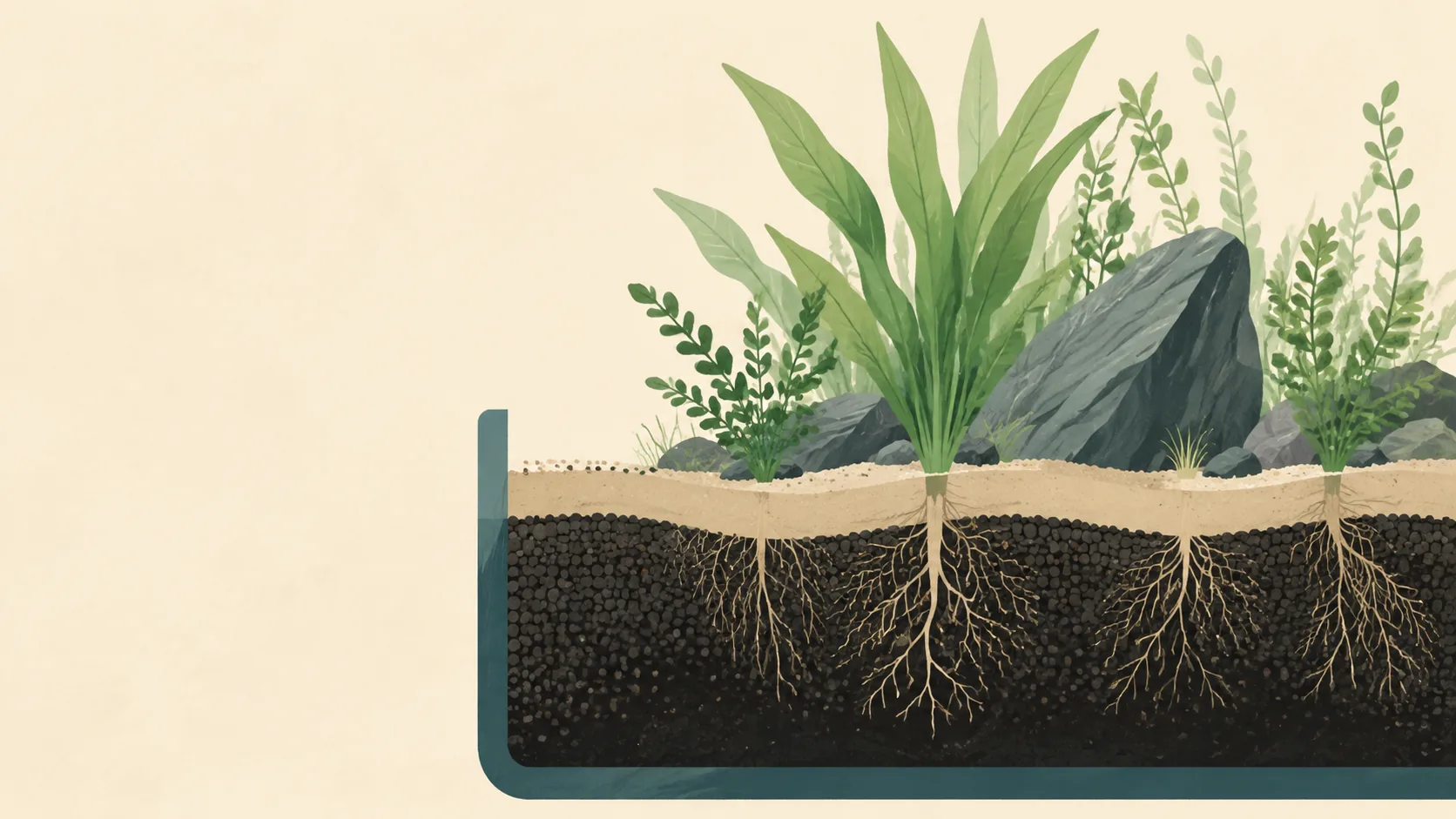
Aquascaping substrate is more than something to anchor plants in. An active soil changes your water chemistry on purpose, an inert gravel leaves it alone, and which you choose decides whether your plants can feed themselves or need help. Get this right at setup, because changing it later means tearing the tank down.
Active soil versus inert gravel
Aquascaping soils are active substrates. Aquasabi explains that soil works as a cation exchanger: it releases hydrogen ions and removes the calcium and magnesium behind water hardness, lowering pH, total hardness and carbonate hardness. The result is soft, acidic water that suits most tropical fish, shrimp and plants. Soil also stores nutrients and releases them to plant roots when needed.
Inert gravel and sand are water-neutral and supply no nutrients at all. Plants will grow in them, but root feeders have to be fed directly with root tabs pushed into the substrate.
Building it in layers
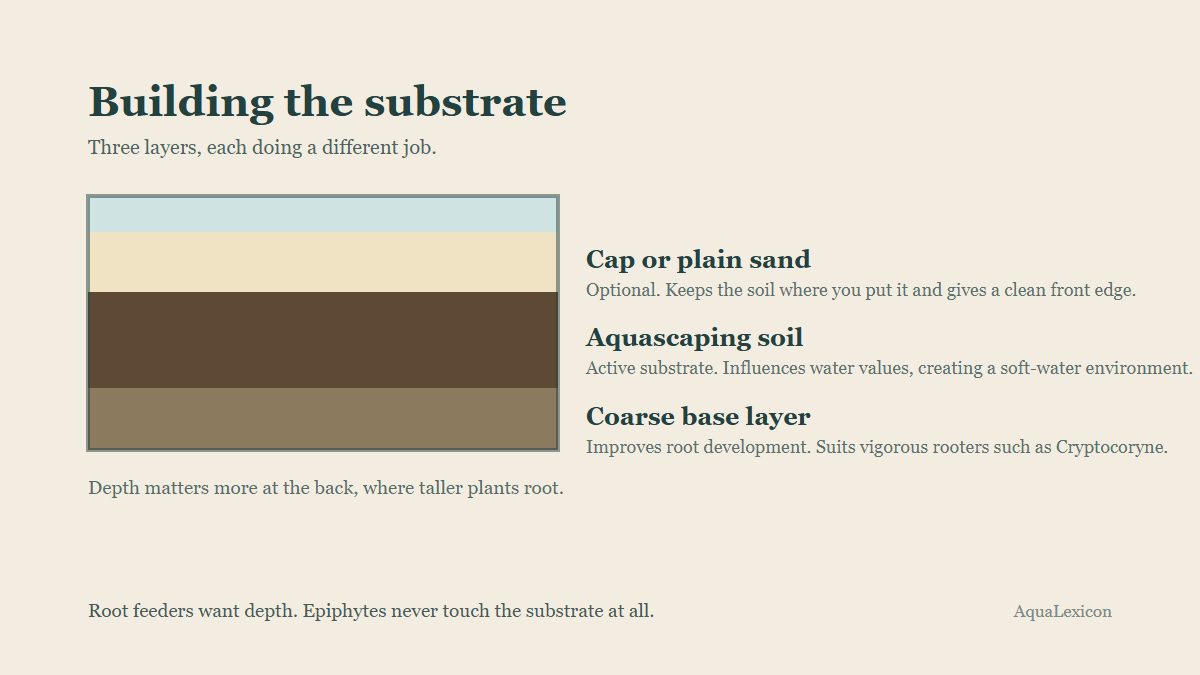
A nutrient base layer such as ADA Power Sand goes under the soil. Aquasabi says its porous volcanic granules leave gaps that roots grow into, and recommends it for plants that root deeply, naming Cryptocoryne and Echinodorus. A sand cap on top is optional and mostly cosmetic, keeping the soil where you put it and giving a clean front edge.
Slope it deeper at the back. Taller plants root there, and the rise adds depth to the layout in the same way a focal point does.
Which plants care most
- Heavy root feeders: Amazon sword is an Echinodorus, which Aquasabi says actively absorb nutrients through their roots, so give it a nutrient soil or root tabs.
- Rosette plants: Cryptocoryne wendtii roots into the substrate, and Aquasabi says Cryptocoryne need to spread their roots in bacteria-rich substrate.
- Most other plants: Aquasabi notes that nutrient uptake improves for most plants below pH 7, which is where an acidic soil keeps the water.
- Epiphytes: Anubias and Java fern never touch it. They attach to hardscape instead.
The messy start
A fresh nutrient soil releases a lot of ammonium straight after it goes in. Aquasabi’s guide to ADA Amazonia explains that ammonium is not toxic to fish and shrimp in itself, but turns into highly toxic ammonia above pH 7, so it advises planting straight away and adding fish and shrimp two to three weeks after planting. Cloudy water usually comes from granules that dried out or crumbled into powder, and the fix is to remove the cloudy water and refill slowly. ADA also says that once the granules crumble and the substrate becomes less permeable, blue-green algae may develop in it, and the answer then is to rebuild the substrate. The Walstad method accepts a similarly rough start with ordinary soil under gravel.
Substrate questions
Do you need aquasoil for a planted tank?
No, but it makes life easier. Plants grow in inert gravel provided root feeders get root tabs. An active soil stores nutrients for the roots and softens the water, which Aquasabi says suits most tropical fish, shrimp and plants.
Can you put sand on top of aquasoil?
Yes, as a cap. It holds the soil in place and gives a tidy front edge. Keep it shallow so plant roots can still reach the nutrients underneath.
Why is my new tank cloudy after adding soil?
Usually because the soil granules dried out or crumbled into powder. Aquasabi’s advice for ADA Amazonia is to remove the cloudy water and pour new water in slowly. New soil also releases ammonium at first, so wait two to three weeks after planting before adding fish or shrimp.
Sources: Aquasabi, Soil; Aquasabi, ADA Power Sand; Aquasabi, ADA Substrate Fertilizers; Aquasabi, ADA Aqua Soil Amazonia.