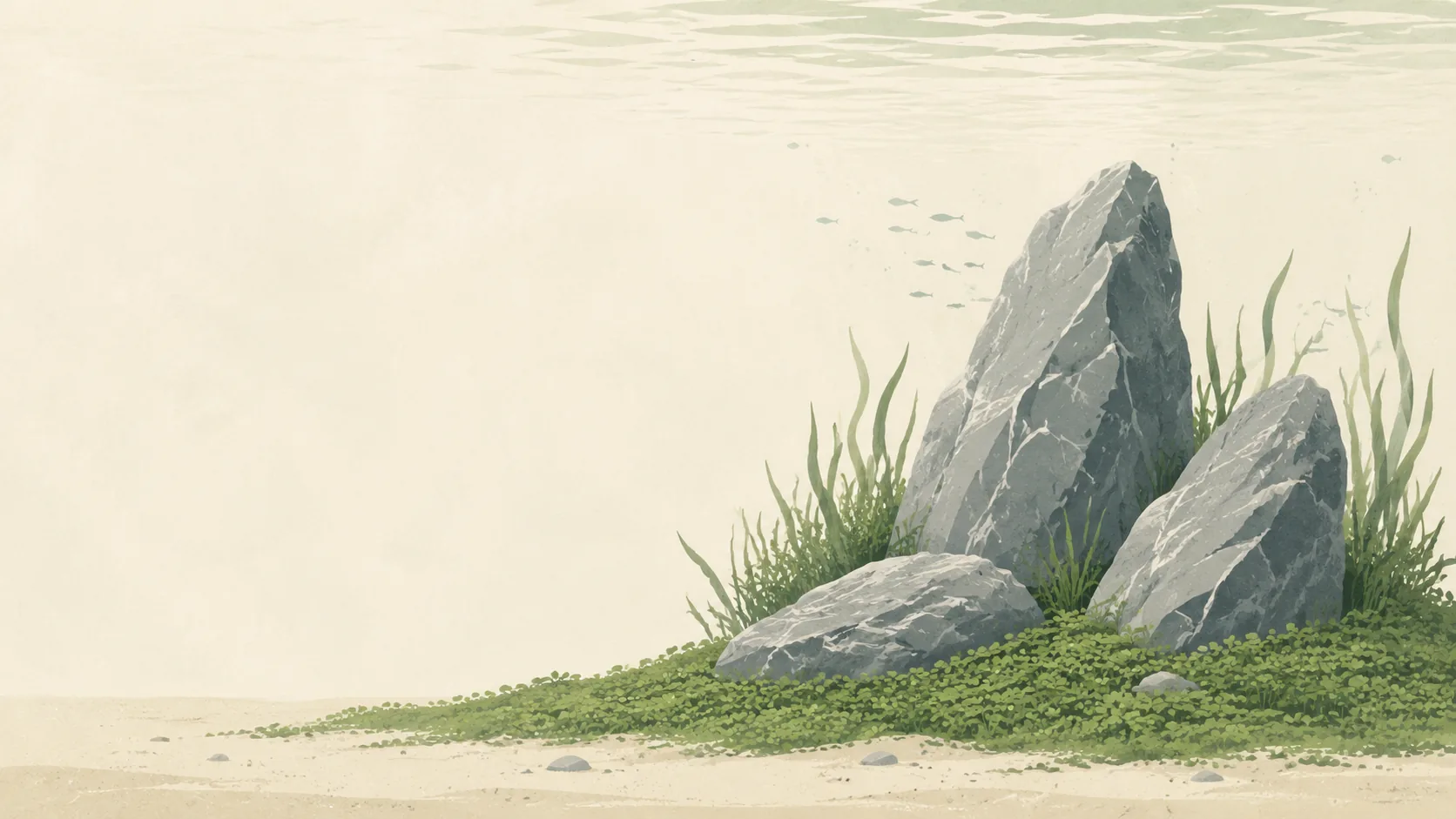
Iwagumi is a minimalist Japanese aquascaping style built around an odd number of carefully placed stones, usually three, and typically a single carpeting plant. Popularised by Takashi Amano, it prizes open space, asymmetry and one clear focal point, creating a calm, natural-looking underwater landscape rather than a densely planted display.
Where Iwagumi comes from
The word iwagumi means “rock formation” in Japanese, and the style grew out of the Nature Aquarium movement led by Takashi Amano. It borrows directly from Japanese garden design and Zen aesthetics: restraint, balance and the suggestion of a much larger landscape inside a small space. Where a Dutch-style tank is a lush plant showcase, Iwagumi is the opposite. Stone is the star, and the planting is deliberately simple.
The stones and their roles
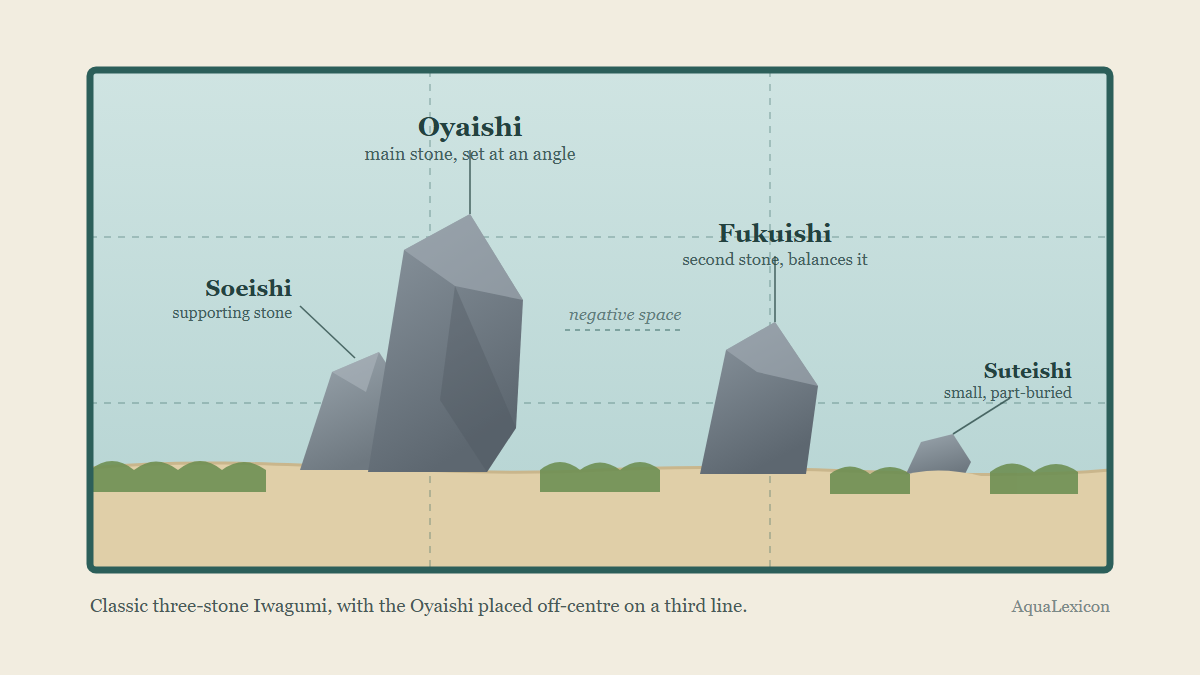
A classic Iwagumi uses an odd number of stones (three, five or seven) so the layout never falls into symmetry. In a three-stone arrangement each rock has a defined role:
- Oyaishi: the main stone. The largest, set at an angle and placed off-centre as the composition’s single focal point.
- Fukuishi: the second stone. Smaller than the Oyaishi, it sits to one side and balances it.
- Soeishi: the supporting stone. Smaller again, it complements the two main stones rather than competing with them.
- Suteishi: the “sacrificial” stone. The smallest, often partly buried, adding naturalness without drawing the eye.
One more rule of thumb: use a single type of stone throughout, with Seiryu stone and dragon stone the common choices, so the formation reads as one natural outcrop rather than a collection of unrelated rocks.
Composition principles
- The rule of thirds: the Oyaishi sits about a third of the way across, never centred.
- A single focal point: everything guides the eye to the main stone.
- Negative space: open substrate and open water are part of the design, not gaps to fill.
Plants for an Iwagumi
Iwagumi almost always uses one carpeting species, kept low so the stones dominate. That choice decides how technical the tank is: Tropica’s ratings for the common carpets run from easy, with low light and CO₂ demand, to advanced, with high demand for both.
| Carpet plant | Latin name | Light demand | CO₂ demand | Difficulty |
|---|---|---|---|---|
| Dwarf hairgrass | Eleocharis acicularis | Low | Low | Easy |
| Monte Carlo | Micranthemum tweediei | Medium | Medium | Medium |
| Dwarf baby tears (HC Cuba) | Hemianthus callitrichoides ‘Cuba’ | High | High | Advanced |
| Glossostigma | Glossostigma elatinoides | High | High | Advanced |
Dwarf hairgrass is the easiest starting point, then Monte Carlo. HC Cuba and Glossostigma give the finest carpet but are the most demanding.
Livestock
The open water above the carpet suits small, peaceful schooling fish and shrimp. Ember tetra (Hyphessobrycon amandae), chili rasbora (Boraras brigittae) and Amano shrimp (Caridina multidentata), which also grazes algae, are popular. Because compatibility depends on the full combination of tank size, temperament and water parameters, run any stocking list through a stocking calculator before you buy rather than assuming individual species will get along.
Common mistakes
- Using an even number of stones, or a symmetrical layout.
- Mixing different rock types, which breaks the natural look.
- Filling the open space instead of treating it as part of the design.
- Choosing a demanding carpet without the strong light and CO₂ it needs to grow flat.
Iwagumi questions
How many stones do you need for an Iwagumi?
An odd number, classically three: the Oyaishi (main), Fukuishi (second) and Soeishi (supporting). That keeps the arrangement asymmetrical. Larger tanks may use five or seven.
Do you need CO₂ for an Iwagumi tank?
It depends on the carpet. Tropica rates dwarf hairgrass as low CO₂ demand, so a low-tech Iwagumi is possible with it. Monte Carlo needs added CO₂ to become really compact, and HC Cuba and Glossostigma are rated high.
What’s the difference between Iwagumi and the Nature Aquarium style?
Iwagumi is a minimalist, stone-only sub-style within the broader Nature Aquarium approach. Nature Aquarium layouts can include driftwood and a wider variety of plants. Iwagumi is rocks plus, typically, a single carpet.
Sources: Tropica, Eleocharis acicularis; Tropica, Micranthemum tweediei 'Monte Carlo'; Tropica, Micranthemum callitrichoides 'Cuba'; Tropica, Glossostigma elatinoides.