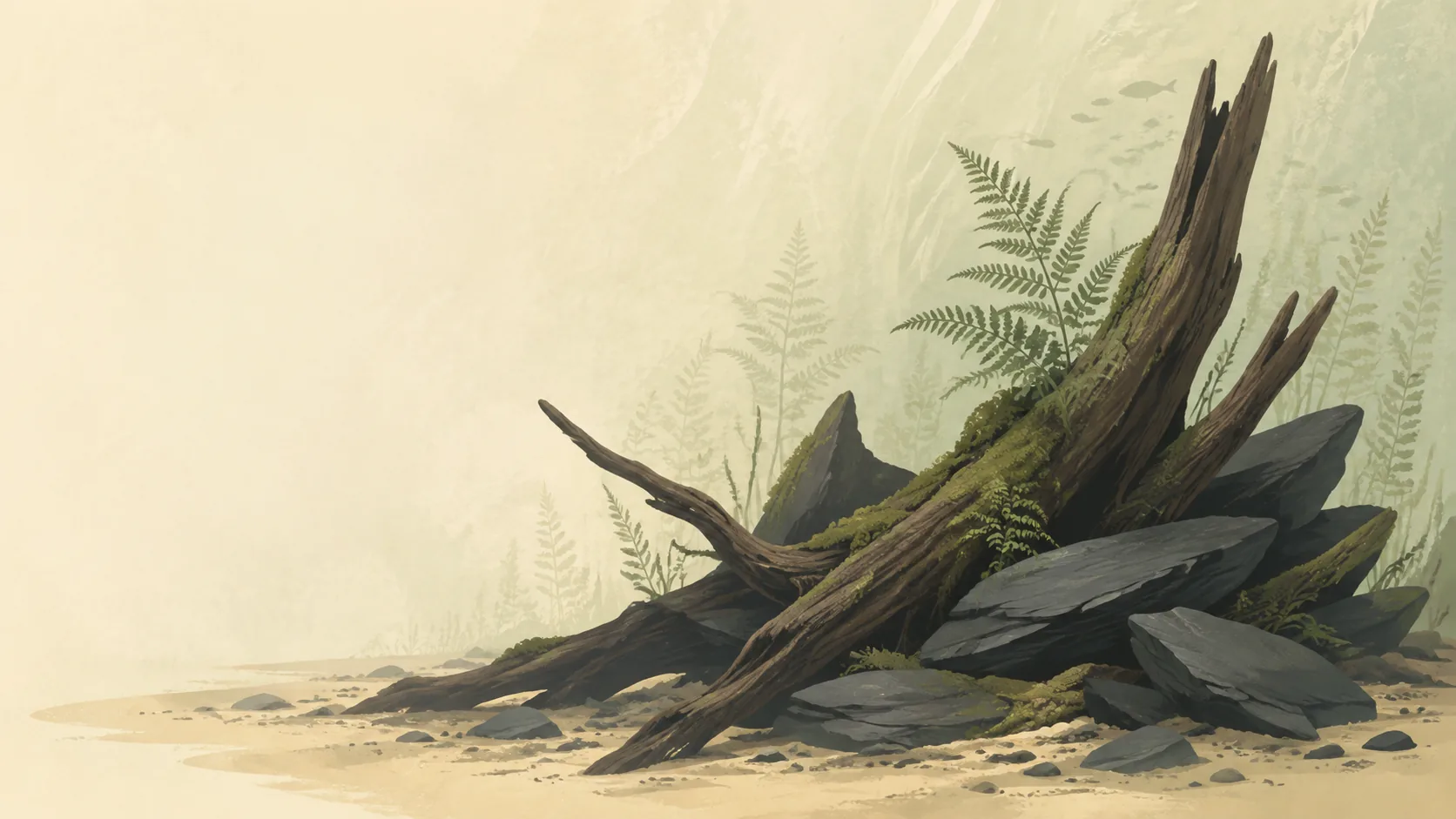
The Nature Aquarium is the style most people picture when they imagine aquascaping: driftwood and rock arranged to evoke a real landscape such as a forest, a hillside or a riverbank, with plants softening the structure until it looks grown rather than built. It’s the style Takashi Amano made famous, and the one the others are usually measured against.
Where it comes from
The Nature Aquarium was developed by the Japanese photographer and designer Takashi Amano, whose company ADA still sets much of the aesthetic standard through its annual international layout contest. Amano borrowed from Japanese garden design and the idea of capturing the feeling of a natural scene in miniature, suggesting a place rather than copying one exactly. The minimalist, stone-only Iwagumi layout is really a sub-style within this broader approach.
What defines it
- Hardscape first. Driftwood and rock set the structure before a single plant goes in: the layout should read as a landscape even bare.
- Asymmetry and a focal point. Built on the rule of thirds, with the eye led to one dominant feature rather than a centred, symmetrical scene.
- Depth. Foreground carpets, midground detail and taller background planting create the illusion of distance.
- A grown-in feel. Mosses and epiphytes soften the wood until it looks aged, not placed.
The plants that suit it
Because the hardscape leads, much of the planting is epiphytes and mosses lashed to wood and rock, which is why dragon stone turns up so often in these layouts: its crevices hold moss and give a rhizome something to grip. These do not root in substrate and they age the layout well:
| Plant | Latin name | Light demand | CO₂ demand | Difficulty |
|---|---|---|---|---|
| Anubias nana | Anubias barteri var. nana | Low to high (Flowgrow) | Not needed (Flowgrow) | Easy |
| Java fern | Leptochilus pteropus | Low | Low | Easy |
| Bucephalandra | Bucephalandra sp. | Low | Low | Easy |
| Christmas moss | Vesicularia montagnei | Medium | Low | Medium |
Carpets and stem plants then fill the floor and background. Branching spider wood is a favourite for the canopy effect, with Java fern and Anubias attached along its length.
Nature Aquarium vs the others
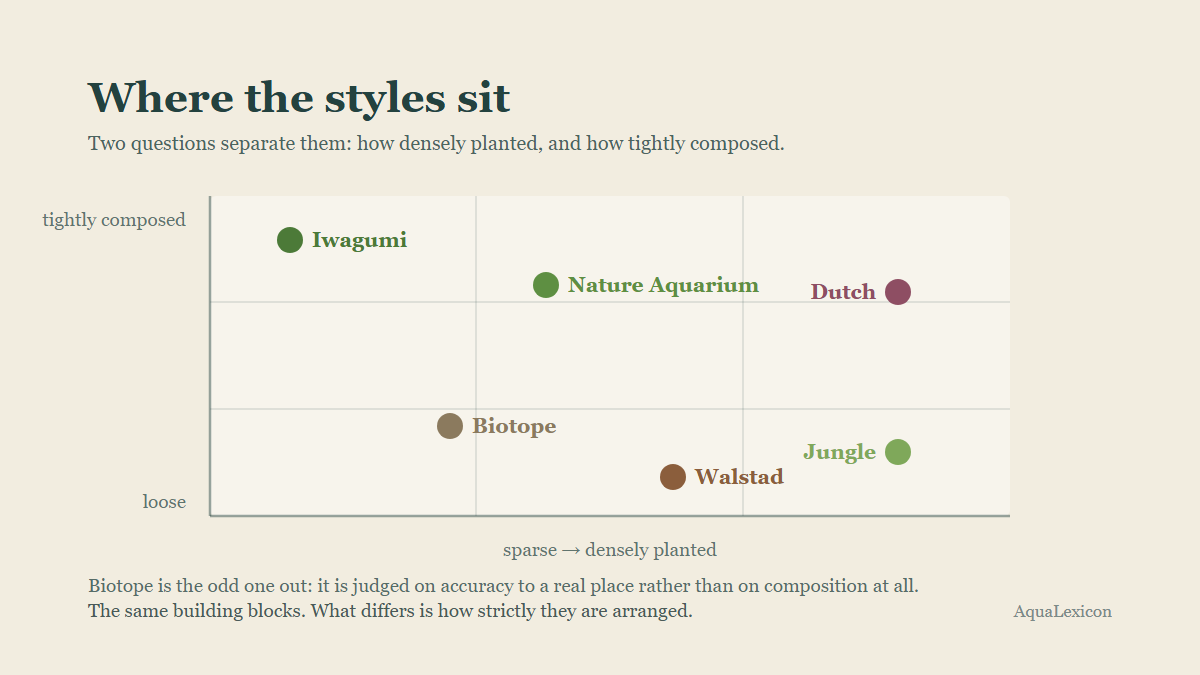
Set it beside a Dutch tank and the contrast is stark: Dutch is a formal garden with no hardscape and tidy plant rows, while a Nature Aquarium is a wild landscape held together by wood and stone.
Nature Aquarium questions
Is the Nature Aquarium style good for beginners?
It can be. The epiphytes and mosses it leans on are hardy and low-tech, so a simple version is achievable early. The harder part is the composition. Arranging hardscape that reads as a believable landscape takes practice rather than equipment.
What’s the difference between Nature Aquarium and Iwagumi?
Iwagumi is a minimalist, stone-only sub-style with usually a single carpet plant. The Nature Aquarium is the broader school it sits inside, and freely uses driftwood and a wider mix of plants.
Do you need CO₂ for a Nature Aquarium?
It depends on the planting. A moss-and-epiphyte layout can run low-tech, but the detailed, carpet-heavy contest-style tanks almost always use added CO₂ and strong light to get that lush, filled-in look.
Sources: Flowgrow, Anubias barteri var. nana; Tropica, Anubias barteri var. nana; Tropica, Microsorum pteropus (Java fern); Tropica, Bucephalandra diabolica 'Kedagang'; Tropica, Vesicularia montagnei 'Christmas Moss'.