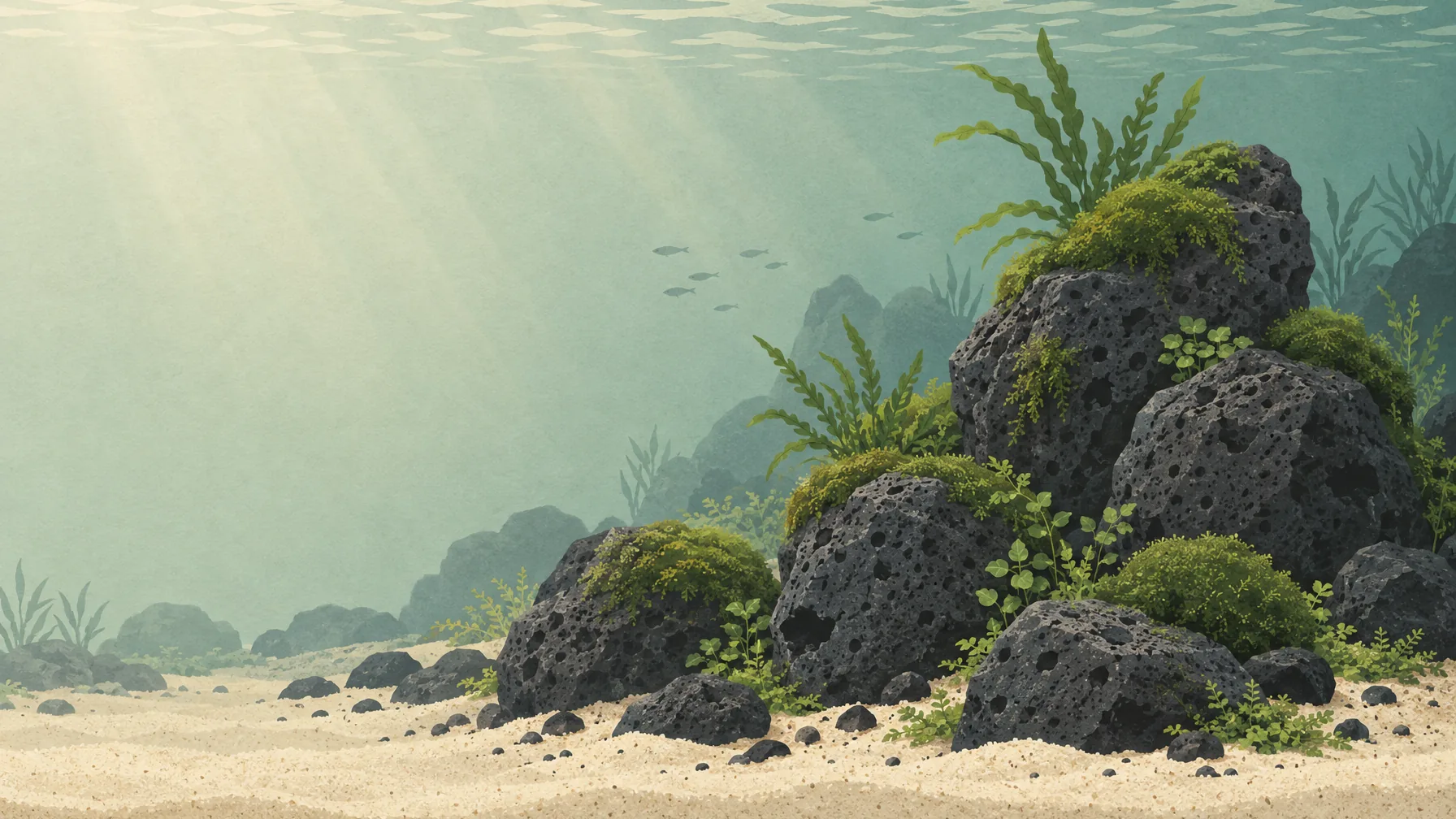
Lava rock is light, porous volcanic stone, sold in black, red and dark brown grades for aquascaping. Its pores give plant roots a grip, which makes it a favourite base for mosses and ferns. Aquasabi classes it as water-neutral, though ADA rates its own KUMU lava stones as having a moderate effect on hardness.
What lava rock is
Aquasabi describes it as stone of volcanic origin with a porous texture that makes it very light. Aquarium Science puts it more bluntly: “Lava rock is just a porous natural ceramic product.”
The light weight is the practical draw. Aquasabi says porous stones such as lava give more volume per kilo than dense stones, so large structures are possible, and you need considerably less of it by weight than of a heavy stone. Its rule of thumb for stone in general is your tank’s volume in litres divided by six, in kilograms. With lava you can come in under that.
Does lava rock float?
Sometimes, briefly. Aquasabi reports that some of its Island Lava floated on the surface for a short while before sinking, and Buce Plant, which sells lava, says smaller pieces may be slightly buoyant. Aquarium Science says it doesn’t float. Drop each piece in water before you build, and weight or wedge any that bob up.
Does it change your water?
Mostly no, with one exception worth knowing about.
| Source | What it says |
|---|---|
| Aquasabi guide | Lava doesn’t influence water quality; it lists Black Lava among its water-neutral stones |
| Aquasabi and Buce Plant listings | Black, red and Icelandic lava are inert and don’t raise hardness |
| ADA KUMU lava (Aquasabi listing) | Black: moderate effect on GH and pH. Red: low effect on pH, moderate on GH |
So the ADA claim covers one product line, and Aquasabi’s own guide still calls lava neutral. If soft water matters to you, for shrimp or soft-water plants, soak-test the stone you actually buy. Our aquascaping rocks page explains how.
Is it good filter media?
The shops say yes and the one test says no. Buce Plant’s listing claims its millions of tiny holes give beneficial bacteria a huge surface, and ADA’s listing credits it with natural biofiltration. Aquarium Science tested half-inch lava rock and found it did poorly at oxidising ammonia, which it says surprised it, and it lists “lava rock is a great biological filtration media” among hobby myths. It also says garden-centre lava, typically two to three inches across, is far too big to work as filter media.
Buy lava for the look and for planting. Treat any filtration benefit as unproven.
The colours on sale
| Grade | How sellers describe it |
|---|---|
| Black lava | Very dark, black to grey (Aquasabi, Buce Plant) |
| Red lava | Deep brick red to burnt orange (Buce Plant) |
| Icelandic lava | Deep, dark brown when submerged (Buce Plant) |
| Galapagos rock | Dark, with some brown accents (Aquasabi) |
All of it looks darker wet, Buce Plant notes. Aquasabi says a classic Iwagumi can be built from black lava, whose dark colour contrasts with the grey stones more commonly used.
Planting on lava rock
This is lava’s real strength. Aquasabi calls the porous structure ideal for ferns and mosses, and describes “Green Reef” scapes: tall lava structures covered in epiphytes such as Microsorum and Bolbitis ferns and moss, whose roots find a grip in the pores. It adds that lava is often used with driftwood roots, the stones covered in moss for forest-style scapes.
Tropica grows plants on lava for sale, including Anubias, Bucephalandra, Cryptocoryne, Microsorum (Java fern) and Bogor moss. It says plants grown directly on wood and stone are far hardier than plants grown in pots.
Preparing it
Rinse every piece under running water. Aquasabi says this removes fine dust that would otherwise cloud a new tank, and its listing for WIO red lava adds that fine mechanical filtration may be needed for 24 to 48 hours. Don’t use cleaning agents. Aquarium Science sees no point in boiling or bleaching rock, since a new fish or plant brings in far more pathogens than any stone. If the water does cloud, our cloudy water page covers the causes.
Lava breaks easily. Aquasabi says black lava crushes readily with a hammer and chisel, and to cover the stone with a cloth first so the shards don’t hurt anyone.
Lava rock questions
Does lava rock raise pH or hardness?
Aquasabi says lava doesn’t influence water quality, and most sellers call it inert. The exception is ADA’s KUMU lava, which ADA rates as having a moderate effect on GH. Soak-test it if soft water matters to you.
Does lava rock float in an aquarium?
Occasionally, for a short while. Aquasabi saw some Island Lava float before sinking, and Buce Plant says small pieces may be slightly buoyant. Test each piece before you build.
Is lava rock sharp enough to hurt fish?
Aquarium Science says no. It says the edges of lava rock used in aquariums are far too dull to cut a fish, and that the rare glassy lava sharp enough to cut skin is only found near fresh eruptions.
Sources: Aquasabi, Types of hardscape; Aquasabi, Choose your hardscape by weight; Aquasabi, Black Lava (shop listing); Aquasabi, ADA KUMU Black Lava Stone (shop listing); Aquasabi, ADA KUMU Red Lava Stone (shop listing); Aquasabi, WIO Wild Red Lava Stone (shop listing); Buce Plant, Black Lava Rock (shop listing); Buce Plant, Red Lava Rock (shop listing); Buce Plant, Icelandic Lava Stone (shop listing); Tropica, AquaDecor; Aquarium Science, Lava rock; Aquarium Science, Rocks; Aquarium Science, Falsehoods and myths.