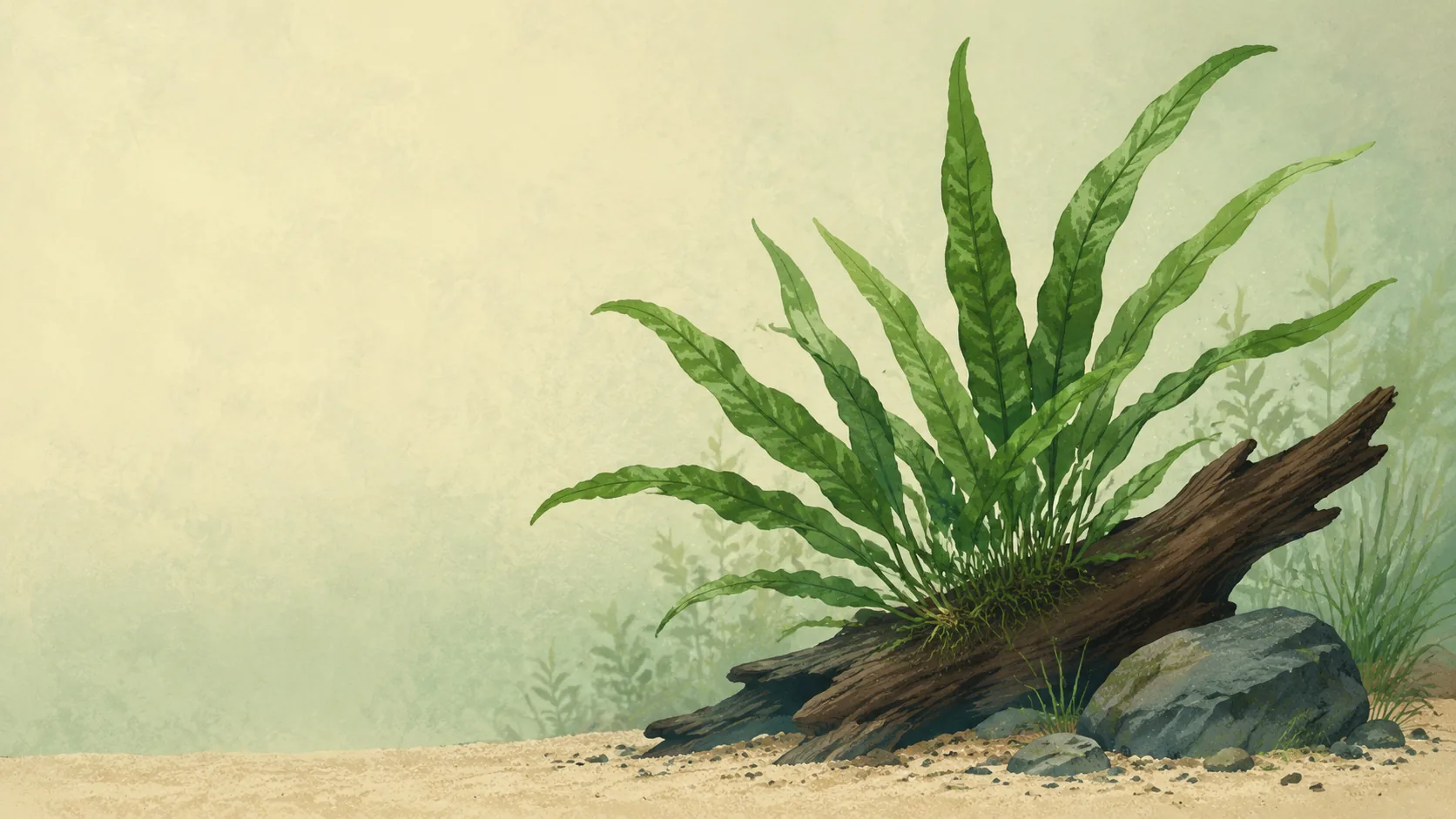
Java fern is one of the hardiest aquarium plants there is. Tropica calls it a hardy plant that grows in all conditions, and rates it easy, with a low demand for light and CO2. It attaches to wood and rock rather than rooting in the substrate.
The name has changed
Java fern has been reclassified as Leptochilus pteropus, having moved from Microsorum pteropus, and you will still see it sold under the older name, including by Tropica. Both refer to the same plant. Aquatic plant naming genuinely does move around, so the trade name is often the more reliable thing to shop by.
Where to attach it
| Requirement | Java fern |
|---|---|
| Light demand | Low |
| CO2 demand | Low |
| Difficulty | Easy |
| Growth rate | Slow |
| Placement | Epiphyte, mid to background |
Attach it to wood or rock and leave it alone. The crevices in dragon stone are useful here, because they give the rhizome somewhere to wedge while it takes hold. Like Anubias, it grows from a rhizome, and burying that rhizome in the substrate will rot it. Tropica recommends attaching it with fishing line until it has gained a hold.
Its taller, mid-to-background habit makes it a natural fit for Nature Aquarium layouts, where much of the planting is epiphytes lashed to the hardscape, and for the low-tech Walstad method.

Black spots under the leaves
The black spots on the underside of mature leaves worry a lot of people. Tropica is clear about them: they are sporangia, the fern’s reproductive organs, and not a sign of disease.
Leave spotted leaves in place. If you want more plants, Tropica’s advice is to split the horizontal rhizome.
Java fern questions
Does Java fern need to be planted in substrate?
No, and it should not be. It is an epiphyte that attaches to wood and rock. Tropica warns that if it is planted in the bottom, the rhizome must not be covered, because it will rot.
Is Java fern easy to care for?
Yes. Tropica rates it easy, with a low demand for light and CO2, and calls it a hardy plant that grows in all conditions. The main way to fail with it is to bury the rhizome.
Why is my Java fern growing so slowly?
Because that is what it does. Tropica rates its growth as slow, so that is normal and no sign of a problem. It is also why the plant copes so well with conditions that would kill a fast-growing stem plant.
Sources: Tropica, Microsorum pteropus (Java fern).