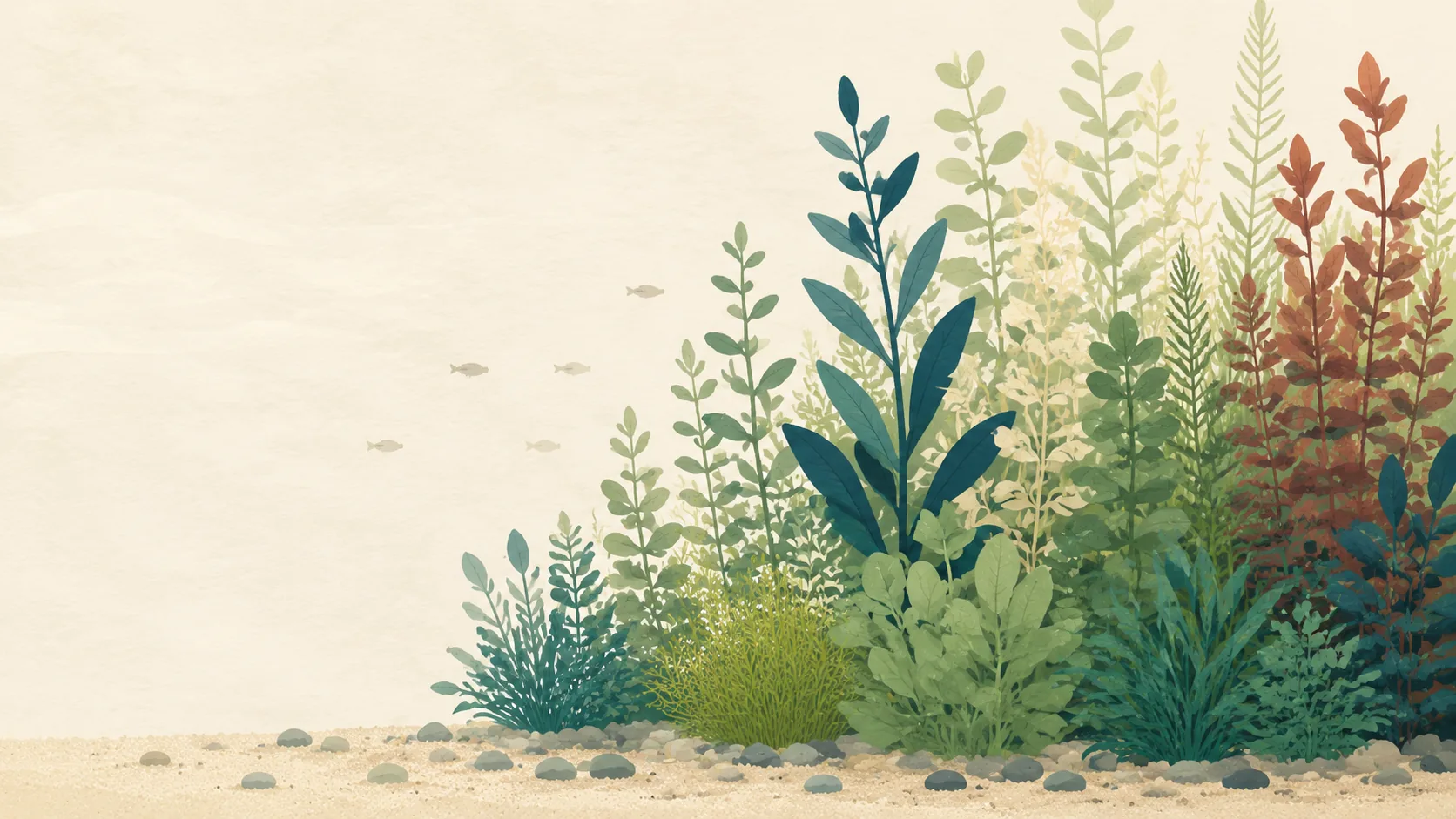
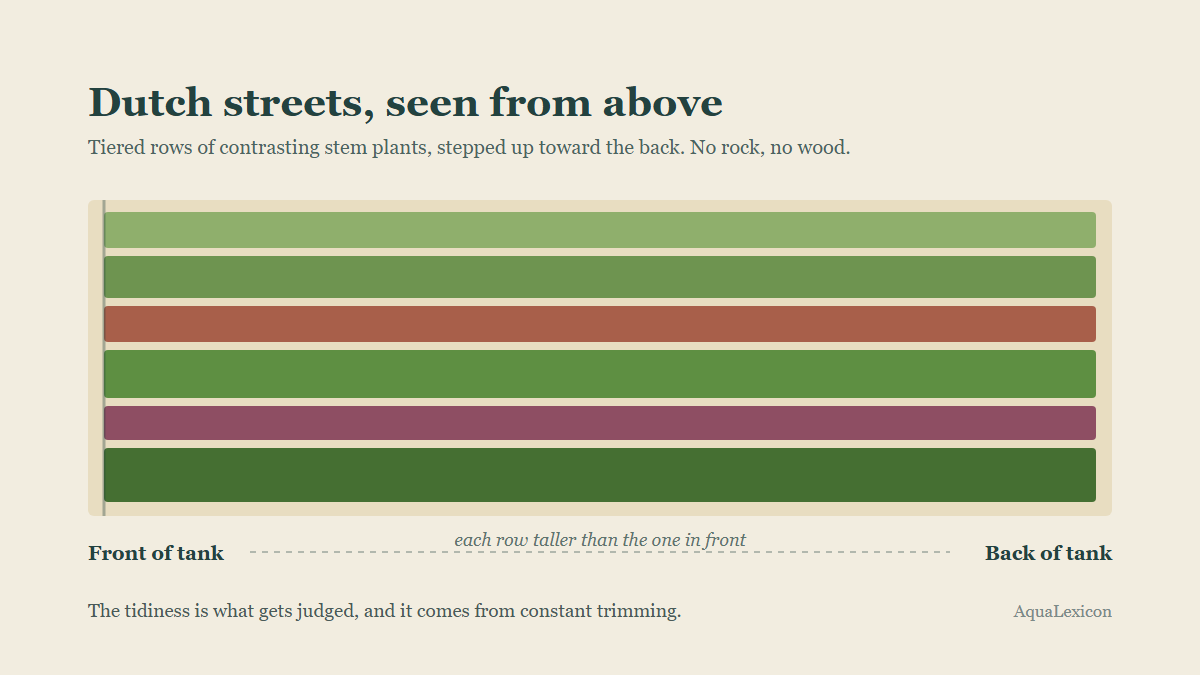
The Dutch style is the oldest school of aquascaping: a dense, hardscape-free display built entirely from plants. Where other styles lean on rock and driftwood, a Dutch tank throws them out and lets tiered rows of contrasting stem plants, the famous “Dutch streets”, carry the whole composition. It’s gardening underwater, not landscaping.
Where it comes from
The style grew up in the Netherlands around the Dutch aquarists’ society, the NBAT (Nederlandse Bond Aqua Terra), founded in 1930. In 1956 the NBAT published the first formal guidelines defining a Dutch aquascape. That pedigree shows. A proper Dutch scape is a manicured underwater garden rather than a wild slice of nature, judged on tidiness, contrast and plant health as much as on beauty.
What makes a tank “Dutch”
Take away the rocks and wood, and a handful of rules do the heavy lifting:
- Dutch streets. Diagonal rows of plants, graded low to tall, that lead the eye into the tank: planted along a sightline rather than straight across the glass.
- Groups, not specimens. Each species sits in a defined clump, never dotted around, so colours and leaf textures read as solid blocks.
- Colour and contrast. Reds against greens, fine leaves against broad ones. A single red group often does the job a focal rock would in another style.
- Variety and density. The early NBAT guidelines asked for at least ten plant species per 100 litres, so there is little open space and no bare hardscape on show.
The plants that do the work
Dutch scapes live and die on stem plants, which you trim, top and replant constantly to keep those streets sharp. A few workhorses turn up again and again:
| Plant | Latin name | Light demand | CO₂ demand | Difficulty |
|---|---|---|---|---|
| Rotala | Rotala rotundifolia | Low | Low | Easy |
| Ludwigia repens ‘Rubin’ | Ludwigia repens | Medium | Low | Easy |
| Alternanthera reineckii ‘Rosanervig’ | Alternanthera reineckii | Medium | Medium | Medium |
| Bacopa | Bacopa caroliniana | Low | Low | Easy |
Notice the pattern: the colour plants need light to colour. Tropica says Rotala needs good light to produce red leaves, and that Ludwigia ‘Rubin’ colours more intensely in strong light. Alternanthera reineckii goes further, with good light, fertiliser and added CO₂ all named by Tropica as material for its growth and colour. Bacopa caroliniana is the safety net: it has few demands and grows slowly, which Tropica says makes it one of the few stem plants that do not need much attention.
Is the Dutch style for you?
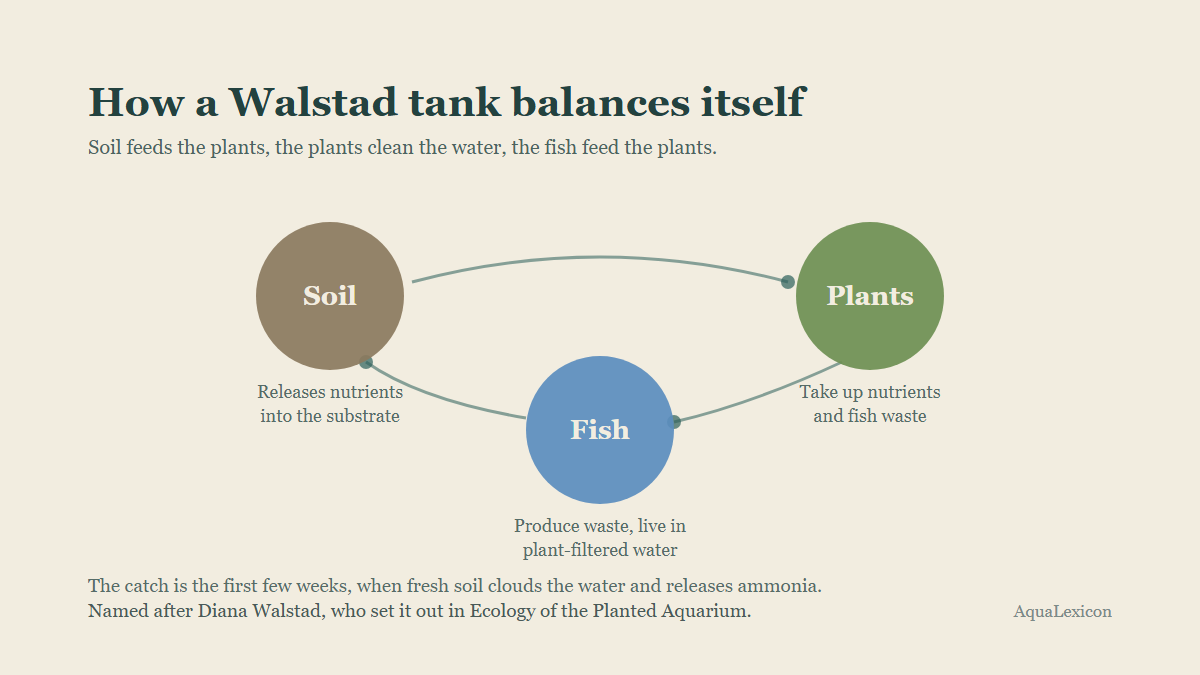
Be honest with yourself about trimming. A Dutch tank is one of the most maintenance-heavy styles there is: those streets only look crisp because someone prunes and replants them on a schedule, often weekly once the plants take off. If you find pruning meditative, it’s deeply satisfying work. If you want set-and-forget, a low-tech Walstad tank or a simple Iwagumi will frustrate you far less.
Dutch style questions
Is the Dutch style harder than other aquascaping styles?
Generally yes, though the work is in maintaining it rather than setting it up. The look depends on dense stem plants, and keeping them tidy means regular trimming, topping and replanting. The skill is in the upkeep, not the initial layout.
Do you need CO₂ for a Dutch aquascape?
Not for every plant. Tropica rates Rotala, Ludwigia ‘Rubin’ and Bacopa as low CO₂ demand, but Alternanthera reineckii needs added CO₂ for growth and colour. You can build a greener, simpler version without it, but the classic vivid Dutch look usually leans on plants like that.
What’s the difference between Dutch and Nature Aquarium styles?
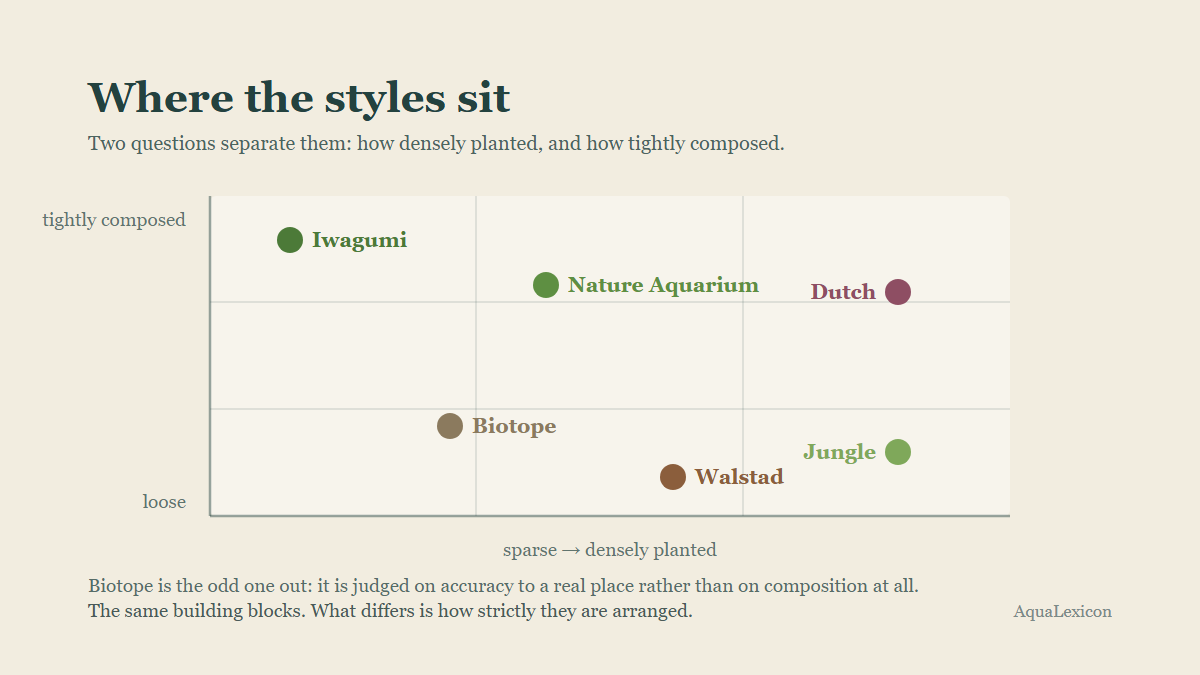
Hardscape. A Nature Aquarium is built around rock and driftwood arranged to evoke a landscape, with plants supporting that structure. A Dutch tank uses no hardscape at all. The plants are the design, arranged like beds in a formal garden rather than a wild scene.
Sources: Fin & Stem, A history of aquascaping; Tropica, Rotala rotundifolia; Tropica, Ludwigia repens 'Rubin'; Tropica, Alternanthera reineckii 'Rosanervig'; Tropica, Bacopa caroliniana.