
The rule of thirds in aquascaping means dividing the tank into three parts each way and placing your main stone or wood where those lines cross, rather than in the middle. It is borrowed from photography and painting, and it is the quickest way to stop a layout looking static.
How it works
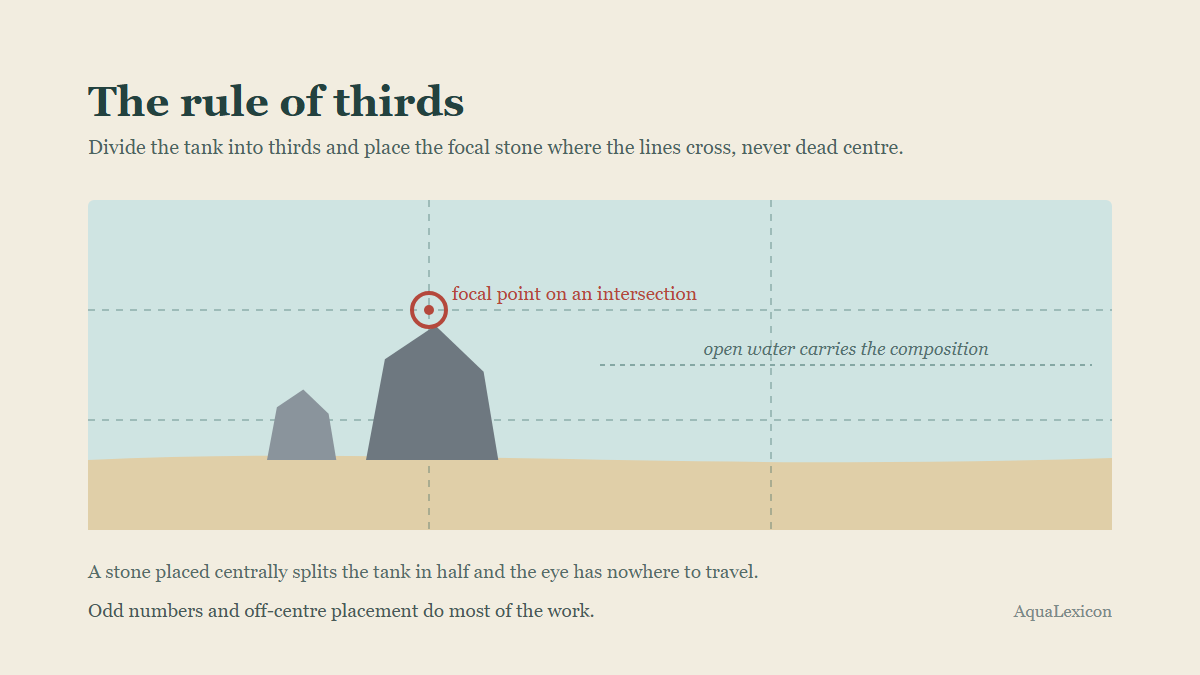
Picture two vertical lines and two horizontal lines across the front glass, splitting the view into nine. The four points where those lines meet are where the eye naturally settles. Put your subject on one of them.
Why centre is the weak spot
A stone placed dead centre splits the tank into two equal halves. Neither half is more interesting than the other, so the eye has nowhere to travel and the layout reads as a diagram rather than a landscape.
Off-centre placement creates an imbalance the eye wants to resolve, and resolving it is what makes someone look for longer. That is the whole mechanism.
Where you will see it
Iwagumi is the clearest example. The style uses an odd number of stones precisely so the arrangement can never fall into symmetry, and the Oyaishi, the main stone, sits about a third of the way across rather than in the middle.
It works alongside two related ideas. Negative space is what fills the two thirds you have not planted, and the focal point is what the placement is trying to create.
Treat it as a starting point
It is a rule of thumb rather than a law, and plenty of good scapes ignore it. But it is a reliable default when a layout feels wrong and you cannot say why, and moving the main stone off centre fixes more compositions than any other single change.
Composition questions
Does the rule of thirds apply to planting as well as hardscape?
Yes, though hardscape matters more because it sets the structure before anything is planted. Tall plants placed on a third line rather than centrally follow the same logic.
What is the golden ratio in aquascaping?
A slightly different proportion used for the same job, placing the focal point at roughly 0.618 of the width rather than a clean third. In a tank the two land close enough together that the practical advice is identical: off centre, and not by a small amount.
Can you break the rule of thirds?
Regularly. A deliberately symmetrical layout can work when the symmetry is the point. The rule is worth knowing so that breaking it is a decision rather than an accident.