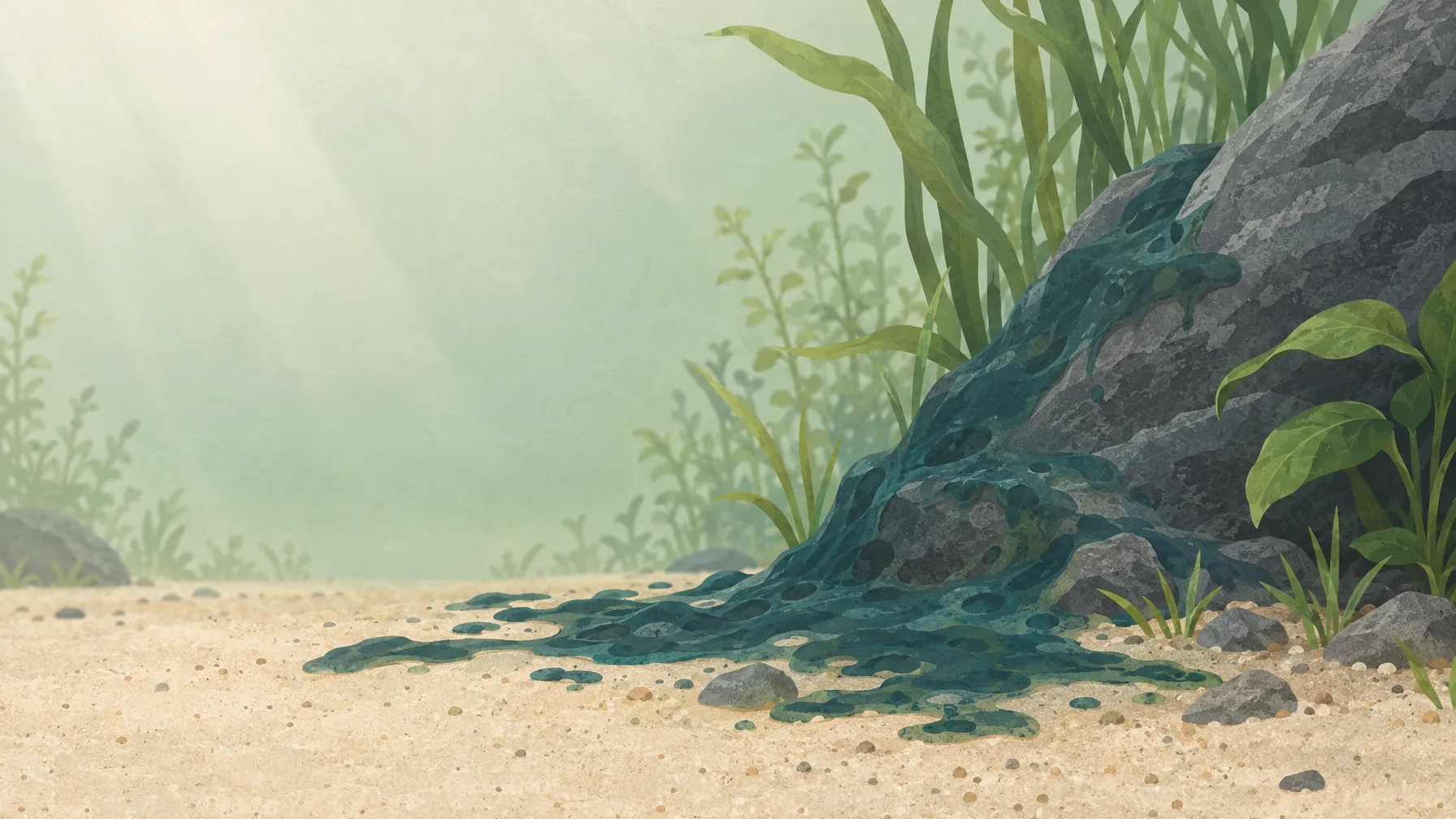
Cyanobacteria, sold to hobbyists as blue-green algae or slime algae, are bacteria rather than algae. They form slimy dark green to near-black coats on plants, hardscape and substrate that lift off easily. The sources disagree on what causes them, so check nutrients, flow, temperature and feeding before you reach for any treatment.
How to recognise it
Aquasabi and Aquarium Science agree it isn’t an alga at all: cyanobacteria are bacteria that photosynthesise. In the tank they show up as dark green, blue-green or almost black coats that feel slimy. Aquarium Science adds that they can also be yellow-green, reddish brown or purple.
Two quick tests help. It doesn’t attach firmly, so Aquasabi says small patches siphon straight off, unlike most true algae. Smell is less reliable: Aquasabi calls the foul, earthy odour characteristic, but Aquarium Science says it is very common for it to have no smell at all. A small patch where the substrate meets the front glass is normal, in Aquasabi’s view, and nothing to worry about. If what you have is green threads, see hair algae. Dark, bristly tufts that grip hard are black beard algae.
What causes it
There is no single agreed cause. Each source points somewhere different, and they overlap on only one thing: high phosphate.
| Suspected cause | Who says so |
|---|---|
| High phosphate, sometimes with low nitrate | Aquasabi; Aquarium Science lists high phosphate too |
| Too few competing microbes, most often in a new tank | Aquasabi |
| Overfeeding in fish tanks | Tropica |
| Low flow, high temperature and low oxygen | Aquarium Science |
| Old aqua soil that has crumbled and compacted | ADA |
Aquarium Science adds two caveats: some outbreaks happen with none of these present, and cyanobacteria are found almost everywhere, so you can’t keep them out of a tank entirely.
How to get rid of it
- Siphon it off during a water change. Small patches come away easily.
- Feed less. Tropica says less intense feeding usually makes it disappear again.
- Raise flow and oxygen, and lower the temperature. Aquarium Science’s fix is more water movement, a cooler tank, surface agitation, and large water changes to bring phosphate down. It says a 95% water change is harmless to fish.
- Check the substrate. ADA says blue-green algae can grow in aqua soil that has crumbled and packed down, and the answer then is to rebuild the substrate. Our aquasoil page covers how soil breaks down.
For a stronger infestation, Aquasabi recommends a blackout: siphon off as much as you can, switch off CO2 and liquid fertiliser, keep the tank well aerated, and keep it dark for no more than 7 days if it holds stem and carpet plants, or up to two weeks if it mostly holds shade plants.
Treatments the sources argue about
Three treatments come up, and each has a source against it. Aquasabi recommends bacteria products to restore the microbial balance, which Aquarium Science calls a myth. Aquasabi uses hydrogen peroxide as a last resort. Aquarium Science says never to use chemicals other than antibiotics on cyanobacteria, and warns that antibiotics only work for a while and can spike ammonia and nitrite in an established tank.
Aquarium Science’s conclusion is the one to hold on to: any treatment gives only temporary respite, and the cyanobacteria come back unless you remove the cause.
Keeping it away
Change water regularly: Aquasabi recommends around 50% a week to stop nutrient spikes. Keep feeding moderate, keep the tank within the 20 to 26°C range Aquarium Science gives as ideal for plants and fish, and keep water moving across the substrate. In a soil tank, replace the soil once it has broken down.
Blue-green algae questions
Is blue-green algae actually algae?
No. Both Aquasabi and Aquarium Science say it is a bacterium, cyanobacteria, that photosynthesises like a plant.
Does a blackout kill blue-green algae?
Aquasabi recommends a blackout for stronger infestations, with CO2 and fertiliser off and the tank well aerated, for no more than 7 days in a tank with stem and carpet plants. Remove as much as you can by siphon first.
Why does blue-green algae keep coming back?
Because the cause is still there. Aquarium Science says chemicals and antibiotics give only temporary respite. Look at phosphate, feeding, flow, oxygen and temperature, and at the state of the substrate.
Sources: Aquasabi, Blue-green algae (BGA); Aquasabi, Algae in the aquarium; Aquasabi, Black-out treatment; Aquasabi, Treatment with hydrogen peroxide; ADA, Aqua Soil Amazonia (via Aquasabi); Tropica, Types of algae; Aquarium Science, Blue-green algae; Aquarium Science, Algae in high tech tanks.