The easiest way to start aquascaping is to keep it low-tech: a modest tank, hardy plants that don’t need CO₂, and a simple light. Get a feel for how plants actually grow before chasing carpets and pressurised gas. This guide covers the choices that genuinely matter for a first planted tank, plus the beginner mistakes worth dodging.
Start low-tech
Resist the urge to buy everything at once. A low-tech setup (no CO₂, modest lighting, hardy plants) teaches you the fundamentals cheaply and forgives mistakes. You can always upgrade later. You can’t un-spend the money on gear you didn’t need. The jungle style and the Walstad method are both built for exactly this kind of relaxed, low-tech start.
Pick forgiving plants
Begin with hardy, low-light species that don’t need CO₂ and shrug off beginner errors:
- Anubias: slow, tough, attaches to wood or rock, and almost impossible to kill.
- Java fern: another hardy epiphyte that needs no substrate and little light.
- Cryptocoryne wendtii: an undemanding rosette that Tropica says thrives in almost all conditions. It may lose leaves after planting before it settles.
- Floating plants: they draw nutrients from the water and shade the tank, which helps while it finds its feet.
Notice what’s not on that list: carpet plants. Tropica rates dwarf hairgrass easy, but the finest lawns, HC Cuba and Glossostigma, are advanced plants, so save those for tank two. Before you buy any plant, the plant ratings chart shows its light, CO₂ and difficulty ratings in one place.
The basics: tank, substrate, light
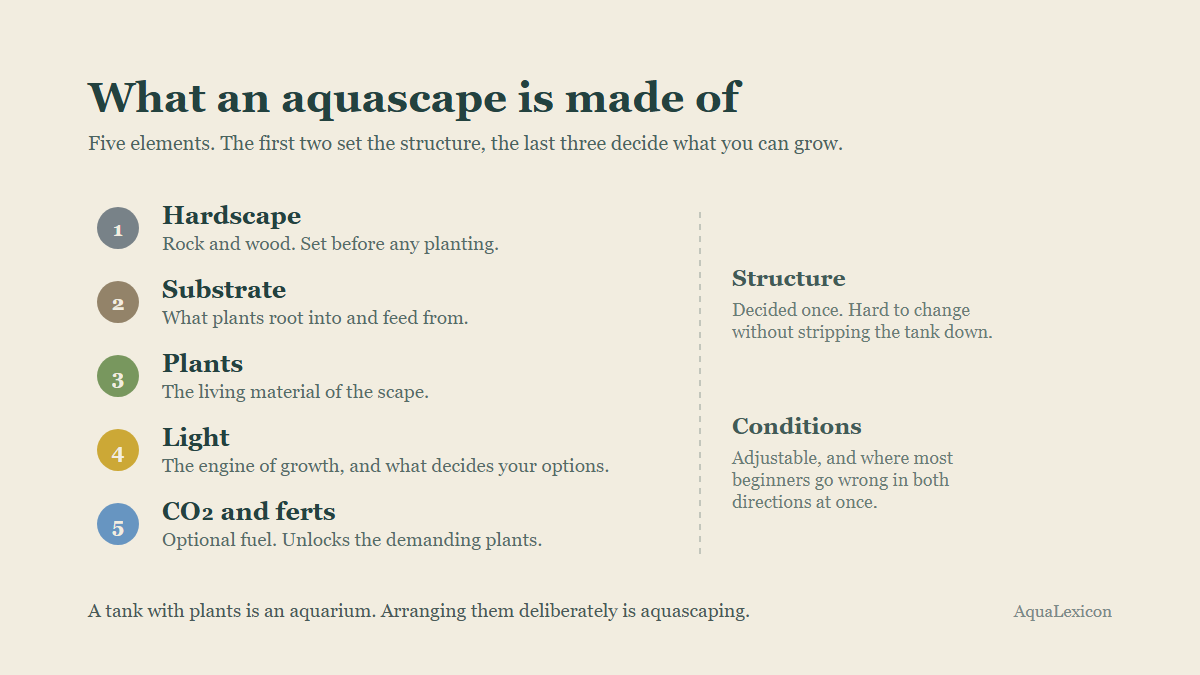
A wider tank beats a tall one, with more floor area to plant and easier lighting. A nutrient aquasoil gives root-feeders a real head start over plain gravel. And keep the light moderate at first: too much light over a new, lightly planted tank is the fastest route to an algae problem.
Mistakes beginners make
- Too much light, too soon. Bright light with few plants feeds algae, not your scape.
- Demanding carpets first. Starting with HC Cuba or Glossostigma, which Tropica rates advanced with a high CO₂ demand, is the quickest way to a patchy carpet.
- No patience. A new tank needs to cycle and settle. Rushing fish in or judging it after a week is the classic error.
- Overstocking. Too many fish too fast overwhelms a young tank’s balance.
Beginner questions
What’s the cheapest way to start aquascaping?
A low-tech tank with hardy plants and no CO₂. Skip pressurised gas and high-end lighting at first. A modest light, some Anubias and Java fern, and patience will get you a good-looking planted tank for very little.
Do you need CO₂ for a beginner planted tank?
No. Many hardy plants have a low CO₂ demand. CO₂ only becomes necessary for plants rated high, such as HC Cuba and Glossostigma, not for a first low-tech tank.
How long before a new aquascape looks good?
Usually a couple of months. Plants need time to root, grow in and fill out, and the tank needs to find its balance. The patience to wait through the awkward early weeks is half the skill.
Sources: Tropica, Anubias barteri var. nana; Tropica, Microsorum pteropus (Java fern); Tropica, Cryptocoryne wendtii 'Green'; Tropica, Limnobium laevigatum; Tropica, Eleocharis acicularis; Tropica, Micranthemum callitrichoides 'Cuba'; Tropica, Glossostigma elatinoides; Aquasabi, Appearance of in-vitro plants.