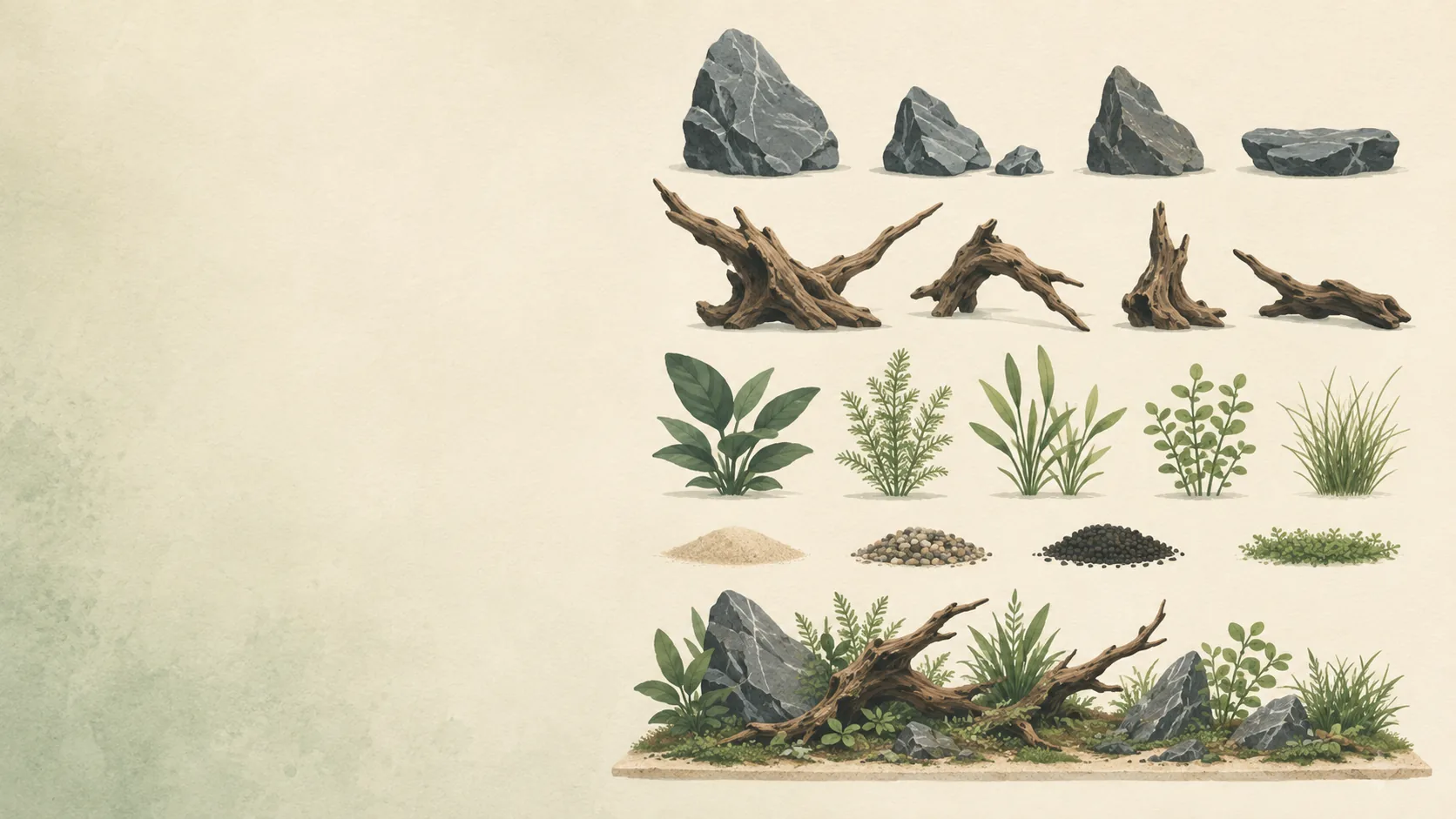
This aquascaping glossary is an A–Z of the terms you will meet in the hobby, covering the styles, plants, hardscape and gear, each with a plain-English definition and a link to the full explainer. Start anywhere, or follow the links through to the pages that cover a term in depth. New entries are added as the library grows.
A–Z of aquascaping terms
- Amazon sword: large, hardy background rosette plant.
- Anubias: slow-growing rhizome plant for wood and rock that thrives even in shade.
- Aquasoil & substrate: the nutrient-rich base plants root into.
- Biotope: a tank recreating one real-world habitat faithfully.
- Black beard algae: tufty dark algae linked to low CO₂ and slow growth.
- Bucephalandra: slow epiphyte grown attached to rock and wood.
- Carpet plants: low, spreading plants that form a lawn across the floor.
- CO₂ injection: added carbon dioxide for faster, denser plant growth.
- Cryptocoryne wendtii: easy rosette plant that may lose leaves after planting.
- Dragon stone (Ohko): knobbly, largely inert aquascaping rock.
- Dutch style: dense, hardscape-free planted garden.
- Dwarf baby tears (HC Cuba): tiny, demanding carpet plant needing high light and CO₂.
- Dwarf hairgrass: easy, grassy carpet plant.
- Floating plants: surface plants that shade the tank and absorb nutrients.
- Focal point: the spot a layout draws the eye toward.
- Iwagumi: minimalist, stone-only Japanese layout.
- Java fern: hardy epiphyte fern attached to wood.
- Java moss: easy moss tied to hardscape.
- Jungle style: wild, overgrown, low-maintenance look.
- Lighting & PAR: light intensity that drives plant growth.
- Monte Carlo: round-leaved carpet plant rated medium difficulty.
- Nature Aquarium: naturalistic landscape style pioneered by Takashi Amano.
- Negative space: deliberate open areas that give a scape room to breathe.
- Plant melt: leaves dissolving after planting as a plant adapts.
- Rotala rotundifolia: undemanding stem plant that needs good light to turn red.
- Rule of thirds: a guide for placing the focal point off-centre.
- Seiryu stone: jagged grey limestone rock that raises water hardness.
- Spider wood: branchy driftwood used for canopy and tree effects.
- Aquascaping tools: the scissors, tweezers and kit for planting and trimming.
- Walstad method: low-tech, soil-based, hands-off approach.
Just starting out? Begin with what aquascaping is and the beginner’s guide.
Using this glossary
What are the most important aquascaping terms to learn first?
Hardscape, substrate and carpet cover most early conversations. Hardscape is the rock and wood that sets the structure, substrate is what the plants root into, and a carpet is the low, spreading planting across the floor of the tank.
Do I need to know the Latin plant names?
Not to get started, but they help when you buy. Trade names vary between shops and some plants are sold under more than one name, so the Latin binomial is the reliable way to check you are getting the species you meant to buy.
Where should a complete beginner start?
Read what aquascaping is for the overview, then the beginner’s guide for the practical choices. Come back to this glossary whenever a term turns up that you have not met before.
Sources: Tropica, Anubias barteri var. nana; Tropica, Cryptocoryne wendtii 'Green'; Tropica, Eleocharis acicularis; Tropica, Micranthemum tweediei 'Monte Carlo'; Tropica, Micranthemum callitrichoides 'Cuba'; Tropica, Rotala rotundifolia; Aquasabi, Appearance of in-vitro plants.