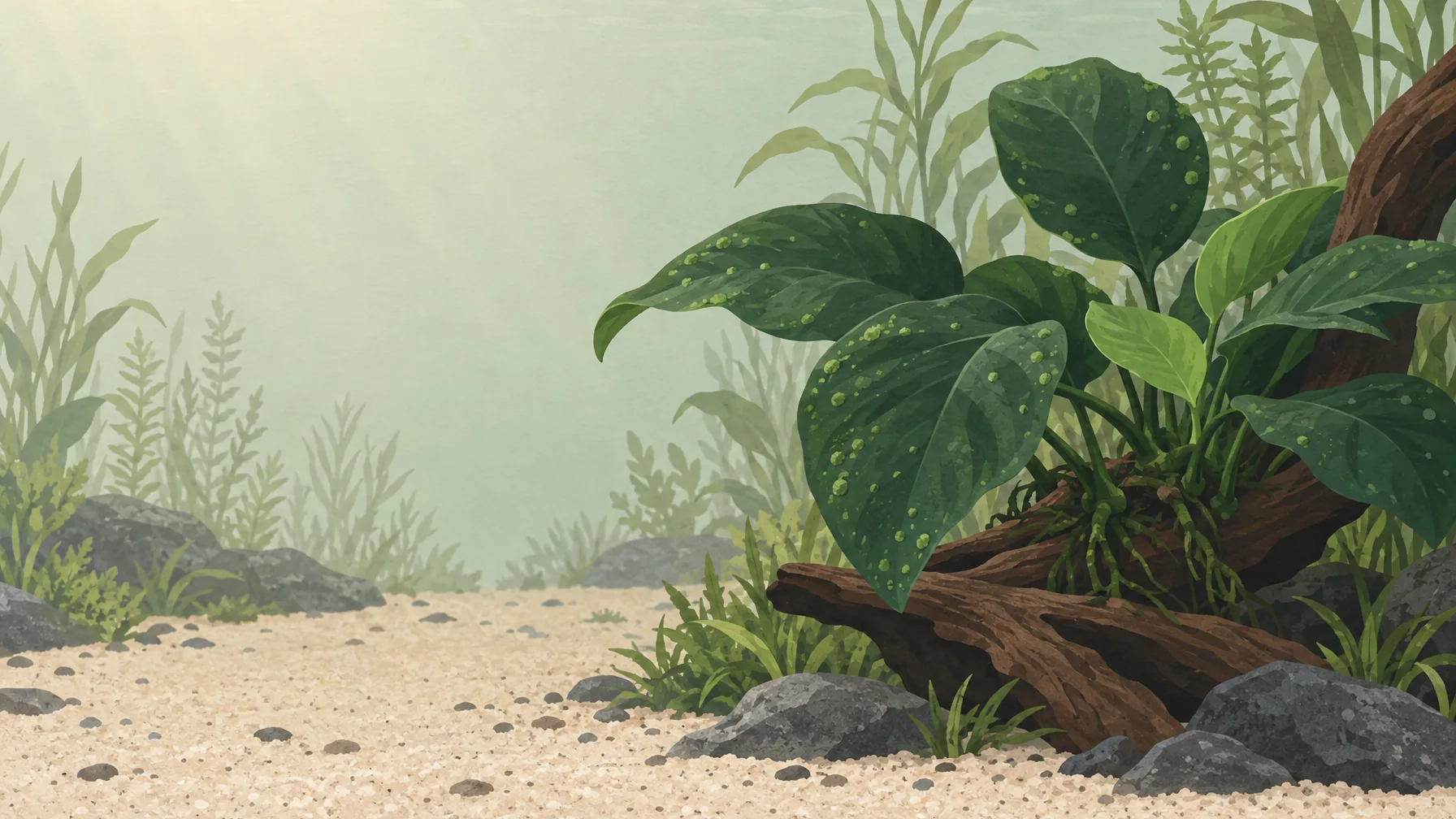
Green spot algae are the small, hard green dots that appear on aquarium glass and on slow-growing leaves like Anubias. Aquasabi links them to phosphate that is either too low or too high, and a blade scraper and snails keep them in check. Some always turn up, so the aim is control rather than zero.
How to recognise it
Aquasabi describes flat, tiny green spots that start out looking like polka dots and are attached very strongly. Given the chance, they widen into coats. They grow mostly on the glass, but also on equipment, decor and long-lived leaves, especially Anubias.
The test Aquasabi gives is how it comes off. Other green coats don’t start as distinct spots, and some wipe away with a finger. Green spot algae won’t: you need a blade. Aquarium Science disagrees on this point, saying it cleans off relatively easily and treating it as the same thing as green coat algae. Dark, bristly tufts on the same slow-growing leaves are black beard algae, which needs a different fix.
What causes it
Aquasabi finds it most often in strongly lit tanks, and says it usually appears when phosphate is too low or too high. It also notes that a shortage of phosphorus can cause spot algae to increase.
Aquarium Science adds a complication. It says green spot algae will grow slowly with almost no nutrients, and that it can also thrive under heavy fertilising. Treat phosphate as the first thing to check, not the only one.
How to fix it
Start with a phosphate test, then act on the reading. These are Aquasabi’s figures:
| Phosphate reading | What Aquasabi suggests |
|---|---|
| At the lower limit of the test | Add phosphate with a fertiliser |
| Around 0.1 to 1 mg/l | The recommended range for a planted tank |
| Around 3 mg/l or above | Bring it down with large water changes, or a phosphate-binding filter medium for a while |
If you already dose phosphate, Aquasabi says to cut the dose to match your readings. Then scrape the glass clean with a blade. That way any new spots show you whether the change has worked.
Snails do the rest. Aquasabi rates sun snails and nerite snails as the most efficient grazers for spot algae, rasping the hard coats off thoroughly.
Keeping it under control
Aquarium Science says green spot algae are found in every aquarium, so a few spots are normal. Aquasabi’s routine is to change around 50% of the water each week to stop nutrients building up, scrape the glass as part of weekly maintenance, and keep snails in the tank.
Green spot algae questions
Does green spot algae mean too much phosphate?
Not necessarily. Aquasabi says it appears when phosphate is too low or too high, and that a phosphorus shortage can make it spread. Test before you dose anything.
How do you remove green spot algae from glass?
Scrape it off with a blade cleaner. Aquasabi says spot algae are always hard to remove, which is one way to tell them from softer green coats that wipe off.
Do snails eat green spot algae?
Yes. Aquasabi rates sun snails and nerite snails as the most efficient algae eaters for spot algae. They rasp the hard coats off thoroughly.
Sources: Aquasabi, Green spot algae (GSA); Aquasabi, Algae in the aquarium; Aquasabi, Green algae coats; Aquasabi, Algae eaters; Aquasabi, Deficiency symptoms in aquatic plants; Aquarium Science, Green spot algae; Aquarium Science, Algae in high tech tanks.