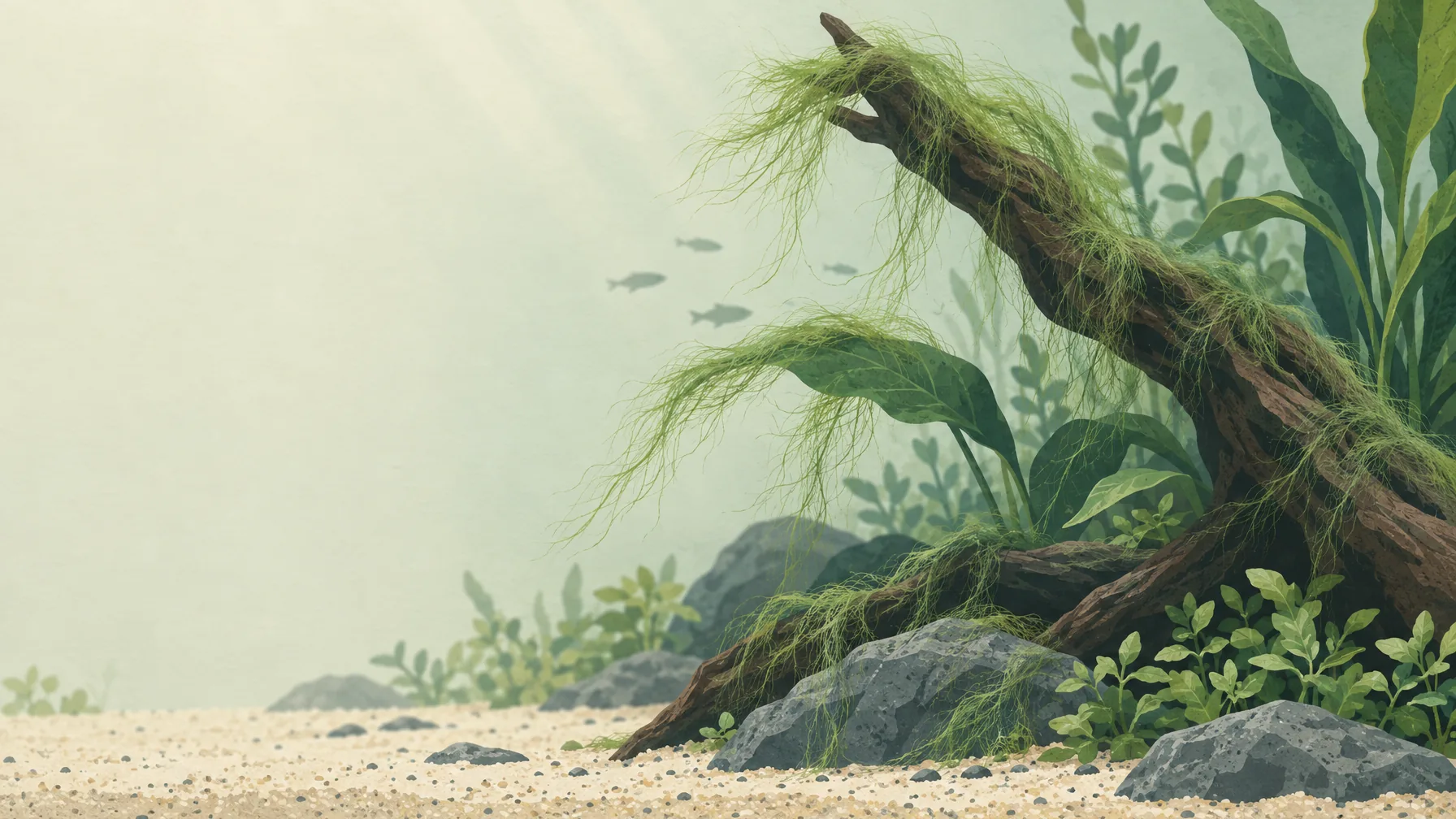
Hair algae is the green, hair-like growth that coats plants and hardscape, most often in a tank only a few weeks old. Aquasabi separates true hair algae, which anchors firmly, from loose thread algae, while other sources use the names for the same thing. The fix is the same for both: balance light, CO2 and nutrients, and add grazers.
Hair algae or thread algae?
The names get mixed up, and it matters a little for removal. Aquarium Science uses “thread algae, hair algae or green hair algae” interchangeably and warns that identifying the exact species is a guess. Aquasabi splits them by how they attach, which is a useful test in your own tank.
| Hair algae | Thread algae | |
|---|---|---|
| Growth | Carpet-like coats of short, dense filaments | Long, soft, loose threads in bushy cushions |
| Attachment | Anchors its base tightly | Doesn’t attach, wraps around plants |
| Spreads by | Growing over plants and decor | Fragments drifting in the current |
| Removal | Hard to pull off; cut infested leaves | Wind onto a rough skewer or siphon out |
One look-alike to rule out is Cladophora. Aquasabi describes it as short, rigid green filaments that branch in many places, with a smell like mushrooms. Two other growths get mistaken for it: a dark, slimy film that siphons straight off is cyanobacteria, and hard green dots on the glass are green spot algae.
What causes it
The most common trigger is a new tank. Aquasabi says hair algae appear mainly during the cycling phase, and that thread-like green algae usually follow the diatoms 3 to 4 weeks after set-up.
In an established tank it points to an imbalance. Aquasabi names a shortage of CO2 or nutrients, nitrogen in particular, along with lighting that is too strong or left on too long. A new, brighter light or extra daylight can set off a sudden outbreak, and so can slack maintenance. Tropica adds heat: temperatures above about 26°C almost always cause algae problems, and thread algae especially likes warmth. Its general rule for any algae is that overfeeding comes first.
How to get rid of it
- Remove what you can: cut off lightly infested leaves, wind thread algae onto a rough skewer, and siphon out loose nests during a water change.
- Fix the imbalance: check CO2 with a drop checker, which Aquasabi says to refill every four to six weeks, and top up nitrogen if plants have stalled. Our CO2 injection page covers reading one.
- Add grazers: Aquasabi calls the Amano shrimp the most efficient shrimp for filamentous algae, and Tropica suggests a large population of them for a while during an outbreak.
- Change more water: Tropica suggests 30% every second day for a period.
- Plant more: if the tank is sparsely planted, Aquasabi recommends adding healthy, fast-growing plants to compete.
A heavy infestation may need a blackout. Aquasabi turns off CO2 and stops liquid fertiliser, keeps the tank dark for up to two weeks if it mostly holds shade plants such as mosses, ferns, Anubias and Cryptocoryne, and no more than 7 days if it holds stem and carpet plants, then does a large water change. Tropica’s blackout, given for green water, is much shorter at 2 to 3 days. Start with the shorter one.
Chemicals are the last resort
The sources split here. Aquasabi spot-treats small patches with hydrogen peroxide and treats the whole tank with an algicide only as a last resort, warning that algicides can upset the tank’s microbial balance and harm some plants, and that at least one kills nerite snails. Tropica generally recommends not removing thread algae with chemicals, and Aquarium Science doesn’t recommend chemicals at all. If you go that way, follow the source’s own dosing exactly, and fix the cause first or it comes back.
Keeping it away
Plant heavily from the first day, with plenty of fast-growing stem plants. Keep the lights short in a new tank: Tropica starts at 6 hours a day for the first 2 to 3 weeks before moving to 8 to 10, and recommends never more than 10 hours, on a timer. Aquasabi adds that more light always needs more nutrients to match. For weekly water changes, Aquasabi recommends at least 50% and Tropica about 25% once a tank is established. Our lighting page covers choosing a level to begin with.
Hair algae questions
Do Amano shrimp eat hair algae?
Yes, the softer kinds. Aquasabi calls the Amano shrimp the most efficient shrimp for filamentous algae, and says ramshorn snails and most dwarf shrimp also eat softer hair algae.
Why does a new tank get hair algae?
Because the tank’s biology hasn’t settled yet. Aquasabi says hair algae appear mainly during the cycling phase and usually clear on their own once nutrients are balanced and enough algae eaters are in the tank.
How long should a blackout for hair algae last?
Sources differ. Tropica suggests 2 to 3 days. Aquasabi allows up to two weeks in a tank of shade plants but no more than 7 days if it holds stem and carpet plants. Either way, do a large water change afterwards, because the dying algae pollute the water.
Sources: Aquasabi, Hair algae; Aquasabi, Green thread algae; Aquasabi, Algae in the aquarium; Aquasabi, Cladophora; Aquasabi, Black-out treatment; Aquasabi, Treatment with hydrogen peroxide; Aquasabi, Algae eaters; Aquasabi, Fertilization during the cycling phase; Tropica, Types of algae; Tropica, Algae control; Tropica, Preventing algae; Tropica, Starting a new aquarium; Aquarium Science, Thread algae; Aquarium Science, Controlling aquarium algae.