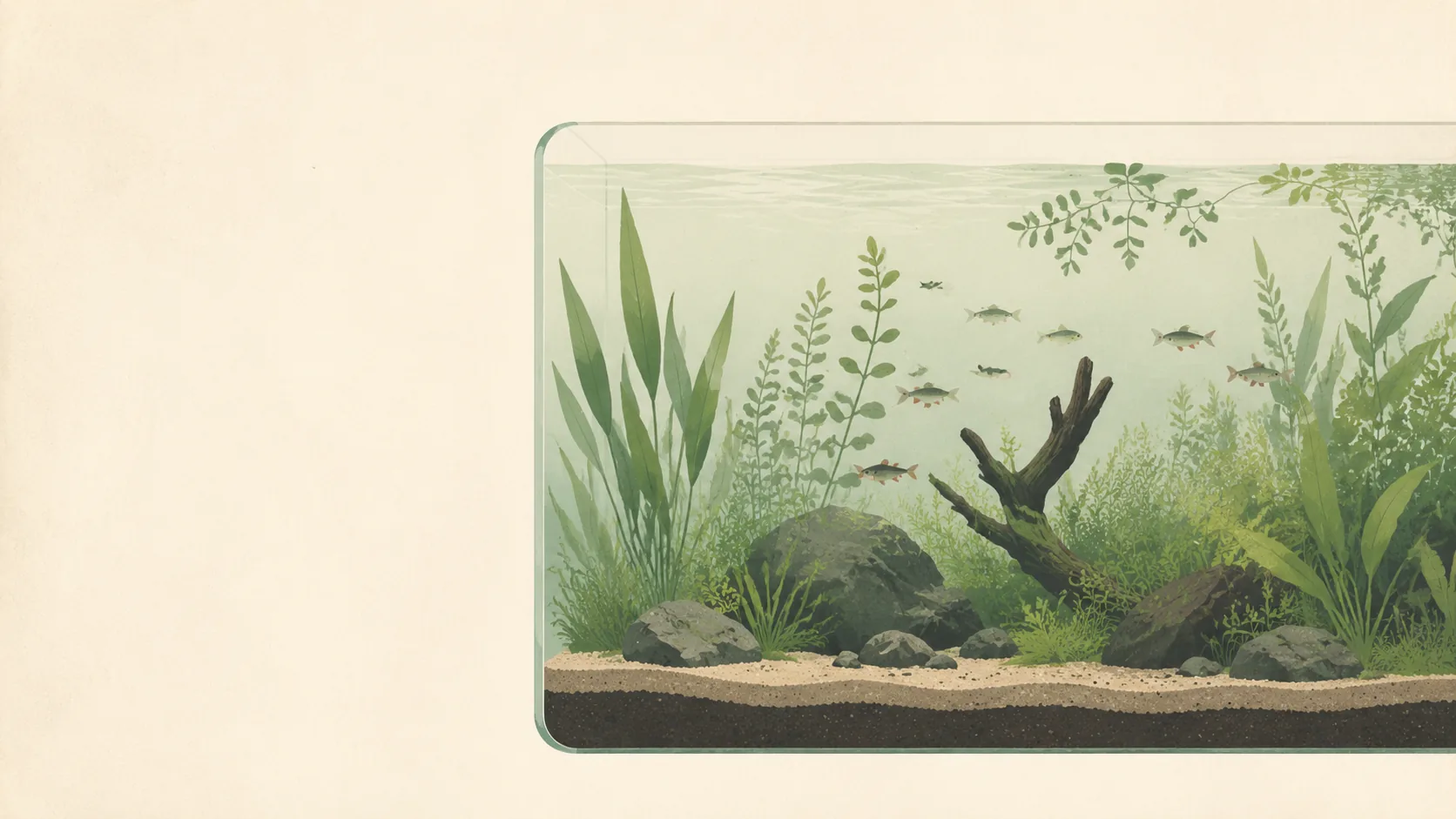
The Walstad method is a way of running a planted tank that largely looks after itself. Diana Walstad set it out in her book Ecology of the Planted Aquarium: ordinary soil under a thin cap, heavy planting from day one, and no CO₂ injection. Plants and soil bacteria, not filters and water changes, keep the water clean.
The idea
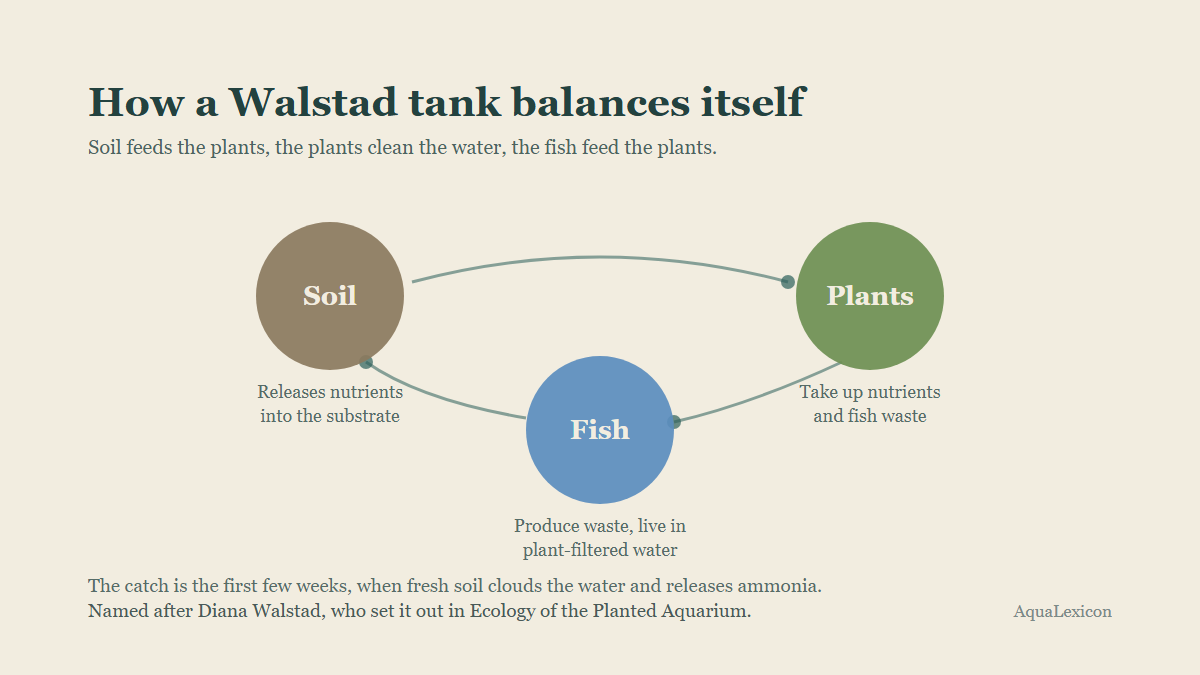
Walstad describes it in one line: “My method mimics nutrient-cycling in nature. It uses plants to keep the fish healthy by recycling fish wastes. In turn, fish and ordinary soil provide the nutrients that plants need.” Her book adds that well-fed fish mean the plants don’t need chemical fertilisers, and that bacteria and fish, not injected gas, supply the plants’ CO₂.
Get the balance right and there is little left to do. In the book she writes that her own aquariums often go six months or more without a water change, and that routine care comes down to topping up evaporated water and pruning.
How to set one up
- Soil: potting soil or ordinary garden soil, which Walstad says ideally shouldn’t be mixed or heavily fertilised. In a 2009 interview she recommended a 2.5 cm underlayer of unfertilised soil, and she warns that soil laid too deep can turn anaerobic and kill the roots.
- A thin cap: just enough sand or gravel to hold the soil down. Walstad says a thick gravel layer does little to stop the soil releasing things into the water, and makes problems more likely.
- Plants, lots of them, from day one: enough fast-growing species to soak up the soil’s early burst of nutrients. Floating plants help, and she calls frogbit vital for controlling algae in two of her tanks.
- No CO₂ injection and no chemical fertilisers: fish food and soil feed the plants.
- Enough light, not excess: Walstad says most submerged plants are shade plants and that excess light only stimulates algae. She runs a 12 to 14 hour day with a 2 to 4 hour lights-off “siesta” at midday, which she says helps control algae in tanks without CO₂.
Leave out driftwood that sits on the soil. Walstad skips it in her own tanks because it smothers the soil layer and shrinks the planted area.
The first few weeks
This is the part that decides whether the tank works. Walstad explains that submerged soil goes through “a temporary but explosive release of nutrients–including NH3 (ammonia)” in the first few weeks, and that this period of soil instability warrants frequent water changes. Test for ammonia and change water until it settles.
Cloudy water should not be part of it for long. In her account, the slight haze from newly flooded soil clears by the next day. Cloudiness that lasts is a warning sign. When a reader sent her a photo of a cloudy tank, she blamed a very thick gravel layer and a big piece of driftwood covering the soil, which were suffocating it. Our cloudy water page covers the other causes. The other warning sign is the plants. If they aren’t growing well within the first couple of weeks and algae takes hold, she says the tank may not succeed.
Plants that thrive
Stick to hardy, low-light species that don’t need CO₂:
- Anubias (Anubias barteri var. nana): thrives even in shade, and grows with or without added CO₂.
- Java fern (Leptochilus pteropus): low light, attaches to wood.
- Cryptocoryne wendtii: an easy rosette that may lose leaves after planting before it recovers.
- Floating plants such as Amazon frogbit (Limnobium laevigatum): they take up nutrients and shade the tank while it establishes.
- Bacopa caroliniana: a stem plant with few demands and slow growth, rated low for CO₂ by Tropica.
Walstad’s own experience matches this list, with a caveat. She says Anubias nana, Cryptocoryne wendtii and Java fern take longer to establish but grow well once they do, so pair them with fast growers for the first weeks. The plant ratings chart lets you filter for the low-CO₂ options.
The trade-offs
It is low-effort once established, but the start needs attention, and it is not an instant display tank. You trade the control and vivid colour of a high-tech Dutch layout for simplicity, and the demanding species in our carpet plants guide generally won’t thrive here without CO₂. If you want hands-off and natural, it suits you. If you want a manicured showpiece, look elsewhere. The substrate guide covers how soil compares with inert gravel.
Walstad method questions
Do you need CO₂ for a Walstad tank?
No. Walstad’s book says her low-tech aquariums have no artificial CO₂ injection. In her words, bacteria and fish provide the CO₂ the plants use.
Do you have to do water changes with the Walstad method?
At the start, yes. Walstad says a new soil tank goes through a temporary period of instability that warrants frequent water changes. Once it settles, very few: she writes that her own tanks often go six months or more without one.
Is the Walstad method good for beginners?
Yes, if you start small. Walstad recommends that beginners start with a one-gallon bowl or a 10-gallon tank, and says the plants you grow will then stock a larger one. Watch ammonia and plant growth closely in the first weeks, which is when these tanks succeed or fail.
Sources: Diana Walstad, Ecology of the Planted Aquarium, fourth edition (2023), preview chapter; Diana Walstad, Updating Ecology of the Planted Aquarium (2020); Diana Walstad, Small Planted Tanks for Pet Shrimp (2023); The Cichlid Stage, Diana Walstad interview (2025); Diana Walstad, 2011 interview; Acuario rosa, interview with Diana Walstad (2009); Tropica, Anubias barteri var. nana; Flowgrow, Anubias barteri var. nana; Tropica, Microsorum pteropus (Java fern); Tropica, Cryptocoryne wendtii 'Green'; Tropica, Limnobium laevigatum; Tropica, Bacopa caroliniana; Aquasabi, Appearance of in-vitro plants.