
Dwarf hairgrass (Eleocharis acicularis) is a grassy carpet plant that spreads by runners into a fine, lawn-like foreground. It’s a popular Iwagumi carpet, but it comes with one firm condition: it needs strong light reaching the substrate, or it grows tall and sparse instead of carpeting flat.
Conditions it wants
- Latin name: Eleocharis acicularis
- Type: carpet / foreground
- Light: high
- CO₂: required for a true carpet
- Difficulty: medium
- Growth rate: medium
Growing dwarf hairgrass
Split it into small clumps and plant them spaced out across the substrate, and they fill the gaps by sending out runners. A nutrient substrate helps it establish. Trimming the tips encourages it to spread sideways rather than upward. It pairs naturally with an Iwagumi layout, where a single low carpet sets off the stones.
Getting it to carpet, not grow tall
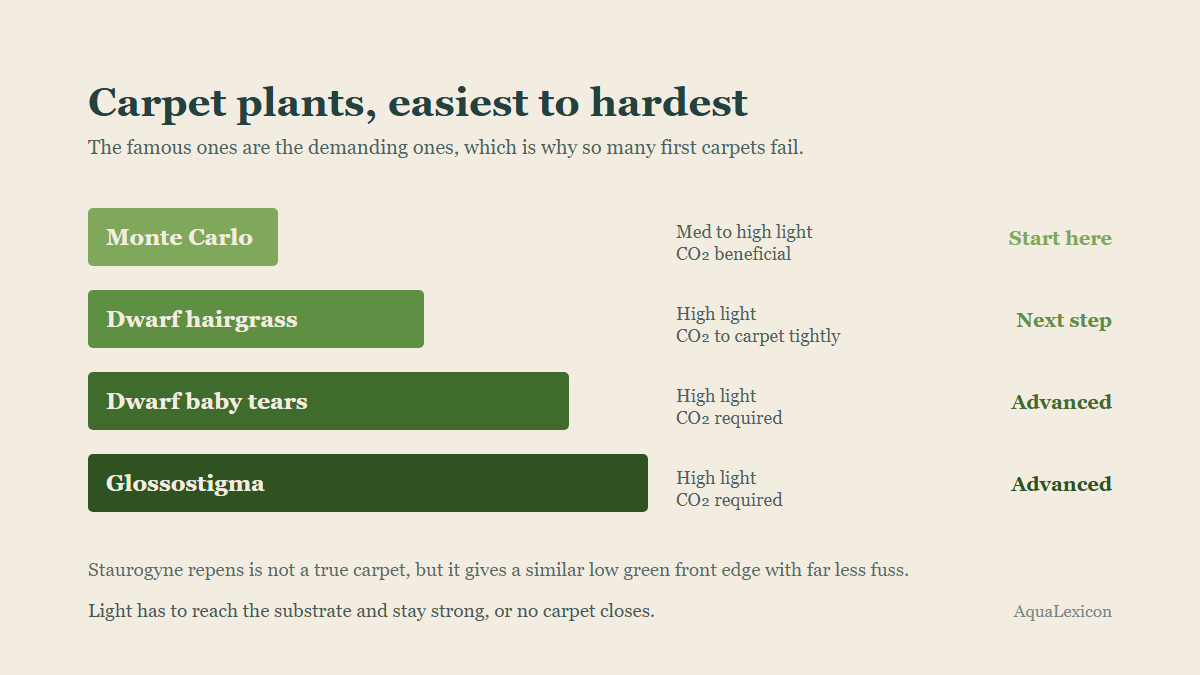
This is the make-or-break point. Dwarf hairgrass won’t carpet tightly without CO₂, and it needs high light reaching the floor. Give it both and it stays low and dense. Starve it of either and the blades stretch upward, thin out and the carpet never closes. If yours is growing tall and patchy, light to the substrate and CO₂ are the first things to check.
Dwarf hairgrass questions
Does dwarf hairgrass need CO₂?
For a true, tight carpet, yes. It will grow without CO₂, but tends to come in taller and looser rather than forming the dense low lawn it’s grown for.
Why is my dwarf hairgrass growing tall instead of spreading?
Almost always too little light reaching the substrate, or no CO₂. Both push the plant to grow upward in search of light rather than spreading flat. Stronger lighting and CO₂ usually fix it.
Dwarf hairgrass or Monte Carlo?
Hairgrass gives a grassy texture, Monte Carlo a leafy one. Both are medium difficulty, but Monte Carlo is a touch more forgiving on light and CO₂, so it’s often the easier first carpet. See the carpet plants guide to compare.