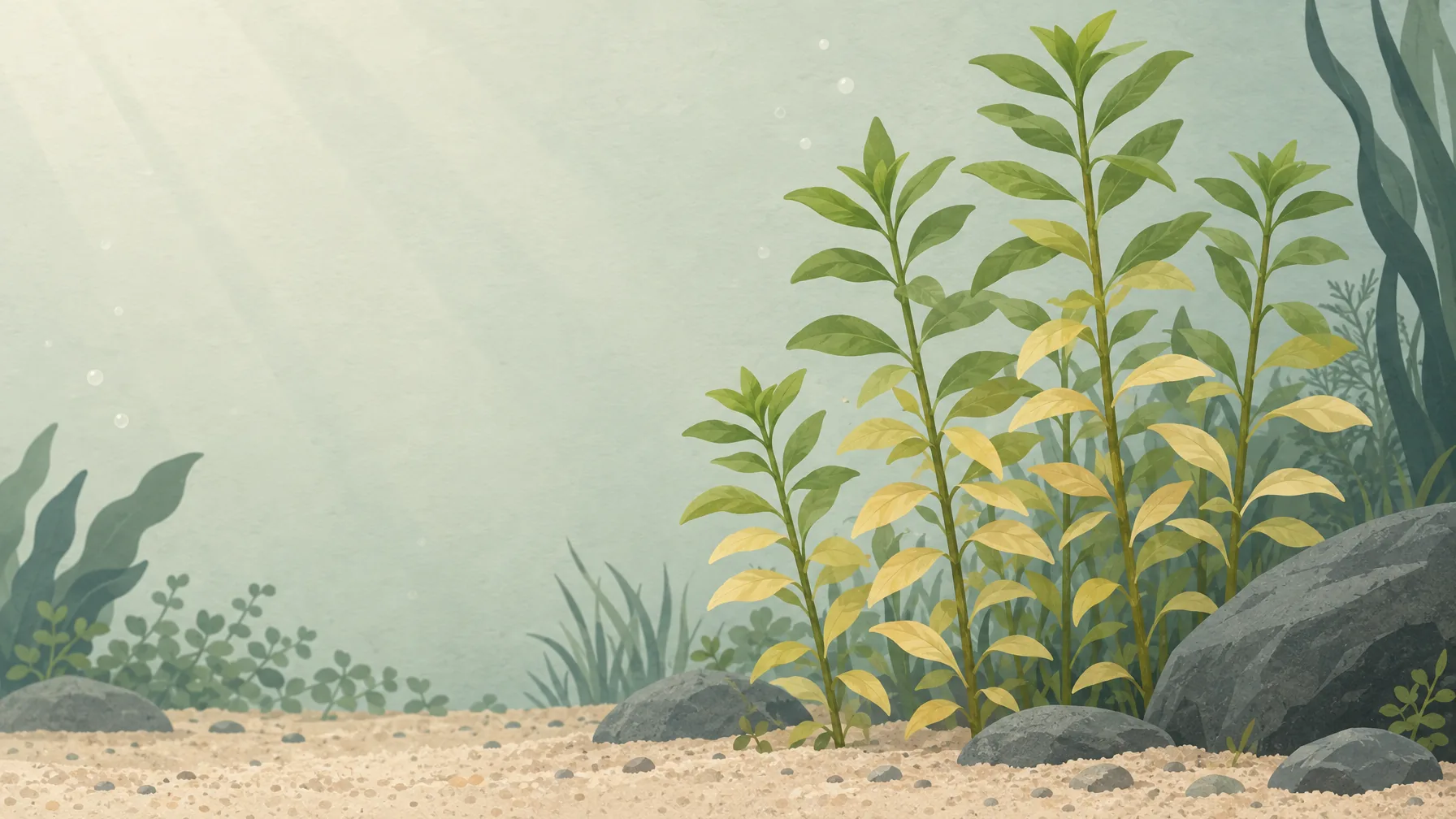
Aquarium plants turning yellow usually lack a nutrient, and where the yellow appears narrows down which. Aquasabi says to rule out a CO2 shortage first, then look at older leaves for nitrogen, magnesium and potassium and at new growth for iron. New plants dropping the leaves they grew above water is a common false alarm.
Check these first
Not every yellow leaf is a deficiency. Aquarium Science points out that many plants are grown with their leaves in air, and those leaves typically die back once submerged and are replaced by new ones. That is normal in a new tank; our plant melt page covers it. Aquasabi adds that some pure white LEDs make bright greens look pale, which can pass for yellowing.
Then rule out CO2. Aquasabi says most deficiency patterns, yellow leaves included, can also be caused by a carbon shortage, so it should be considered before any other nutrient. Tropica agrees that insufficient CO2 can leave plants stunted or discoloured.
Old leaves or new growth?
Where the yellow starts is the clue. Nutrients a plant can move are drawn into new growth, so their shortage shows in older leaves first. Nutrients it can’t move show in new growth first. The patterns below are Aquasabi’s.
| Where | What you see | Likely shortage |
|---|---|---|
| Older leaves | Overall yellowing; new leaves come in smaller, some species redden | Nitrogen |
| Older leaves | Pale or yellow, with the veins staying green | Magnesium |
| Any leaf | Small black dots that become holes edged in yellow or black | Potassium |
| New shoots | Tips turning yellow to white, clearest on fast stem plants | Iron |
| Shoot tips | Very slow growth and shrinking tips, sometimes darker or violet | Phosphorus (not yellowing) |
Aquasabi warns that these patterns overlap, so treat a diagnosis as a best guess and change one thing at a time. Aquarium Science pairs yellow new leaves with nitrogen instead, which contradicts both Aquasabi and the general rule above.
How to fix it
- CO2: check it with a drop checker, and replace the fluid every four to six weeks, as Aquasabi advises. Our CO2 injection page explains the colours.
- Nitrogen or potassium: test and top up. Aquasabi gives optimal ranges of about 10 to 25 mg/l of nitrate and 5 to 10 mg/l of potassium, and warns that most nitrate tests are hard to read. If several macronutrients are short, it suggests a combined macro fertiliser.
- Iron: add a little more complete iron fertiliser. Don’t overdo it: Aquasabi warns that too much can encourage red algae such as black beard algae.
- Light: if only one group of plants is affected, Aquasabi says shading by other plants or decor is a common cause.
Go gently with fertiliser. Tropica’s advice is to start below the recommended dose and raise it as the plants respond.
Preventing it
New plants arrive with nutrients from the nursery. Tropica uses no fertiliser, or only a little, for the first 3 to 4 weeks. Aquarium Science waits much longer, typically three to six months. After that, match fertiliser to light: Aquasabi says more light raises nutrient demand, and an imbalance follows if you don’t top up. Plants Tropica rates medium or advanced need added CO2; the plant ratings chart lets you check yours. And remove dead leaves, which Tropica says can feed nutrient imbalances and algae.
Yellowing leaves questions
Why are my aquarium plants turning yellow?
Usually a nutrient shortage, though Aquasabi says to rule out a lack of CO2 first. Yellowing in older leaves points to nitrogen, magnesium or potassium, and yellowing in new shoots points to iron.
Why are the new leaves on my aquarium plants yellow?
Aquasabi links yellow-to-white new shoots to iron deficiency, clearest on fast-growing stem plants. Adding a little more complete iron fertiliser usually fixes it.
Should I remove yellow leaves?
Remove leaves that are dead or decaying. Tropica says decaying plant matter can contribute to nutrient imbalances and algae. On new plants, expect some leaves grown above water to die back before new underwater leaves replace them.
Sources: Aquasabi, Deficiency symptoms in aquatic plants; Cornell University, Macronutrient mobility; Tropica, Care; Tropica, Fertiliser and CO2; Tropica, FAQ; Tropica, Starting a new aquarium; Aquarium Science, Planted aquariums in depth; Aquarium Science, Estimative index; Aquarium Science, Algae in low tech tanks.