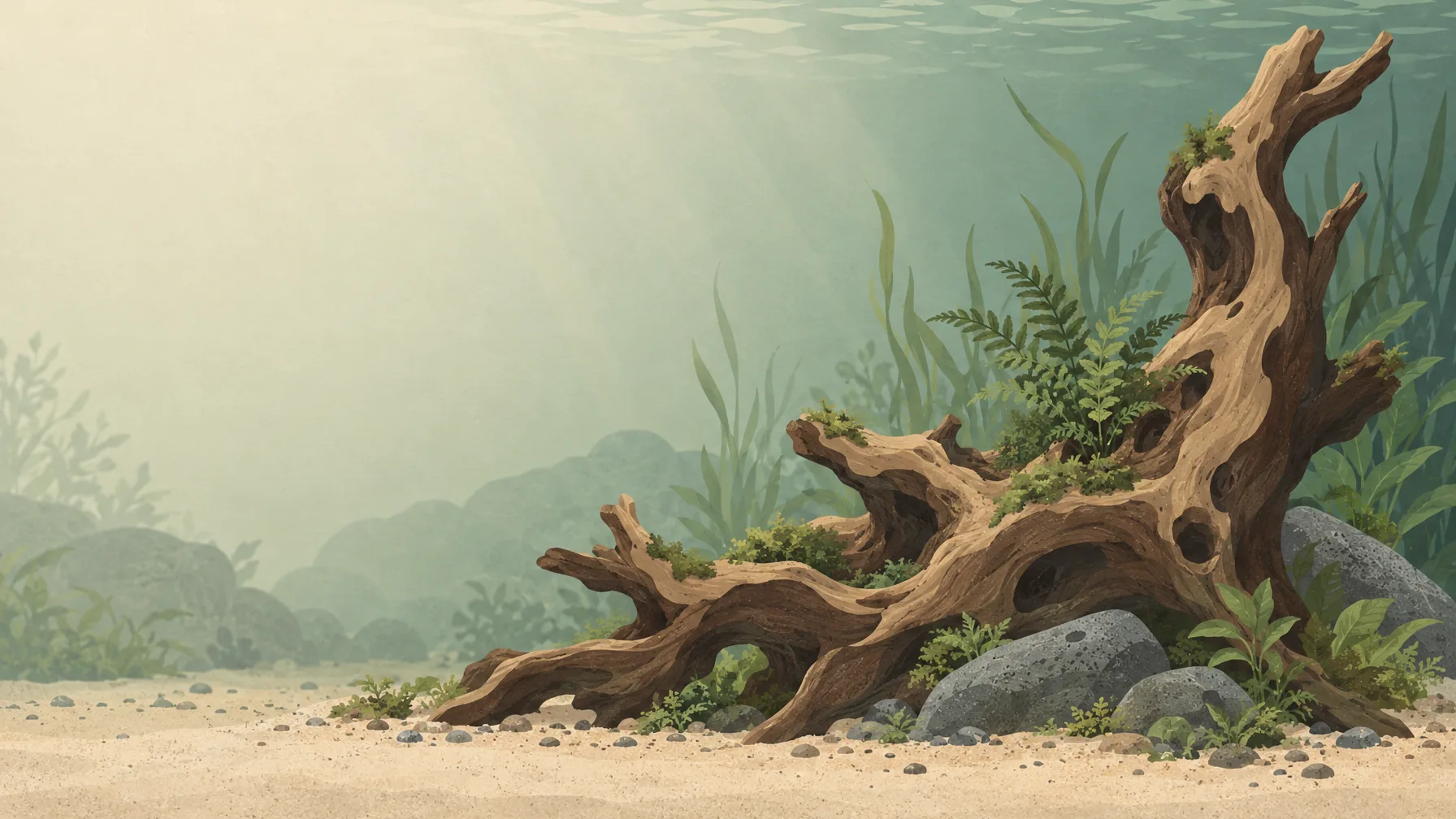
Mopani wood is a dense, two-tone African hardwood that sinks almost straight away and lasts for years underwater. The catch is tannin: most sources say it stains water brown more than most aquarium woods, though Aquasabi says only slightly. Soaking it for a week or two before use takes the worst out.
What mopani is
Mopani comes from the mopane tree, Colophospermum mopane, which the Wood Database, a timber reference, places in southern Africa. Tannin Aquatics lists its range as South Africa, Zimbabwe, Mozambique, Botswana, Zambia, Namibia, Angola and Malawi, and says the tree occurs only in Africa, in hot, dry places on alkaline soils. Aquasabi and Terrarium Tribe both describe the aquarium pieces as root wood.
It is very hard. The Wood Database calls mopane difficult to work, “mainly on account of its incredibly high density”, and Aquasabi classes it as a hardwood.
The two-tone look
Most pieces are two colours: Aquasabi describes yellow and brown, and Buce Plant, which also sells it, sandy tan and deep chocolate brown. Aquasabi says the two-coloured wood is partly sandblasted. The shape is gnarled and knotty, with little branching, which Tannin Aquatics says is the appeal: the texture and colour, more than the outline.
That makes it a centrepiece wood. Terrarium Tribe puts it this way: use mopani’s weight for the centrepiece and leave the fine accents to lighter woods such as spider wood and manzanita.
It sinks, usually
Mopani’s density is the reason people buy it. Aquasabi calls it “instantly-sinking”, Buce Plant says it typically sinks immediately, and Terrarium Tribe says soaking it to make it sink is rarely necessary. Aquasabi’s own listing adds a caveat: its pieces aren’t pre-soaked, so the time to sink can vary. Check each piece stays down before you build around it.
How much it stains the water
This is where the sources split.
| Source | What it says about mopani’s tannins |
|---|---|
| Aquasabi | Can stain the water slightly at first |
| Buce Plant | Very rich in tannins, giving a dark tea-coloured tint |
| Tannin Aquatics | Releases a lot, during curing and beyond. A roughly 10-inch piece browned a 20-gallon tank in a couple of days, even after a two-day soak |
| Terrarium Tribe | As far as driftwoods go, one of the worst for it |
The weight of opinion says to expect a noticeable tint. It is harmless: Terrarium Tribe calls the tint non-toxic, and Aquarium Science, writing about wood tannins in general, says they lower pH only very slightly, from about 7.4 to 7.3. Tannin Aquatics also warns that mopani keeps leaching for a long time, so a pre-soak reduces the tint rather than ending it.
How to prepare mopani
- Rinse and scrub. Tannin Aquatics suggests a good rinse and a light scrub with a soft brush to remove debris.
- Soak it. Tannin Aquatics soaks mopani for a week or two to draw out the first burst of tannins, and changes the soak water every few days.
- Clear what’s left. Small water changes plus activated carbon or a tannin-removing filter medium clear the water within a few days in most cases, according to Tannin Aquatics.
Boiling is the shortcut people ask about, and the sources disagree. Buce Plant recommends 1 to 2 hours for clear water. Terrarium Tribe reports people doing several 2 to 3 hour boils and still finding it leaching, and Tannin Aquatics prefers to soak and wait. Aquarium Science advises against boiling any wood, saying it only reaches the surface tannins and softens the wood. Our aquarium driftwood guide sets out the whole boiling debate.
Is it safe for shrimp?
Yes, according to Aquasabi. Mopani picked up a reputation for killing shrimp, and Aquasabi traced it to the sandblasting: some suppliers used blasting media unsuitable for invertebrates, and tiny metal fragments were found in the crevices. It says manufacturers now cater for shrimp keepers and that “it’s safe to say that Mopani is shrimp-proof”.
Two smaller points. Aquasabi says a bacterial film can appear on new mopani, and Tannin Aquatics says it occasionally gets a surface fungus, dealt with the same way as on manzanita. And plecos may pick at mopani, but Tannin Aquatics says they would rather chew something softer.
How long it lasts
Years. Tannin Aquatics says it lasts “years and years” in an aquarium, and Buce Plant says it breaks down much more slowly than other woods. As timber, the Wood Database rates mopane very durable and resistant to termites.
Tannin Aquatics raises one concern: mopane is a commercial timber used for flooring and furniture, and there is concern about how sustainably it is harvested. The Wood Database notes that the species isn’t listed by CITES or on the IUCN Red List.
Planting on mopani
The knots and crevices hold epiphytes well. Aquasabi suggests moss or ferns, and Buce Plant calls it a long-lasting base for both. Tie or glue Java fern, Anubias, Bucephalandra or Java moss into the gaps and let them take hold.
Mopani wood questions
Does mopani wood sink?
Usually straight away. Aquasabi calls it instantly sinking and Buce Plant says it typically sinks on arrival, because it is so dense. Aquasabi adds that its pieces aren’t pre-soaked, so the odd one may take longer.
How long should you soak mopani wood?
Tannin Aquatics suggests a week or two in fresh water, changing it every few days, to draw out the first burst of tannins. Expect some tint afterwards: it keeps leaching for a long time.
Is mopani wood safe for shrimp?
Aquasabi says yes. Old reports of shrimp deaths came from unsuitable sandblasting media leaving metal fragments in the wood, and it says manufacturers have long since fixed that.
Sources: Aquasabi, Driftwood in a tank with invertebrates; Aquasabi, Mopani Wood (shop listing); Tannin Aquatics, ‘Wood’ you believe this; Tannin Aquatics, ‘Wood’ you? Well, yes, I will; Terrarium Tribe, Mopani wood guide; Buce Plant, Mopani Wood (shop listing); The Wood Database, Mopane; Aquarium Science, Wood.