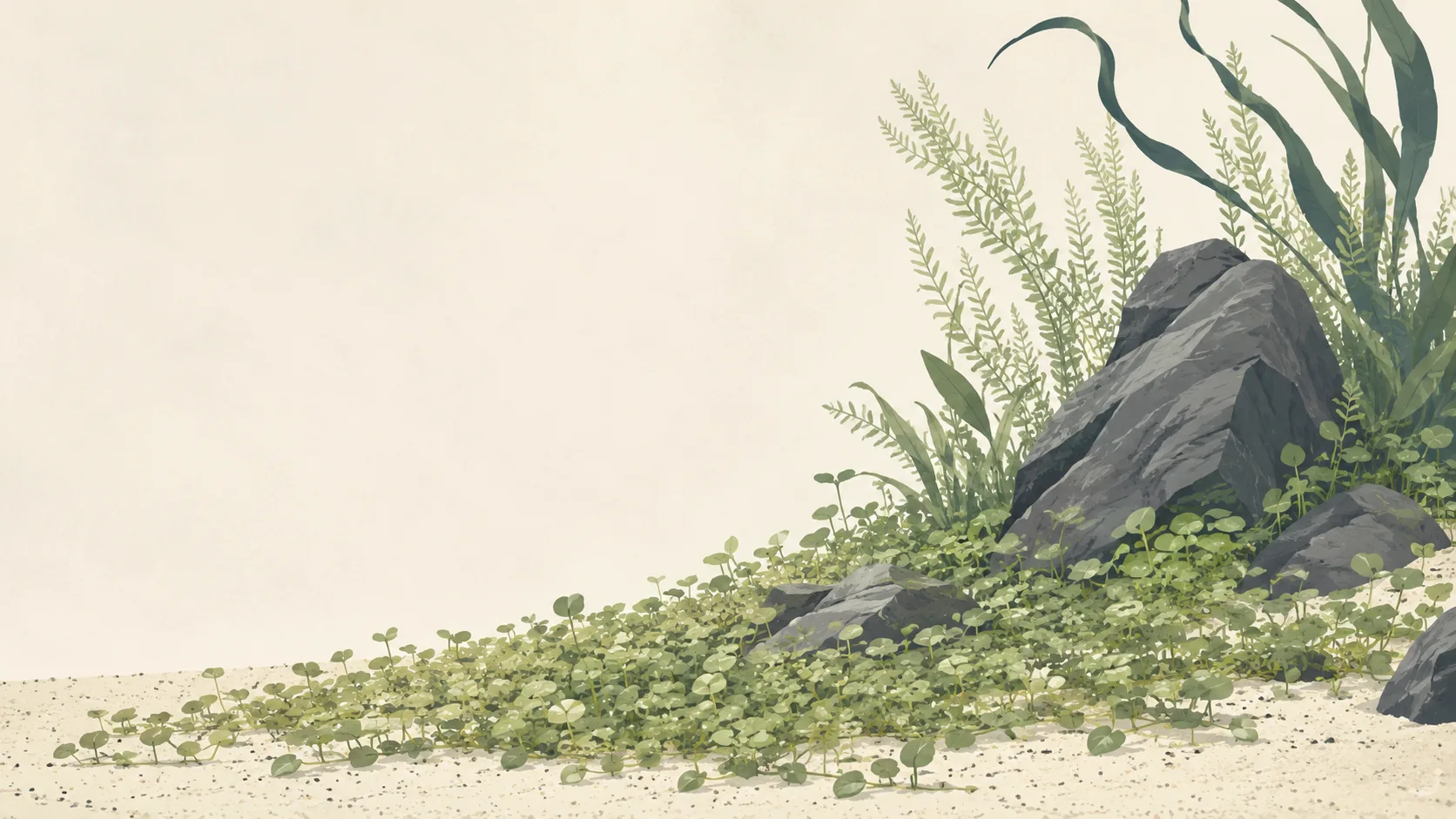
Carpet plants are the low, spreading species that cover an aquarium floor in green, the lawn-like foreground that makes a scape look finished. They’re also where beginners most often come unstuck, because the famous ones are the hardest to grow. The trick is choosing a carpet that matches your setup, not the one in the photo.
What makes a plant a “carpet”
A carpet plant stays low and spreads sideways by runners, knitting into a continuous mat across the substrate. That horizontal habit is the easy part. The hard part is that light has to reach all the way to the floor and stay strong there, which is why most true carpets want bright light and, usually, added CO₂.
The five, side by side
| Plant | Latin name | Light | CO₂ | Difficulty |
|---|---|---|---|---|
| Staurogyne repens | Staurogyne repens | Med–high | Beneficial | Easy–med |
| Monte Carlo | Micranthemum tweediei | Med–high | Beneficial→required | Medium |
| Dwarf hairgrass | Eleocharis acicularis | High | Required | Medium |
| Dwarf baby tears (HC Cuba) | Hemianthus callitrichoides ‘Cuba’ | High | Required | Advanced |
| Glossostigma | Glossostigma elatinoides | High | Required | Advanced |
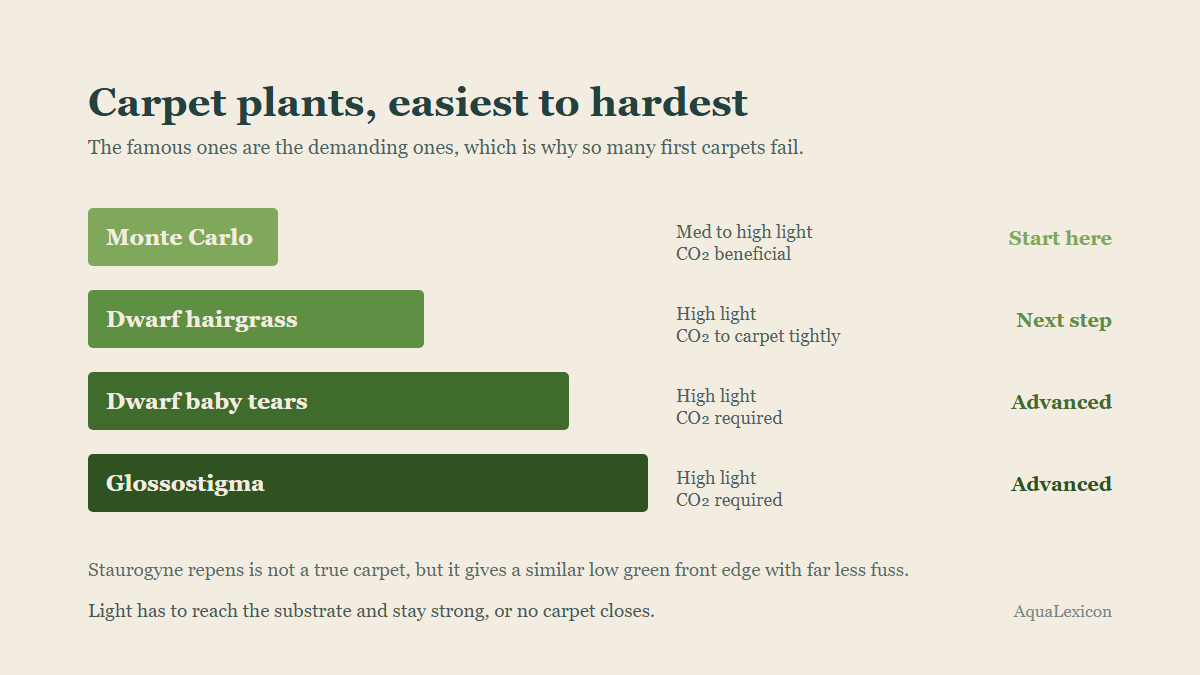
Start here
If you want a realistic first carpet, Monte Carlo is the one to choose. It is the most forgiving, tolerates slightly less light than the rest, and will even limp along without CO₂ (just slowly). Dwarf hairgrass is the next step: grassy rather than leafy, still very doable, but it really does want strong light to carpet tightly rather than grow tall and sparse.
Approach with caution
Dwarf baby tears (HC Cuba) and Glossostigma are the carpets behind most of the jaw-dropping photos, and most of the beginner failures. Both demand high light and pressurised CO₂. Without that, they grow leggy, lift off the substrate and melt. They’re rewarding once you’ve got a tank dialled in, but they’re the wrong place to begin.
The “carpet without the difficulty” option
Staurogyne repens is a low foreground plant rather than a true carpet, but it gives a similar low, green front edge with far less fuss, tolerating medium light and not strictly needing CO₂. If the demanding carpets feel like a step too far, it’s the sensible compromise.
Carpet plant questions
What’s the easiest carpet plant for beginners?
Monte Carlo. It is the most forgiving of the true carpets and the most tolerant of less-than-perfect light and CO₂, which is why it is the usual recommendation for a first carpet.
Can you grow carpet plants without CO₂?
A few, barely. Monte Carlo and Staurogyne can manage without it but grow slowly and less densely. The high-light carpets like HC Cuba effectively need CO₂ to carpet at all.
Why won’t my carpet plant spread?
Usually not enough light reaching the floor, or no CO₂. Starved of either, carpets grow upward and leggy instead of spreading sideways, or simply stall.