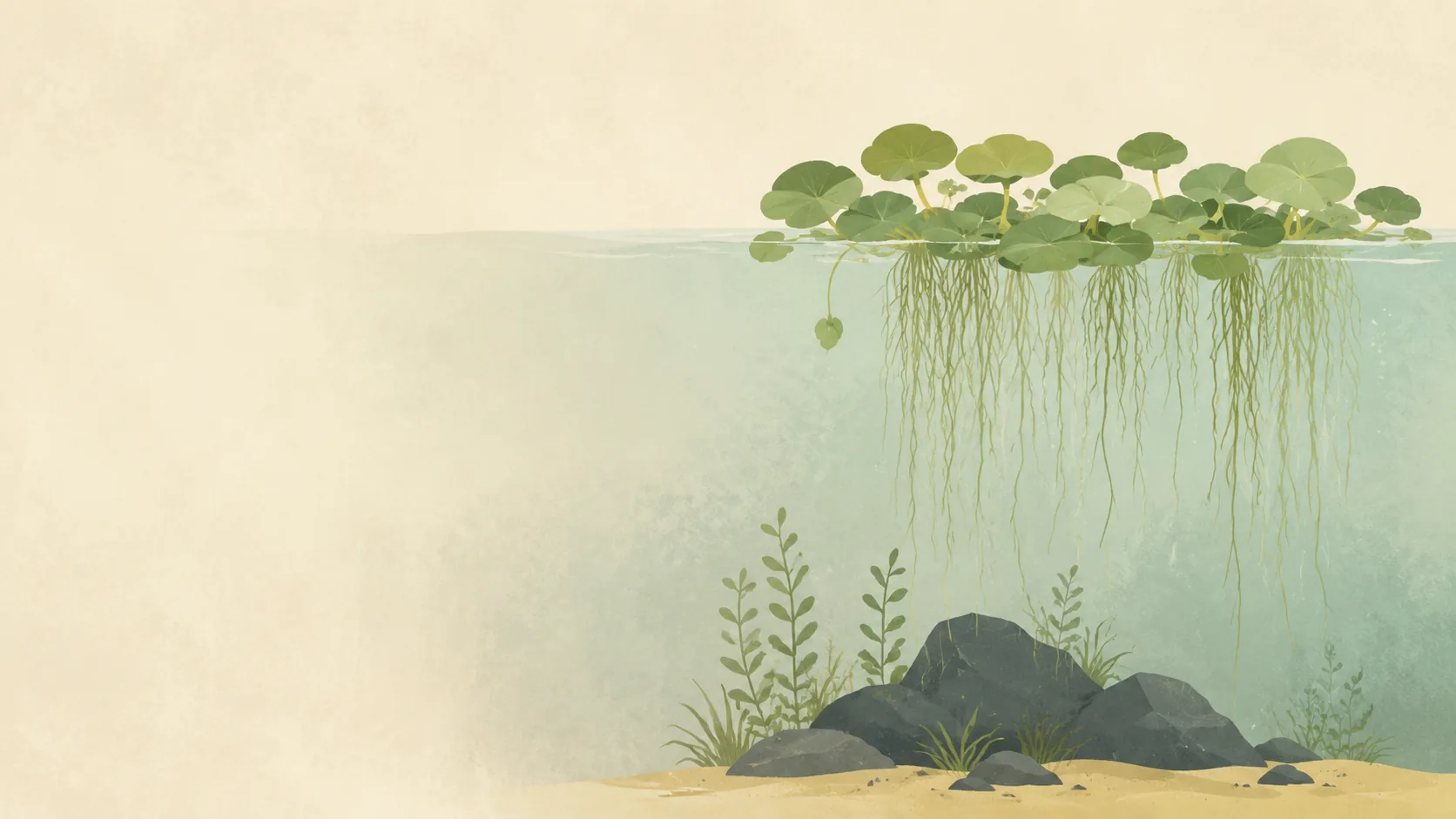
Floating aquarium plants sit on the surface with their roots hanging free, and they do two useful jobs at once. They take up nutrients from the water, which leaves less for algae, and they shade the tank below. Both help most in a new tank, and both need managing once the cover grows.
Why put them in at all
A new tank is at its most vulnerable to algae in the first few weeks, when the planting is sparse and nothing is competing for nutrients yet. Floaters are a common answer. They take up nutrients from the water and shade the tank from the day they go in. Hair algae is one that Aquasabi says appears mainly while a new tank is cycling.
That makes them a natural fit for the Walstad method, where the whole approach depends on plants outcompeting algae rather than on equipment, and for the jungle style, where a surface canopy is part of the look.
Amazon frogbit
Amazon frogbit, Limnobium laevigatum, is the usual starting point. Leaves sit on the surface with long, fine roots beneath, which Tropica says give cover to gouramis and other surface fish. Tropica also notes that it grows much more slowly when nutrients run low, which makes it a useful indicator of what is available in the water.
| Requirement | Amazon frogbit |
|---|---|
| Light demand | Low |
| CO2 demand | Low |
| Difficulty | Easy |
| Growth rate | Medium |
| Placement | Floating |
The shading cuts both ways
Shade is the point, and it is also the catch. Tropica warns that it may become necessary to remove some frogbit so the plants beneath still get light, and a surface that started as partial cover can close over if you let it. Everything below then gets less light than you planned for.
That matters most if you are growing anything demanding underneath. A carpet needs strong light reaching the substrate, and a floating canopy is directly at odds with that. Shade plants such as Anubias, Java fern and Cryptocoryne wendtii are the natural companions.
Scoop out handfuls regularly. Treat it as a routine chore rather than a problem, in the same way you would trim a stem plant.
Floating plant questions
Do floating plants help with algae?
Yes, in two ways. They take up nutrients, leaving less available to algae, and they shade the tank, reducing the light algae needs. They are most useful in the early weeks of a new tank.
Will floating plants block too much light?
They can. Left unchecked they form a solid mat and starve the plants below. Thin them regularly, and avoid pairing them with a carpet that needs strong light at the substrate.
Do floating plants need CO2?
No. Tropica rates Amazon frogbit low for both CO2 and light demand.
Sources: Tropica, Limnobium laevigatum.