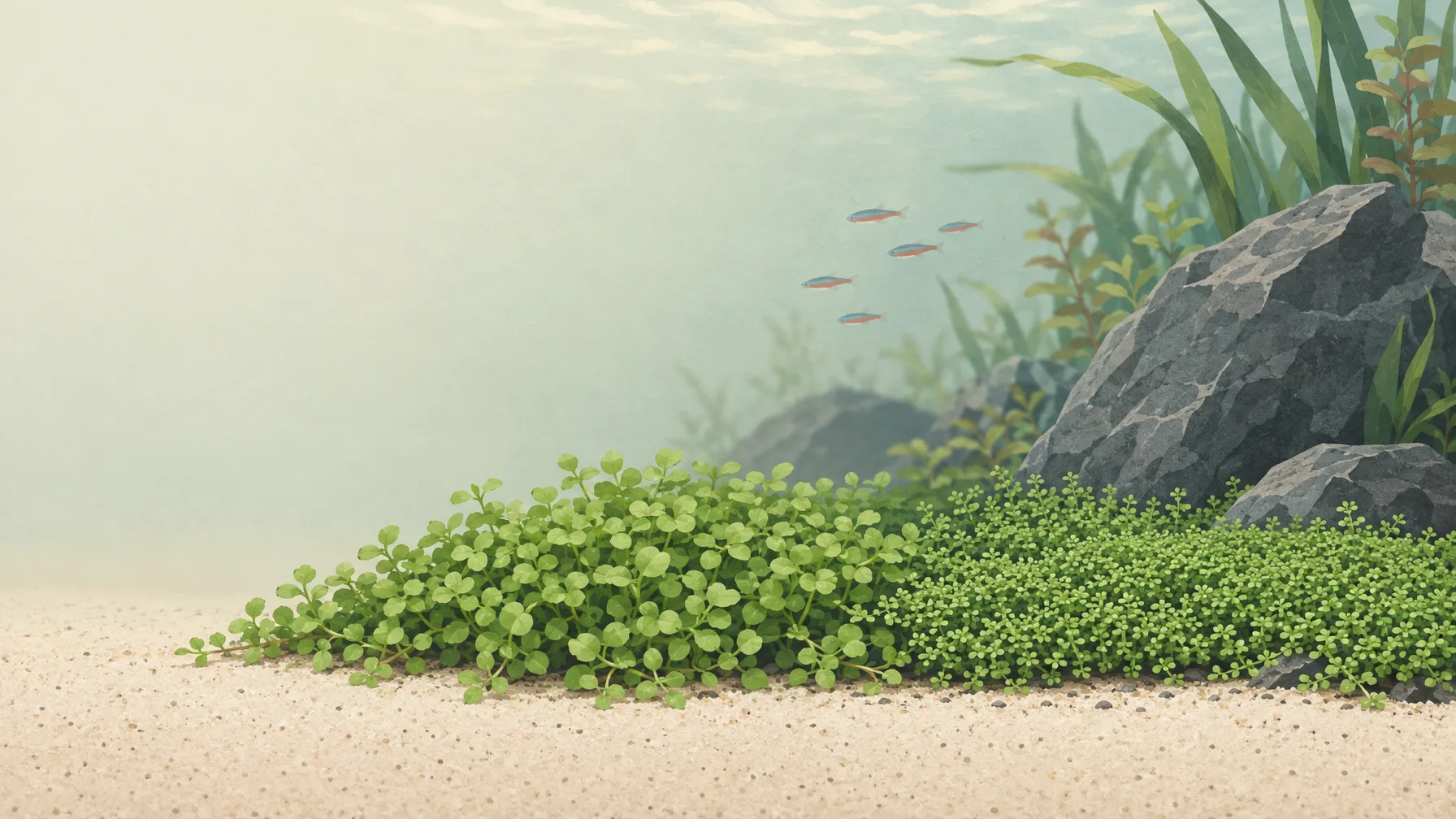
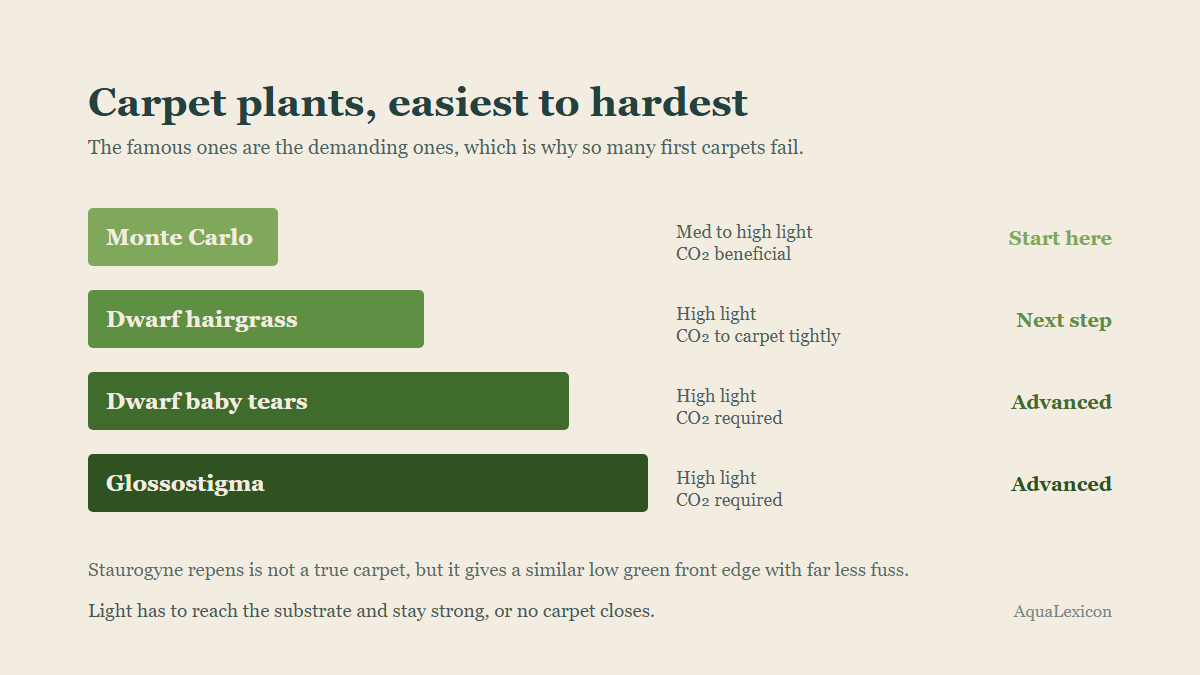
Monte Carlo is the carpet to start with and HC Cuba is the one to work up to. Tropica rates Monte Carlo medium for light, CO2 and difficulty, and HC Cuba high, high and advanced. Tropica’s HC Cuba page even recommends Monte Carlo as the less demanding alternative. Both grow to about 3 to 5 cm.
Side by side
Monte Carlo
HC Cuba
Sold as
Micranthemum tweediei ‘Monte Carlo’
Micranthemum callitrichoides ‘Cuba’, also sold as Hemianthus callitrichoides or dwarf baby tears
Leaves
Compact, round, light green
Millimetre-sized and round
Light demand
Medium
High
CO2 demand
Medium
High
Difficulty
Medium
Advanced
Height
3 to 5+ cm
3 to 5+ cm
Origin
Argentina
Cuba, west of Havana
Tropica’s own advice
The clearest line comes from Tropica’s HC Cuba page. It lists what HC needs to thrive, which is enough light, added CO2, water circulation and fertiliser, then says that if these conditions are hard to create, you may use Monte Carlo as an alternative, because it is less demanding.
The same page also calls HC Cuba “not a difficult plant” while its difficulty icon reads Advanced. Go by the ratings and the list of conditions. Those are what decide whether it carpets or fails.
What HC Cuba needs
Tropica calls it one of the smallest aquarium plants in the world. Plant it in small clumps a few centimetres apart and, given those conditions, it spreads quickly and covers the bottom. Trim it regularly: Tropica warns that otherwise the lower parts do not get enough light, which causes root death. Our dwarf baby tears page goes into more detail.
What Monte Carlo needs
Monte Carlo can grow in light shadow, Tropica says, but it still needs good light and added CO2 to develop optimally and become really compact. It is the easier plant, not an effortless one. For a carpet without CO2, dwarf hairgrass is the option.
Monte Carlo vs HC Cuba questions
Can you grow HC Cuba without CO2?
Not reliably. Tropica rates its CO2 demand as high and lists added CO2 among the conditions it needs to thrive. If you cannot add CO2, Tropica points you to Monte Carlo instead.
Is Monte Carlo easier than HC Cuba?
Yes. Tropica rates Monte Carlo medium for difficulty and HC Cuba advanced, and describes Monte Carlo as less demanding.
How do you plant HC Cuba?
In small clumps a few centimetres apart, which Tropica says lets it spread and cover the bottom like a carpet. Trim it regularly so light keeps reaching the lower parts.
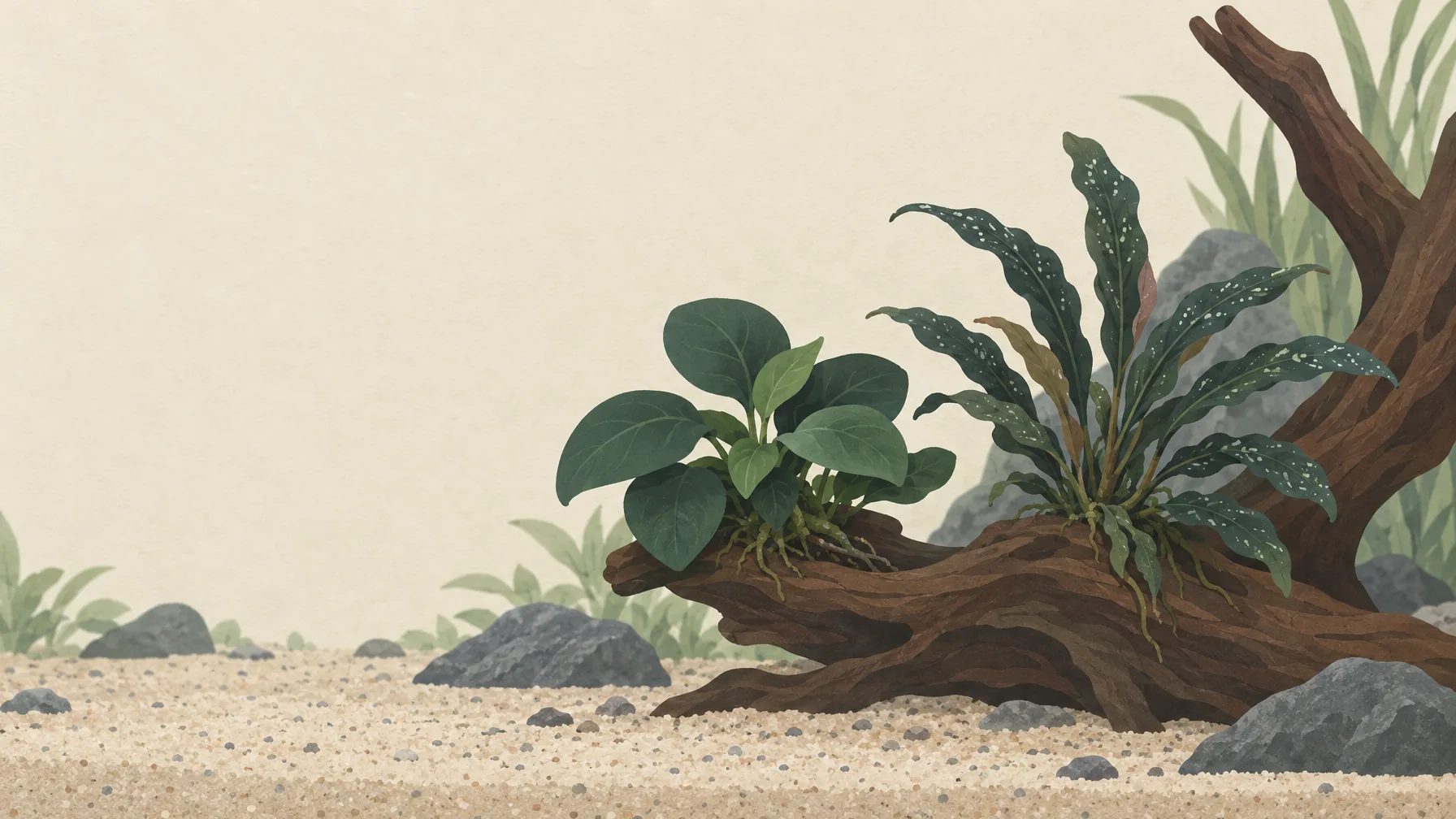
Anubias and Bucephalandra are the two easiest plants to tie onto wood or rock, and both grow slowly from a rhizome. Tropica rates both easy. Choose Anubias for a shady spot or a tank with plant-eating fish, and Bucephalandra for its narrow, dark leaves, which can show a blue metallic sheen underwater.
Side by side
Anubias nana
Bucephalandra ‘Kedagang’
Sold as
Anubias barteri var. nana
Bucephalandra diabolica ‘Kedagang’
Origin
Cameroon
Borneo
Light demand
Not rated by Tropica (Flowgrow: low to high)
Low
CO2 demand
Not rated by Tropica (Flowgrow: with or without)
Low
Difficulty
Easy
Easy
Growth
Slow
Slow
Size
5 to 10 cm tall
Leaves 1 to 2 cm wide, up to 6 cm long
Both live on hardscape
Neither plant wants its rhizome buried. Tropica says Anubias does best planted on a stone or tree root, held with fishing line until it gains a hold, and that if it goes in the substrate the rhizome must not be covered because it tends to rot. Bucephalandra is a rhizome plant too, and it is used the same way.
Leaves and colour
This is where they part. Tropica describes ‘Kedagang’ as having long, narrow, dark green leaves with white dots, red rhizomes, and a blue metallic shade that may appear on the leaves underwater. Tropica describes Anubias nana as a small, attractive plant and notes that it flowers frequently under water.
Slow growth has a cost
Both are slow, and both pay for it. Tropica says Anubias leaves survive for several years, which gives slow-growing algae the chance to become established on them. Bucephalandra is one of the plants Aquasabi names as most affected by leaf loss after planting, while it adjusts to a new tank. Our plant melt page covers what to do.
Which to choose
Anubias for shade and for tanks with herbivores. Tropica says it will thrive in shady places where other plants will not, and that herbivorous fish do not eat it. Bucephalandra for colour and detail in a low-light tank, if you can wait out a slow, sometimes messy start.
Anubias vs Bucephalandra questions
Is Anubias or Bucephalandra easier?
Tropica rates both easy. Anubias is the more forgiving at the start, because Bucephalandra is one of the plants Aquasabi names as most prone to losing leaves while it settles into a new tank.
Do Anubias and Bucephalandra need CO2?
No. Tropica rates Bucephalandra ‘Kedagang’ low for CO2, and Flowgrow says Anubias nana grows with or without added CO2, though it may benefit from it.
Which is better with plant-eating fish?
Anubias. Tropica says herbivorous fish do not eat it. Tropica’s Bucephalandra page says nothing either way.
Dwarf hairgrass is the easier carpet and Monte Carlo is the lower, rounder one. Tropica rates hairgrass easy with a low demand for light and CO2, and Monte Carlo medium on all three, saying it needs good light and added CO2 to become really compact. Hairgrass also grows taller, as a carpet of 6 to 15 cm.
Side by side
Dwarf hairgrass
Monte Carlo
Sold as
Eleocharis acicularis
Micranthemum tweediei ‘Monte Carlo’
Leaves
Fine blades
Compact, round, light green, on creeping stalks
Light demand
Low
Medium
CO2 demand
Low
Medium
Difficulty
Easy
Medium
Height
A carpet of 6 to 15 cm
3 to 5+ cm
Origin
Cosmopolitan
Argentina
What each needs
Tropica says dwarf hairgrass thrives in almost all conditions in an aquarium, though an open space without shading from other plants is still preferable. That makes it the carpet you can grow in a low-tech tank.
Monte Carlo can grow in light shadow, Tropica says, but it requires good light and added CO2 to develop optimally and become really compact. Without them it still grows, just less compact. Our CO2 injection page covers what adding it involves.
Keeping each one low
Hairgrass spreads by its roots, which Tropica says colonise the surroundings after planting. If the carpet grows too tall, you can cut it back carefully to the height you want. Monte Carlo stays low by nature, at 3 to 5+ cm, and Tropica describes it as creating a fast-growing carpet at the front of the tank, although its spec table rates the growth rate as medium.
Which to choose
No CO2 injection means hairgrass, and so does a first carpet. Pick Monte Carlo if you already inject CO2, have good light, and want a lower, softer lawn of round leaves. The carpet plants guide ranks both against the harder options.
Dwarf hairgrass vs Monte Carlo questions
Can you grow dwarf hairgrass or Monte Carlo without CO2?
Hairgrass, yes: Tropica rates its CO2 demand as low. Monte Carlo will survive, but Tropica says it requires added CO2, along with good light, to develop optimally and become really compact.
Which is easier for beginners, dwarf hairgrass or Monte Carlo?
Dwarf hairgrass. Tropica rates it easy and says it thrives in almost all conditions. Monte Carlo is rated medium for difficulty, light and CO2.
Which carpet stays lower?
Monte Carlo, at 3 to 5+ cm in Tropica’s figures. Hairgrass forms a carpet of 6 to 15 cm, which Tropica says you can cut back if it grows too tall.
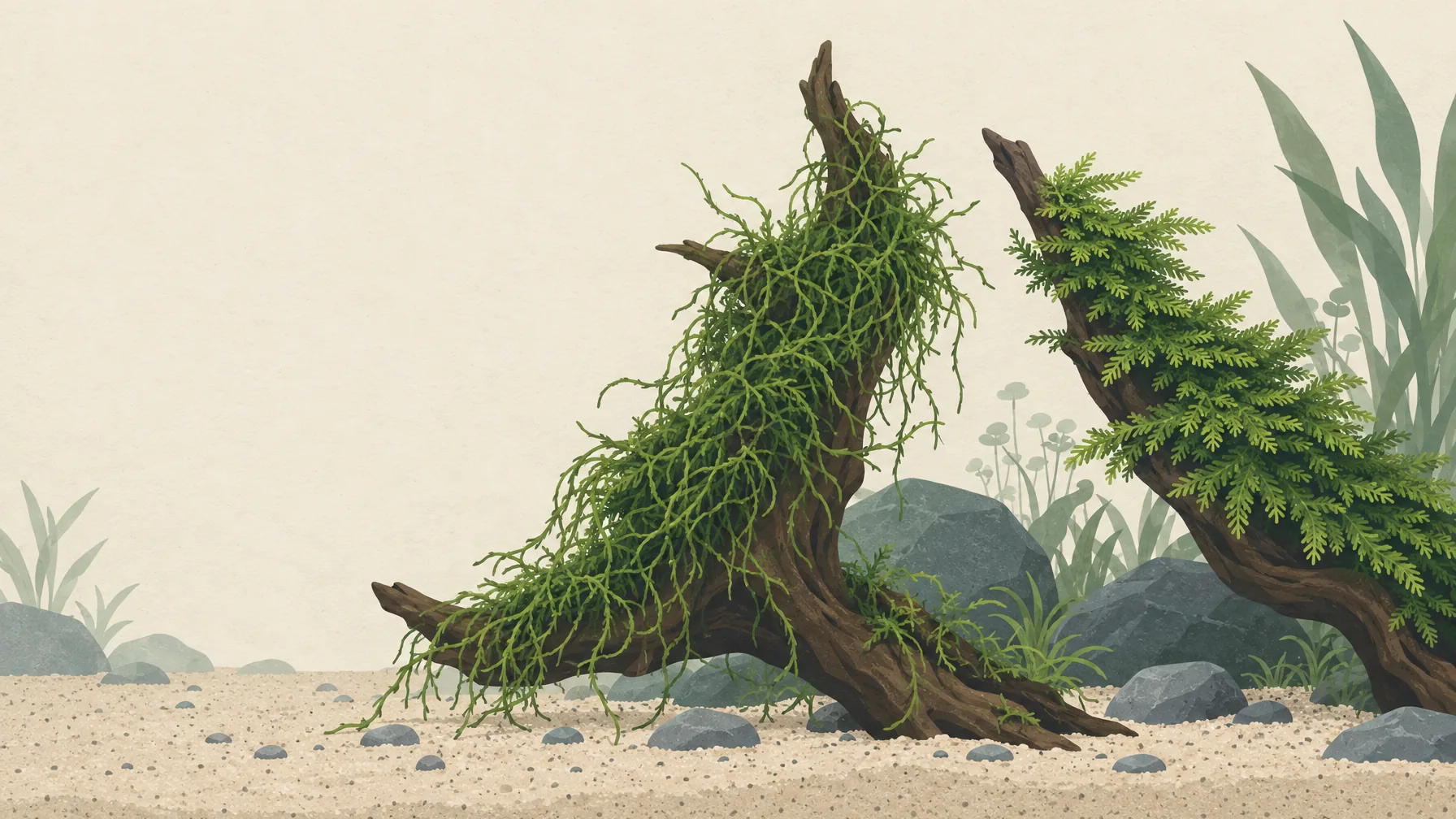
Java moss is the easy one and Christmas moss is the neat one. Tropica rates Java moss easy with a low demand for light, and Christmas moss medium for both difficulty and light, adding that it grows more slowly. Both attach to wood and rock, both have a low CO2 demand, and both need trimming to keep their shape.
Side by side
Java moss
Christmas moss
Sold as
Taxiphyllum barbieri ‘Bogor Moss’
Vesicularia montagnei ‘Christmas Moss’
Light demand
Low
Medium
CO2 demand
Low
Low
Difficulty
Easy
Medium
Thickness
3 to 10 cm
1 to 3 cm tall
Origin
South-East Asia
Brazil
The shape is the real difference
Christmas moss is named for its side branches. Tropica says their structure distinguishes it from ordinary Vesicularia dubyana and looks like fir tree branches, which gives a layered, orderly look on a branch. Java moss grows willingly on any surface and builds up thicker, which Tropica says makes it ideal for decorating stones and tree roots or hiding installations in the tank.
What each asks of you
Tropica describes Java moss as a hardy plant that makes few demands on the water or light. Christmas moss is more demanding than ordinary Java moss and grows more slowly, in Tropica’s words, and its light demand is rated a step higher.
One inconsistency to know about: Tropica’s spec tables rate both mosses medium for growth rate, while its description of Christmas moss says it grows more slowly. Plan on the slower pace.
Attaching and trimming
The method is the same for both. Tropica suggests fishing line or cotton thread to hold Java moss until it has gained a hold, and says Christmas moss attaches readily to roots and stones. Spread either one thinly on spider wood or the crevices of dragon stone.
Then keep cutting. Tropica says Java moss can be pruned with scissors if its growth becomes too luxuriant, and that Christmas moss needs pruning as it spreads to keep its shape attractive.
Which to buy
Java moss if it is your first moss, your light is modest, or you want cover fast. Christmas moss if the moss is a feature of the layout and your light is at least medium. It rewards the extra care with a neater shape.
Java moss vs Christmas moss questions
Which is easier, Java moss or Christmas moss?
Java moss. Tropica rates it easy with a low light demand and calls it hardy. Christmas moss is rated medium for difficulty and light, and Tropica says it is more demanding than Java moss.
Is Java moss or Christmas moss better for shrimp?
Neither Tropica page rates them for shrimp. Java moss grows thicker, at 3 to 10 cm, and Tropica calls it a wonderful hiding place for young fish in breeding aquariums, so it gives more cover.
Does Christmas moss need CO2?
No. Tropica rates the CO2 demand of both mosses as low. Light is where they differ: medium for Christmas moss, low for Java moss.
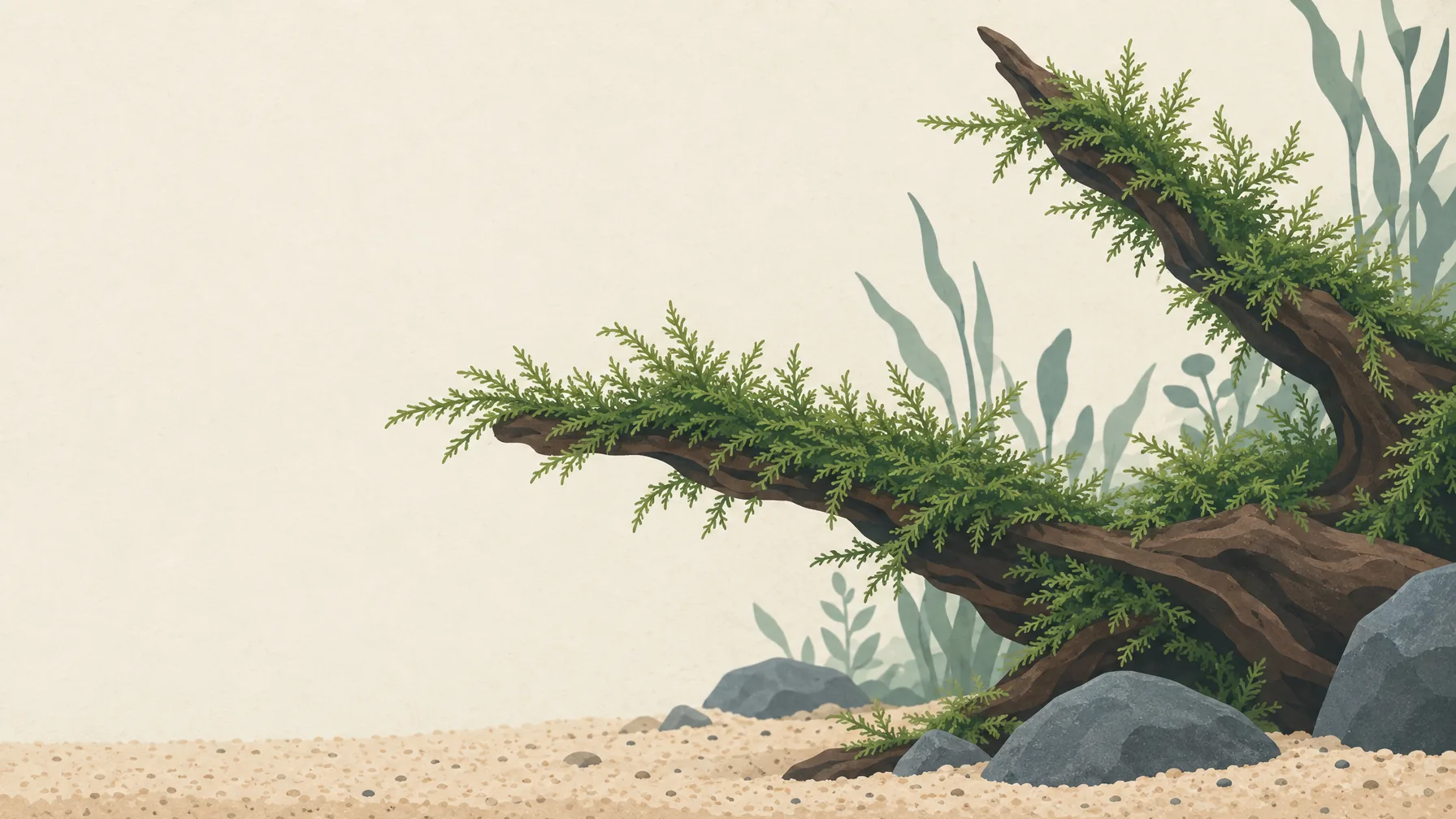
Christmas moss is the moss people choose when Java moss looks too shaggy. Tropica sells it as Vesicularia montagnei ‘Christmas Moss’, rates it medium for light and difficulty and low for CO2, and puts it at 1 to 3 cm tall. It is slower and fussier than Java moss.
Why it looks like a fir branch
The name comes from the shape. Tropica describes its side branch structure as what distinguishes it from ordinary Vesicularia dubyana, and says it looks like fir tree branches. That regular, layered growth is why it reads as deliberate on a branch where Java moss reads as a green tangle.
More demanding than Java moss
Tropica is direct about this: it is more demanding than ordinary Java moss and grows more slowly. That shows in the ratings, where Java moss is easy with a low light demand and Christmas moss is medium for both.
What it needs
Requirement
Christmas moss
Light demand
Medium
CO2 demand
Low
Difficulty
Medium
Growth rate
Medium
Placement
Moss, attach to wood or rock
Attaching and trimming it
Tropica says it attaches readily to roots and stones, so tie or glue a thin layer onto the surface you want covered and let it take hold. The branching structure of spider wood suits it, and so do the crevices in dragon stone.
Then keep cutting. Tropica says that as it spreads in the water it needs pruning to keep its shape attractive, which is the same rule that keeps any moss from shading out its own base.
Christmas moss questions
Christmas moss or Java moss?
Java moss to start with. Tropica rates it easy with a low light demand, while Christmas moss is medium for both and grows more slowly. Christmas moss is the better-looking one once you can keep it.
Does Christmas moss need CO2?
No. Tropica rates its CO2 demand as low. Its light demand is medium, which is the rating that separates it from Java moss.
How do you attach Christmas moss?
Spread a thin layer over wood or rock and hold it there with cotton thread, fishing line or gel glue until it grips. Tropica says it attaches readily to roots and stones.
Glossostigma elatinoides makes the finest carpet in aquascaping and asks the most in return. Tropica calls it one of the smallest aquarium plants at 2 to 3 cm tall, rates it advanced, and puts both its light and CO2 demand at high. In a dim tank it grows upwards instead of flat.
The smallest plant in the tank
Tropica describes it as much in demand in Japanese-inspired aquariums, which is where most people meet it: the bright green lawn under the stones of an Iwagumi layout. At 2 to 3 cm tall it makes the stones look bigger, which is the whole trick.
What it needs
Requirement
Glossostigma elatinoides
Light demand
High
CO2 demand
High
Difficulty
Advanced
Growth rate
Not rated by Tropica
Placement
Carpet, foreground
Tropica calls it a difficult plant demanding a lot of light, says it grows upwards if light is poor, and warns you to make sure larger plants do not overshadow it. They also say CO2 addition and soft water promote its growth. A carpet that grows upward is the plant telling you the light is not reaching the substrate.
How to plant it
Tropica’s instruction is to split the pot into small clumps, roughly an eighth of a pot each, and place them at intervals of a few centimetres so the plants grow together more quickly. Spacing them is what turns separate clumps into a lawn.
Choose it on purpose
Our carpet plants guide ranks the usual choices by what they demand. Dwarf hairgrass is the forgiving starting point at low light and low CO2, Monte Carlo sits in the middle, and Glossostigma is at the far end with dwarf baby tears. Pick it because you want the finest carpet and have the CO2 and light to match.
One inconsistency worth flagging: Tropica’s own page gives Australia in its origin field while the description opens by calling it Glossostigma elatinoides from New Zealand.
Glossostigma questions
Does Glossostigma need CO2?
Yes, in practice. Tropica rates its CO2 demand as high and says CO2 addition and soft water promote its growth. Without added CO2 and strong light you will not get a flat carpet.
Why is my Glossostigma growing upwards?
Not enough light at the substrate. Tropica says it grows upwards if light is poor and warns against letting larger plants overshadow it.
Is Glossostigma good for beginners?
No. Tropica rates it advanced and calls it a difficult plant demanding a lot of light. Dwarf hairgrass, which Tropica rates easy with low light and CO2 demand, is the better first carpet.
Alternanthera reineckii is the red plant most planted tanks end up with. Tropica sells it as three cultivars rather than the plain species, and rates all of them medium for light, CO2 and difficulty. The colour is the point, and the colour is what the conditions decide.
Three cultivars, three sizes
Tropica lists no plain Alternanthera reineckii. Which one you buy changes how big it gets and where it belongs in the tank.
Cultivar
Height (Tropica)
What Tropica says
‘Mini’
5 to 10+ cm
Compact, slower growing, for small tanks or the foreground of a larger scape
‘Pink’
20 to 30+ cm, stems 25 to 50 cm
Pink leaf undersides, strongest planted in groups
‘Rosanervig’
5 to 20+ cm
Vibrant pink leaves with light nerves, compact, for the mid-section or the front when cut well
What it needs
Requirement
Alternanthera reineckii
Light demand
Medium
CO2 demand
Medium
Difficulty
Medium
Growth rate
Medium
Placement
Stem, midground
This is the first plant in this batch that asks for something. Tropica’s line on the genus is that good light and fertiliser conditions, as well as CO2 additive, are material for growth and colour development. For ‘Mini’ they say high light intensity and the addition of CO2 improves the plant’s growth and overall appearance.
Getting the colour
For ‘Pink’, Tropica says good light encourages the leaves to turn red, and that the pink undersides give an effective contrast to the green plants around them, particularly in groups. One stem on its own is wasted. A block of it against green is what people are copying when they build a Dutch layout.
Propagating it
Tropica’s method for ‘Pink’ is to nip off the terminal bud and plant it in the substrate. That also makes the mother plant bushier, because more side shoots form. It is the same trim and replant cycle as Rotala, and it is how one pot becomes a group.
Alternanthera reineckii questions
Does Alternanthera reineckii need CO2?
Tropica rates its CO2 demand as medium and says CO2 addition is material for growth and colour development. It will grow without, but this is not a plant that shows its best in a tank with no added carbon.
Which Alternanthera reineckii suits a small tank?
‘Mini’. Tropica gives it a height of 5 to 10+ cm and describes it as compact and slower growing, suitable for small aquariums or as a foreground plant in larger aquascapes.
How do you get Alternanthera reineckii to turn red?
Light, first. Tropica says good light encourages the leaves of ‘Pink’ to turn red, and adds that good light and fertiliser, together with added CO2, are material for colour development across the genus.
Bacopa caroliniana is the stem plant that does not run away from you. Tropica rates it easy, with a low demand for light and CO2, and rates its growth slow. That last rating is the reason to choose it, because most stem plants need cutting back every week or two.
A stem plant that stays put
Tropica says Bacopa caroliniana originates from the US and has been used as an aquarium plant for many years. Its stems become 10 to 30 cm long and 3 to 4 cm wide, branching willingly from the bottom. It has few demands, which Tropica calls very convenient for beginners, and its slow growth rate makes it one of the few stem plants that do not need much attention.
One oddity in Tropica’s own listings: four of their five entries give a height of 20 to 30+ cm while one gives 10 to 30+ cm. The description’s 10 to 30 cm stems is the figure to plan around.
What it needs
Requirement
Bacopa caroliniana
Light demand
Low
CO2 demand
Low
Difficulty
Easy
Growth rate
Slow
Placement
Stem, midground to background
Low demands and slow growth make it a natural fit for a low-tech setup, including the Walstad method, where the whole point is a tank that mostly runs itself.
Planting and propagating
Tropica says it is most decorative planted in small groups, like most stem plants, and is easy to propagate by cuttings: take a side shoot and plant it in the bottom. For a bunch tied to an anchor, their instructions are to remove the anchor, split it into separate plants, strip the leaves from the lowest 5 cm, and plant each stem with some distance between them.
Give the stems room and they branch from the base, which fills the group out without any help from you.
It smells
A detail nobody warns you about. Tropica notes that if either the stem or the leaves are damaged, a strong scent is emitted. You will notice it when you trim.
Bacopa caroliniana questions
Does Bacopa caroliniana need CO2?
No. Tropica rates its CO2 demand as low and its light demand as low, which is why it turns up in so many low-tech tanks.
How fast does Bacopa caroliniana grow?
Slowly, and that is the appeal. Tropica rates its growth rate slow and calls it one of the few stem plants that do not need much attention.
How do you propagate Bacopa caroliniana?
By cuttings. Tropica’s method is to take a side shoot and plant it in the substrate. The plant branches willingly from the bottom, so the parent thickens up as well.
Ludwigia repens is the red stem plant to start with. Tropica rates the ‘Rubin’ variety easy, with a medium demand for light and a low demand for CO2, so the colour does not depend on a pressurised system. Light is what decides how red it goes.
Tropica rates the ‘Rubin’ variety
Worth knowing before you shop. Tropica lists no plain Ludwigia repens, only the variety ‘Rubin’, so the figures on this page are theirs for that plant. Tropica describes it as a variety of Ludwigia repens from North America with striking dark red leaves and stalk, with stems from 20 to 50 cm and 4 to 6 cm wide.
Light makes the red
Tropica says the plant has few demands, but that if light is insufficient the lower leaves tend to fall off, and that in strong light the colour becomes more intense. Bare lower stems are the first sign that your light is not reaching far enough down.
What it needs
Requirement
Ludwigia repens ‘Rubin’
Light demand
Medium
CO2 demand
Low
Difficulty
Easy
Growth rate
Medium
Placement
Stem, background
Plant it in groups and keep cutting
Tropica’s advice is to plant it in large groups to enhance the decorative effect and to prune regularly to encourage bushy growth. That is the same trim-and-replant cycle Rotala runs on, and the discipline behind the Dutch style, where rows of contrasting colour carry the layout.
A red group reads strongest against plain green neighbours, so give it space rather than scattering single stems through the tank.
Ludwigia repens questions
Does Ludwigia repens need CO2?
No. Tropica rates the CO2 demand of ‘Rubin’ as low. Added CO2 is not what makes it red, light is.
Why are the lower leaves falling off my Ludwigia?
Usually light. Tropica says that if light is insufficient, the lower leaves tend to fall off. Thinning the stems above so light reaches down, or raising the light level, is the fix.
How do you make Ludwigia repens red?
Give it stronger light. Tropica says the colour becomes more intense in strong light, and rates the plant’s own light demand as medium.
Staurogyne repens is the low, bushy green plant people use along the front of a tank when a true carpet feels like too much work. Tropica rates it easy, with a low demand for light and CO2, and puts its height at 3 to 10 cm. Trim it and it creeps sideways.
A compact plant from the Amazon
Tropica describes Staurogyne repens as a fresh green, compact and hardy plant for the foreground, found in the River Rio Cristalino in the southern Amazonas. Its nearest relative in the hobby is Hygrophila, but it is far more compact, growing low and bushy at 5 to 10 cm with small green leaves.
Make it creep instead of climb
This is the part that decides how it looks. Tropica’s instruction is to cut off the longest upright shoots when you plant it. New horizontally creeping shoots then form from the base and gradually colonise the gravel.
Light decides the rest. Tropica says that at low light the growth will be more upright and much less side shoots will be formed. It survives in a dim tank, but it spreads in a bright one, so treat your lighting as the difference between a mat and a row of small upright stems.
What it needs
Requirement
Staurogyne repens
Light demand
Low
CO2 demand
Low
Difficulty
Easy
Growth rate
Medium
Placement
Stem, foreground
It roots into the substrate, so it does better in a nutrient aquasoil or with root tabs than in bare gravel.
Where it fits
Think of it as the forgiving alternative to a true carpet. The plants on our carpet plants page mostly want strong light and added CO2, and dwarf hairgrass is the easiest of those. Staurogyne asks for less than any of them and gives you a low green edge rather than a lawn.
Staurogyne repens questions
Is Staurogyne repens a carpet plant?
Not really. Tropica calls it a compact, low and bushy foreground plant of 5 to 10 cm, and its creeping shoots colonise the gravel over time. It makes a low green mass at the front rather than the flat lawn a true carpet plant gives you.
Does Staurogyne repens need CO2?
No. Tropica rates its CO2 demand as low, along with its light demand, which is why it suits low-tech tanks.
Why is my Staurogyne repens growing upwards?
Most likely not enough light. Tropica says that in low light the growth is more upright and far fewer side shoots form. Cutting the tallest shoots also pushes it to throw out creeping ones.
Vallisneria is the tall, ribbon-leaved background plant that spreads by runners. Tropica rates all three it sells as easy, with a low demand for light and CO2, which makes it a low-tech plant. Size is the thing to plan for. The giant form grows leaves long enough to lie across the surface.
Three types of Vallisneria
Shops sell several Vallisneria under names that say nothing about how big they get. Tropica lists three, and the gap between the smallest and the largest is the whole decision.
Type
Leaves (Tropica)
What it suits
Vallisneria spiralis ‘Tiger’
30 to 50 cm long, 1 to 2 cm wide
Small aquariums
Vallisneria americana ‘Natans’
50 to 100 cm long, 1 cm wide
Fine, narrow leaves that shade little
Vallisneria ‘Gigantea’
50 to 150 cm long, 2 cm wide
Large aquariums only
Tropica gives Asia as the origin of all three, including Vallisneria americana ‘Natans’, whose name suggests the Americas.
What it needs
Requirement
Vallisneria
Light demand
Low
CO2 demand
Low
Difficulty
Easy
Growth rate
High for ‘Natans’, not rated for the other two
Placement
Stolon, background
Tropica calls ‘Tiger’ an excellent plant for beginners that grows in virtually all light and water conditions, and ‘Natans’ a hardy plant for beginners. Neither needs added CO2, which is why Vallisneria turns up so often in low-tech tanks and in the Walstad method.
It spreads by runners
Vallisneria sends out runners with new plants along them, which is how a few plants become a back wall. Tropica says ‘Tiger’ forms runners easily and is thus easy to propagate, and that ‘Gigantea’ propagates through runners that are prolific if the bottom is nutritious.
That gives you a choice at setup. A nutrient aquasoil gets it spreading faster, and plain gravel slows it down. Either way, pull up the runners you do not want while they are small, and give away or bin the rest.
Mind the light it takes
The giant form is the one that causes trouble. Tropica says its leaves grow so long in most aquariums that they float on the surface, so the plant needs pruning to stop it taking too much light from plants growing beneath. That is the same problem floating plants create, except this one starts at the substrate.
The two smaller types are kinder to their neighbours. Tropica describes ‘Tiger’ as having narrow leaves that do not overshadow smaller plants, and ‘Natans’ as having fine, narrow leaves that do not overshadow other plants much.
Where it fits in a layout
Vallisneria is a background plant. Its height and its habit of filling space suit the jungle style, where overgrowth is the point, and it does the same job as an Amazon sword with a very different shape: ribbons instead of broad blades.
One more point in its favour for a stocked tank. Tropica says the leaves of ‘Gigantea’ are tough and strong, so they are not normally eaten by herbivorous fish.
Vallisneria questions
Does Vallisneria need CO2?
No. Tropica rates the CO2 demand of all three types as low, along with their light demand, which is what makes Vallisneria a standard choice for a low-tech planted tank.
How tall does Vallisneria get?
It depends which one you buy. Tropica gives ‘Tiger’ leaves of 30 to 50 cm, ‘Natans’ 50 to 100 cm, and ‘Gigantea’ 50 to 150 cm. In most tanks the giant form’s leaves reach the surface and lie along it.
Is Vallisneria good for beginners?
Yes. Tropica calls ‘Tiger’ an excellent plant for beginners, growing in virtually all light and water conditions, and describes ‘Natans’ as hardy and suitable for beginners. Buy for the size of your tank and thin the runners, and it asks very little else.
The Amazon sword is the classic large background plant for a planted aquarium. It grows tall, broad leaves from a central rosette, and Tropica rates it easy, with a low demand for light and CO2. The one thing that pays off is a well-fed substrate, because it takes up nutrients through its roots.
Feed it through the roots
Echinodorus grisebachii feeds heavily through its roots. Aquasabi notes that Echinodorus species actively absorb nutrients through their roots, and Tropica says a nutritious bottom promotes growth, so put the nutrients where the roots are.
Use root tabs or fertiliser sticks pushed into the substrate near the plant, or grow it in a nutrient aquasoil that supplies them directly. If the older leaves start to yellow, our yellowing leaves page covers which nutrient is likely short.
Give it room
Requirement
Amazon sword
Light demand
Low
CO2 demand
Low
Difficulty
Easy
Growth rate
Not rated by Tropica
Placement
Rosette, background
This is a big plant. Put it at the back and give it space. Tropica recommends it for quite large aquariums and warns that it needs pruning to stop it depriving the plants underneath of light.
Its size and loose habit make it a natural fit for the jungle style, where overgrowth is the point, and for a South American biotope, since it belongs to that region.
Amazon sword questions
Do Amazon swords need root tabs?
In inert gravel or sand, yes. It is a heavy root feeder, so it needs nutrients at the roots. In a nutrient aquasoil the substrate already supplies them.
Does an Amazon sword need CO2?
No. Tropica rates its CO2 demand as low, and says it does well even in poorly lit aquariums because it grows towards the light. A well-fed substrate matters more to this plant.
How big does an Amazon sword get?
Tropica gives ‘Bleherae’, the classic form, a height of 20 to 50 cm, which makes it a background plant in most tanks and too big for a small one. Plan its position on the assumption it will fill the space.
Anubias is the plant to start with if you have killed everything else. Tropica rates every Anubias it sells easy, with a low CO2 demand and, for all but one variety, a low light demand. It doesn’t need added CO2, and it attaches to wood and rock instead of rooting in substrate. The trade-off is slow growth.
What it is
Anubias is an epiphyte, meaning it grows attached to surfaces rather than planted in the substrate. Thick, dark, leathery leaves rise from a horizontal stem called a rhizome. The variety you’ll see most is Anubias nana, Anubias barteri var. nana, which Flowgrow calls one of the most widely spread aquarium plants in Europe, Asia and the US. It is compact enough for the foreground and middle of a tank, and Tropica says herbivorous fish don’t eat it.
Requirement
Anubias nana
Light
Low (Tropica)
CO2
Low (Tropica)
Difficulty
Easy (Tropica)
Growth rate
Slow (Tropica)
Placement
Epiphyte, foreground to mid
Does Anubias need CO2?
No. Tropica rates the CO2 demand of every Anubias it sells as low, Flowgrow says nana grows with or without added CO2, and Aquasabi says it doesn’t need it. Added CO2 can still help: Flowgrow says it may benefit growth, and Buce Plant, which sells the plant, says it speeds up growth and makes the foliage denser.
Aquarium Science goes further, listing Anubias among the plants that seem to live in all substrates with no fertiliser at all, even in very low light, as long as the rhizome isn’t buried. Our do you need CO2 page covers which plants do.
How much light Anubias needs
Not much. Tropica rates its Anubias low for light, except the white-patterned ‘Pinto’, which it rates medium, and says nana thrives in shady places where other plants won’t. Across its range, Tropica’s advice is to avoid high light and plant Anubias in a shady spot, such as under larger plants, to keep algae off the leaves.
What too much light does
Anubias survives it: Flowgrow says it grows under very low and strong light alike. The cost is algae on the leaves. Buce Plant says the leaves are prone to it under high light, and Flowgrow names spot algae as the problem under strong light, controlled by good phosphate, iron and micronutrient supply or by moving the plant into shade. On ‘Pinto’, Tropica warns that excessive light can also damage the leaves. Our lighting page covers choosing a level.
Never bury the rhizome
This is the one rule that matters. Tropica is explicit: if it is planted on the bottom, the rhizome must not be covered, because it tends to rot. On its Anubias gracilis page it goes further: covered, the whole plant will rot and die.
Tie it to rock or wood instead. Tropica gets its best results that way, holding the plant with fishing line until it gains a hold. Dragon stone works particularly well because its crevices give you somewhere to wedge the rhizome while it attaches.
What the rhizome does
Aquasabi calls the rhizome the most important part of an Anubias. New leaves and roots sprout from its growing tip, and even without leaves or roots it can grow back into a complete plant, as long as it isn’t crushed or left to rot. Underwater, Aquasabi says, the roots act more as holdfasts that grip wood and stone than as a way of taking up nutrients.
Slow growth cuts both ways
Tropica rates every Anubias slow-growing. That is why it needs so little, and also why algae finds it. Tropica explains that the leaves survive for several years, which gives slow-growing algae the chance to become established on them. Its broad, dark leaves are a favourite site for black beard algae, and Aquasabi says green spot algae turns up especially on long-lived Anubias leaves.
Removing badly affected old leaves is usually the right move, and Flowgrow lists removing old leaves among the things that help growth. Cut them off at the rhizome with plant scissors. Aquasabi says no new leaf grows from the leftover stalk, only from the rhizome’s tip and side shoots.
Splitting Anubias
To get more plants, cut the rhizome into two or more pieces with sharp scissors, as Flowgrow and Aquasabi describe. Each piece grows on as a plant of its own, Buce Plant says. Tropica suggests dividing a clump once it gets too dense and placing the new plants elsewhere in the tank.
Varieties
Tropica sells a range of Anubias, which differ mostly in size and leaf shape.
Variety
Height
What sets it apart
‘Mini Coin’
Among the smallest
Each leaf smaller than a little fingernail
‘Petite’
Under 5 cm
Very small leaves
Nana
5 to 10 cm
Tropica’s small, attractive all-rounder
‘Pinto’
Not given
White-patterned leaves; medium light
‘Coffeifolia’
15 to 25 cm
Leaves arch between the ribs; new leaves red-brown
No. Tropica rates the CO2 demand of every Anubias it sells as low, and Flowgrow says it grows with or without added CO2. Added CO2 can still speed up its growth.
How much light does Anubias need?
Little. Tropica rates its Anubias low for light, except ‘Pinto’ at medium, and advises a shady spot to keep algae off the leaves. It survives strong light, but Flowgrow says spot algae becomes a problem.
Why are my Anubias leaves turning yellow or covered in algae?
Older leaves attract algae because they last so long: Tropica notes they survive for several years. Tropica advises planting Anubias in shade to keep algae off the leaves, so strong light is the first thing to check. For yellowing, our yellowing leaves page covers the nutrient side.
Can Anubias be planted in gravel?
Only if the rhizome stays above the surface. You can wedge the roots into gravel, but the rhizome itself must be exposed or it will rot. Attaching it to hardscape is simpler and more reliable.
Bucephalandra is a slow-growing rhizome plant from Borneo, grown for its dark leaves, which can take on a blue metallic shade underwater. It attaches to hardscape rather than rooting in substrate, and Tropica rates it easy, with a low demand for light and CO2, once it is past the leaf loss many new plants go through.
Varieties and naming
Plants are sold as Bucephalandra sp. followed by a trade name, because the genus contains a great many forms and the naming in the hobby is not settled. Buy by appearance and by the seller’s variety name rather than expecting a stable binomial.
Expect it to melt
Aquasabi describes the first weeks in a new tank as a period of slow or stagnant growth, with possible loss of adult leaves, especially in Cryptocorynes and Bucephalandra. A plant that looks like it is dying usually is not, and new leaves adapted to life underwater follow.
The mistake is reacting to it. People pull the plant out, move it, or throw it away during the very phase it needs to be left alone. Leave the rhizome attached, keep conditions steady, and wait. This is the same behaviour Cryptocoryne wendtii shows, and there is more on it in the plant melt guide.
Light, CO₂ and attachment
Requirement
Bucephalandra
Light demand
Low
CO2 demand
Low
Difficulty
Easy
Growth rate
Slow
Placement
Epiphyte, foreground to mid
Attach it to rock or wood and keep the rhizome above the surface, exactly as with Anubias and Java fern. Tropica rates its CO2 demand as low, so it does not need injection.
Bucephalandra questions
Why is my Bucephalandra melting?
Losing adult leaves while it acclimatises is normal, and Aquasabi names Bucephalandra as one of the plants most prone to it. Leave it attached and new leaves adapted to submerged life will follow.
Does Bucephalandra need CO2?
No. Tropica rates its CO2 demand as low. It grows slowly either way.
Bucephalandra or Anubias?
Both are slow-growing rhizome plants for wood and rock. Tropica says Anubias thrives even in shady spots. Bucephalandra offers narrow, dark leaves with a metallic sheen, at the cost of possible leaf loss when it arrives.
Cryptocoryne wendtii is an easy rosette plant for the midground of a low-tech tank. Tropica says it thrives in almost all conditions, even in the shadow of larger plants, and Aquasabi lists it as low light with no added CO2. It roots into the substrate and often loses leaves when you first plant it.
Crypt melt, and why not to panic
Plant Cryptocoryne wendtii and the leaves may die back. This is crypt melt. Aquasabi describes it as part of acclimatisation: growth slows or stops and adult leaves may be lost, especially in Cryptocorynes, but a plant that looks like it is dying usually is not.
What triggers it is the move into new conditions. New leaves, adapted to life underwater, follow.
Leave the roots in the substrate. Digging the plant up because the leaves have gone only adds another change. Keep conditions stable and wait. There is more in the plant melt guide.
What plant melt looks like
Old leaves go, then leaves adapted to underwater life grow.
Illustration. How long it takes depends on the species.
Growing it
Requirement
Cryptocoryne wendtii
Light
Low (Aquasabi)
CO2
Not required (Aquasabi)
Difficulty
Easy (Tropica)
Growth rate
Medium (Tropica)
Placement
Rosette, midground
It is a rosette plant, so it roots properly into the substrate rather than attaching to hardscape. A nutrient substrate suits it. Aquasabi notes that Cryptocoryne actively absorb nutrients through their roots, and recommends a nutrient base layer such as ADA Power Sand because they need to spread their roots in bacteria-rich substrate.
It is a shade plant in the sense that matters for lighting: it grows healthily in low light and does not need a strong fixture to do well. Tropica adds that, like most Sri Lankan Cryptocorynes, it grows well in hard water too. That makes it a good fit for the Walstad method and for any low-tech planted tank.
Cryptocoryne questions
Why did my Cryptocoryne wendtii melt after planting?
It is acclimatising. Aquasabi says Cryptocorynes in particular may lose adult leaves while they get used to a new tank, and that a plant which appears to die usually is not. Leave the roots undisturbed and new leaves adapted to life underwater will follow.
How long does crypt melt last?
It varies. Aquasabi describes the acclimatisation period as slow to completely stagnant growth, so expect to wait rather than to see a quick recovery. Stable conditions matter more than any intervention.
Does Cryptocoryne wendtii need CO2?
No. Aquasabi lists it as not needing added CO2, and Tropica says it thrives in almost all conditions, which is why it is a staple of low-tech tanks.
Floating aquarium plants sit on the surface with their roots hanging free, and they do two useful jobs at once. They take up nutrients from the water, which leaves less for algae, and they shade the tank below. Both help most in a new tank, and both need managing once the cover grows.
Why put them in at all
A new tank is at its most vulnerable to algae in the first few weeks, when the planting is sparse and nothing is competing for nutrients yet. Floaters are a common answer. They take up nutrients from the water and shade the tank from the day they go in. Hair algae is one that Aquasabi says appears mainly while a new tank is cycling.
That makes them a natural fit for the Walstad method, where the whole approach depends on plants outcompeting algae rather than on equipment, and for the jungle style, where a surface canopy is part of the look.
Amazon frogbit
Amazon frogbit, Limnobium laevigatum, is the usual starting point. Leaves sit on the surface with long, fine roots beneath, which Tropica says give cover to gouramis and other surface fish. Tropica also notes that it grows much more slowly when nutrients run low, which makes it a useful indicator of what is available in the water.
Requirement
Amazon frogbit
Light demand
Low
CO2 demand
Low
Difficulty
Easy
Growth rate
Medium
Placement
Floating
When floating cover closes over
Everything below it gets less light.
Illustration. Scoop out handfuls regularly.
The shading cuts both ways
Shade is the point, and it is also the catch. Tropica warns that it may become necessary to remove some frogbit so the plants beneath still get light, and a surface that started as partial cover can close over if you let it. Everything below then gets less light than you planned for.
That matters most if you are growing anything demanding underneath. A carpet needs strong light reaching the substrate, and a floating canopy is directly at odds with that. Shade plants such as Anubias, Java fern and Cryptocoryne wendtii are the natural companions.
Scoop out handfuls regularly. Treat it as a routine chore rather than a problem, in the same way you would trim a stem plant.
Floating plant questions
Do floating plants help with algae?
Yes, in two ways. They take up nutrients, leaving less available to algae, and they shade the tank, reducing the light algae needs. They are most useful in the early weeks of a new tank.
Will floating plants block too much light?
They can. Left unchecked they form a solid mat and starve the plants below. Thin them regularly, and avoid pairing them with a carpet that needs strong light at the substrate.
Do floating plants need CO2?
No. Tropica rates Amazon frogbit low for both CO2 and light demand.
Java fern is one of the hardiest aquarium plants there is. Tropica calls it a hardy plant that grows in all conditions, and rates it easy, with a low demand for light and CO2. It attaches to wood and rock rather than rooting in the substrate.
The name has changed
Java fern has been reclassified as Leptochilus pteropus, having moved from Microsorum pteropus, and you will still see it sold under the older name, including by Tropica. Both refer to the same plant. Aquatic plant naming genuinely does move around, so the trade name is often the more reliable thing to shop by.
Where to attach it
Requirement
Java fern
Light demand
Low
CO2 demand
Low
Difficulty
Easy
Growth rate
Slow
Placement
Epiphyte, mid to background
Attach it to wood or rock and leave it alone. The crevices in dragon stone are useful here, because they give the rhizome somewhere to wedge while it takes hold. Like Anubias, it grows from a rhizome, and burying that rhizome in the substrate will rot it. Tropica recommends attaching it with fishing line until it has gained a hold.
Its taller, mid-to-background habit makes it a natural fit for Nature Aquarium layouts, where much of the planting is epiphytes lashed to the hardscape, and for the low-tech Walstad method.
Black spots under the leaves
The black spots on the underside of mature leaves worry a lot of people. Tropica is clear about them: they are sporangia, the fern’s reproductive organs, and not a sign of disease.
Leave spotted leaves in place. If you want more plants, Tropica’s advice is to split the horizontal rhizome.
Java fern questions
Does Java fern need to be planted in substrate?
No, and it should not be. It is an epiphyte that attaches to wood and rock. Tropica warns that if it is planted in the bottom, the rhizome must not be covered, because it will rot.
Is Java fern easy to care for?
Yes. Tropica rates it easy, with a low demand for light and CO2, and calls it a hardy plant that grows in all conditions. The main way to fail with it is to bury the rhizome.
Why is my Java fern growing so slowly?
Because that is what it does. Tropica rates its growth as slow, so that is normal and no sign of a problem. It is also why the plant copes so well with conditions that would kill a fast-growing stem plant.
Java moss is one of the easiest aquarium plants you can grow. Tropica calls it a hardy plant that makes few demands on the water or light, and rates it easy with a low demand for light and CO2. It attaches to rock and wood and can be pruned to shape.
Naming
Java moss is Taxiphyllum barbieri, and it is often still sold as Vesicularia dubyana. The older name has stuck in the trade long after the classification moved on, so both point at the same plant on a shop shelf.
Why thick moss browns underneath
Spread it thin so light reaches the whole layer.
Illustration. Trim the top regularly so light gets through.
Attaching and shaping it
Requirement
Java moss
Light demand
Low
CO2 demand
Low
Difficulty
Easy
Growth rate
Medium
Placement
Attach to rock or wood
Tie a thin layer onto the surface you want it to cover rather than piling it on. A thick clump shades its own base, and the buried portion browns off while the top grows. Spread it thin, secure it with thread or gel glue, and let it knit in.
Trimming is what keeps it looking deliberate rather than shaggy. It takes a trim well and regrows from what you leave behind, which is how people get the neat mossed branches and moss walls you see in Nature Aquarium layouts. Spider wood is a natural host for it, and so is the pitted surface of Ohko stone.
Java moss or Christmas moss
Christmas moss, Vesicularia montagnei, is the other moss you will meet. Its side branches look like fir tree branches, which is where the name comes from. Tropica calls it more demanding than ordinary Java moss and slower growing, and rates it medium difficulty with a medium light demand, although its CO2 demand is still low.
Java moss is the better first moss. Christmas moss is the better-looking one once you can keep it.
Java moss questions
How do you attach Java moss to wood or rock?
Spread a thin layer over the surface and hold it in place with cotton thread, fishing line or gel glue. Tropica suggests fishing line or cotton thread to hold it until it has gained a hold.
Why is my Java moss turning brown underneath?
Usually because the layer is too thick. The top shades the bottom, and the lower portion dies off. Thin it out and trim the top regularly so light reaches through.
Does Java moss need CO2?
No. Tropica rates its CO2 demand as low, which is a large part of why it is a common first moss.
Rotala rotundifolia is the stem plant people grow when they want colour. Tropica calls it relatively undemanding and rates it easy, with a low demand for light and CO2, but it needs good light to produce red leaves. In lower light it stays green, just without the colour it is known for.
Getting the colour
Light is what brings out the red in Rotala rotundifolia. Tropica rates its CO2 demand as low, so the colour does not depend on injecting CO2.
Green Rotala is not a failure. It is what the plant looks like in a low-tech tank, and it grows readily there. If the colour is the reason you want it, be honest about whether your tank can supply the conditions before buying it.
Trim, replant, thicken
Cutting a stem gives a new plant and a bushier old one.
Illustration. Trim often, or the lower leaves lose light.
Trimming and propagating
Requirement
Rotala rotundifolia
Light demand
Low (good light for red)
CO2 demand
Low
Difficulty
Easy
Growth rate
Medium
Placement
Stem, background
Trim it regularly. Tropica notes that it forms side shoots willingly and becomes compact and bushy, which makes it hard for light to reach the lower leaves, so prune it frequently. Cut the stems and replant the tops, which is the standard way stem plants are propagated.
That trim-and-replant cycle is the entire discipline of the Dutch style, where tiered rows of stem plants carry the whole composition and the tidiness is what gets judged.
Rotala questions
Why is my Rotala rotundifolia green and not red?
Not enough light, most likely. Tropica says it needs good light to produce red leaves. It is healthy either way.
Does Rotala need CO2?
No. Tropica rates its CO2 demand as low. Good light is what it needs for red leaves.
How do you propagate Rotala?
Cut a stem and replant the top portion in the substrate. It roots readily, and the cut stem branches below the cut, so trimming thickens the stand as well as multiplying it.
Carpet plants are the low, spreading species that cover an aquarium floor in green, the lawn-like foreground that makes a scape look finished. They’re also where beginners most often come unstuck, because the famous ones are the hardest to grow. The trick is choosing a carpet that matches your setup, not the one in the photo.
What makes a plant a “carpet”
A carpet plant stays low and spreads sideways by runners, knitting into a continuous mat across the substrate. That horizontal habit is the easy part. The hard part is keeping light on the floor: Tropica warns that Glossostigma grows upwards if light is poor, and that Staurogyne grows more upright in low light. How much light and CO₂ a carpet needs varies a lot between species.
The five, by Tropica’s ratings
Plant
Latin name
Light demand
CO₂ demand
Difficulty
Dwarf hairgrass
Eleocharis acicularis
Low
Low
Easy
Staurogyne repens
Staurogyne repens
Low
Low
Easy
Monte Carlo
Micranthemum tweediei
Medium
Medium
Medium
Dwarf baby tears (HC Cuba)
Hemianthus callitrichoides ‘Cuba’
High
High
Advanced
Glossostigma
Glossostigma elatinoides
High
High
Advanced
Start here
If you want a realistic first carpet, dwarf hairgrass is the one Tropica’s ratings point to: easy, with a low demand for light and CO₂, and a plant Tropica says thrives in almost all conditions. It forms a grassy carpet and prefers open space without shading from other plants. Monte Carlo is the next step. Tropica rates it medium and says it needs good light and added CO₂ to become really compact. Our dwarf hairgrass vs Monte Carlo comparison sets those two side by side, and Monte Carlo vs HC Cuba covers the step after.
Approach with caution
Dwarf baby tears (HC Cuba) and Glossostigma give the finest carpets and are the two Tropica rates advanced, with a high demand for light andCO₂. Tropica calls Glossostigma a difficult plant demanding a lot of light, and says HC Cuba needs enough light, added CO₂, water circulation and fertiliser to thrive. They’re rewarding once you’ve got a tank dialled in, but they’re the wrong place to begin.
The “carpet without the difficulty” option
Staurogyne repens is a low, bushy foreground plant rather than a true carpet, but it gives a similar green front edge. Tropica rates it easy, with low light and CO₂ demand. Cut off the longest upright shoots when planting and new creeping shoots form from the base and gradually colonise the gravel.
Carpet plant questions
What’s the easiest carpet plant for beginners?
By Tropica’s ratings, dwarf hairgrass. It is rated easy with a low demand for light and CO₂, while Monte Carlo is rated medium and HC Cuba and Glossostigma advanced.
Can you grow carpet plants without CO₂?
Some. Tropica rates dwarf hairgrass and Staurogyne repens as low CO₂ demand. Monte Carlo is medium and needs added CO₂ to become really compact, and HC Cuba and Glossostigma are rated high, so plan on CO₂ for those.
Why won’t my carpet plant spread?
Usually not enough light reaching the floor. Tropica notes that Glossostigma grows upwards when light is poor and that Staurogyne grows more upright in low light, and it advises keeping larger plants from overshadowing a carpet. For the demanding species, missing CO₂ is the other common cause.
Dwarf baby tears (Hemianthus callitrichoides ‘Cuba’), usually shortened to HC Cuba, is one of the smallest aquarium plants in the world, creeping over the bottom with millimetre-sized round leaves. Tropica rates it advanced, with a high demand for both light and CO₂, which makes it one of the most demanding carpets you can choose.
What HC Cuba demands
Latin name:Hemianthus callitrichoides ‘Cuba’ (Tropica now lists it as Micranthemum callitrichoides ‘Cuba’)
Type: carpet / foreground
Light demand: high
CO₂ demand: high
Difficulty: advanced
Growth rate: medium
Growing HC Cuba
Plant it in small clumps a few centimetres apart and Tropica says it will spread rapidly and cover the bottom like a carpet. The conditions are the hard part: enough light, added CO₂, water circulation and fertiliser. Trim the carpet regularly, because Tropica warns that otherwise the lower parts do not get enough light, which causes root death.
Is it the right carpet for you?
Be honest about your setup. HC Cuba is an advanced, high-tech plant. If you cannot give it strong light, CO₂ and fertiliser, Tropica itself suggests Monte Carlo as the less demanding alternative, and dwarf hairgrass, which it rates easy, is the grassy option. Come to HC once your tank is dialled in. The carpet plants guide lays out the full easy-to-hard order.
HC Cuba questions
Is dwarf baby tears hard to grow?
By Tropica’s rating, yes: advanced, with high light and CO₂ demand. Tropica adds that the challenge lies in providing the good conditions it needs to thrive.
Can you grow HC Cuba without CO₂?
Not well. Tropica rates its CO₂ demand as high and lists added CO₂ among the conditions it needs to thrive.
HC Cuba or Monte Carlo?
HC Cuba gives the finer carpet but Tropica rates it advanced. Monte Carlo is rated medium and Tropica calls it less demanding, so it is the better starting point of the two.
Dwarf hairgrass (Eleocharis acicularis) is a grassy carpet plant for the foreground. Tropica rates it easy, with a low demand for light and CO₂, and says it thrives in almost all conditions. Once planted, its roots colonise the surrounding substrate and it forms a carpet 6 to 15 cm tall.
Conditions it wants
Latin name:Eleocharis acicularis
Type: carpet / foreground
Light demand: low
CO₂ demand: low
Difficulty: easy
Growth rate: medium
Growing dwarf hairgrass
Split it into small clumps and plant them spaced out across the substrate, and the roots fill the gaps. Give it open space: Tropica says an area without shading from other plants is still preferable, even though it copes with almost anything. If the carpet grows taller than you want, cut it back carefully to the height you prefer. It pairs naturally with an Iwagumi layout, where a single low carpet sets off the stones.
Keeping it low
Tropica gives the carpet a height of 6 to 15 cm, so trim it if you want it shorter. Trimming is the main lever. Shade is the other, so keep taller plants from overhanging it. CO₂ is not required, since Tropica rates its demand as low.
Dwarf hairgrass questions
Does dwarf hairgrass need CO₂?
No. Tropica rates its CO₂ demand as low and says it thrives in almost all conditions.
Why is my dwarf hairgrass growing tall instead of spreading?
Its normal carpet height is 6 to 15 cm, according to Tropica, so some height is expected. Cut it back carefully to the height you want, and keep taller plants from shading it.
Dwarf hairgrass or Monte Carlo?
Hairgrass gives a grassy texture, Monte Carlo a leafy one. By Tropica’s ratings hairgrass is the easier of the two: easy with low light and CO₂ demand, against medium for Monte Carlo. See the carpet plants guide to compare.
Monte Carlo (Micranthemum tweediei) is a low carpet plant from Argentina with compact, round, light green leaves on creeping stalks. Tropica rates it medium difficulty, with a medium demand for light and CO₂, which puts it between easy dwarf hairgrass and advanced HC Cuba.
What it needs
Latin name:Micranthemum tweediei
Type: carpet / foreground
Light demand: medium
CO₂ demand: medium
Difficulty: medium
Growth rate: medium
Growing Monte Carlo
Plant small portions spaced out across the substrate rather than one clump. Tropica describes it as a fast-growing carpet for the front of the aquarium. Tropica also suggests it as the less demanding alternative to HC Cuba, although it is rated harder than dwarf hairgrass. For the full comparison, see our carpet plants guide.
Getting it to carpet
The two levers are light and CO₂. Tropica says the plant can grow in light shadow, but that it requires good light and added CO₂ to develop optimally and become really compact. Without them, expect a looser carpet.
Monte Carlo questions
Is Monte Carlo good for beginners?
It is a middle step. Tropica rates it medium difficulty, while dwarf hairgrass is rated easy, so hairgrass is the gentler first carpet. Monte Carlo is the less demanding choice if you are weighing it against HC Cuba.
Does Monte Carlo need CO₂?
For a compact carpet, yes. Tropica rates its demand as medium and says it needs added CO₂, along with good light, to become really compact.
Monte Carlo or dwarf baby tears?
Monte Carlo is less demanding. Dwarf baby tears (HC Cuba) gives a finer carpet but Tropica rates it advanced. Between the two, Monte Carlo is the safer choice, and dwarf hairgrass is easier still.