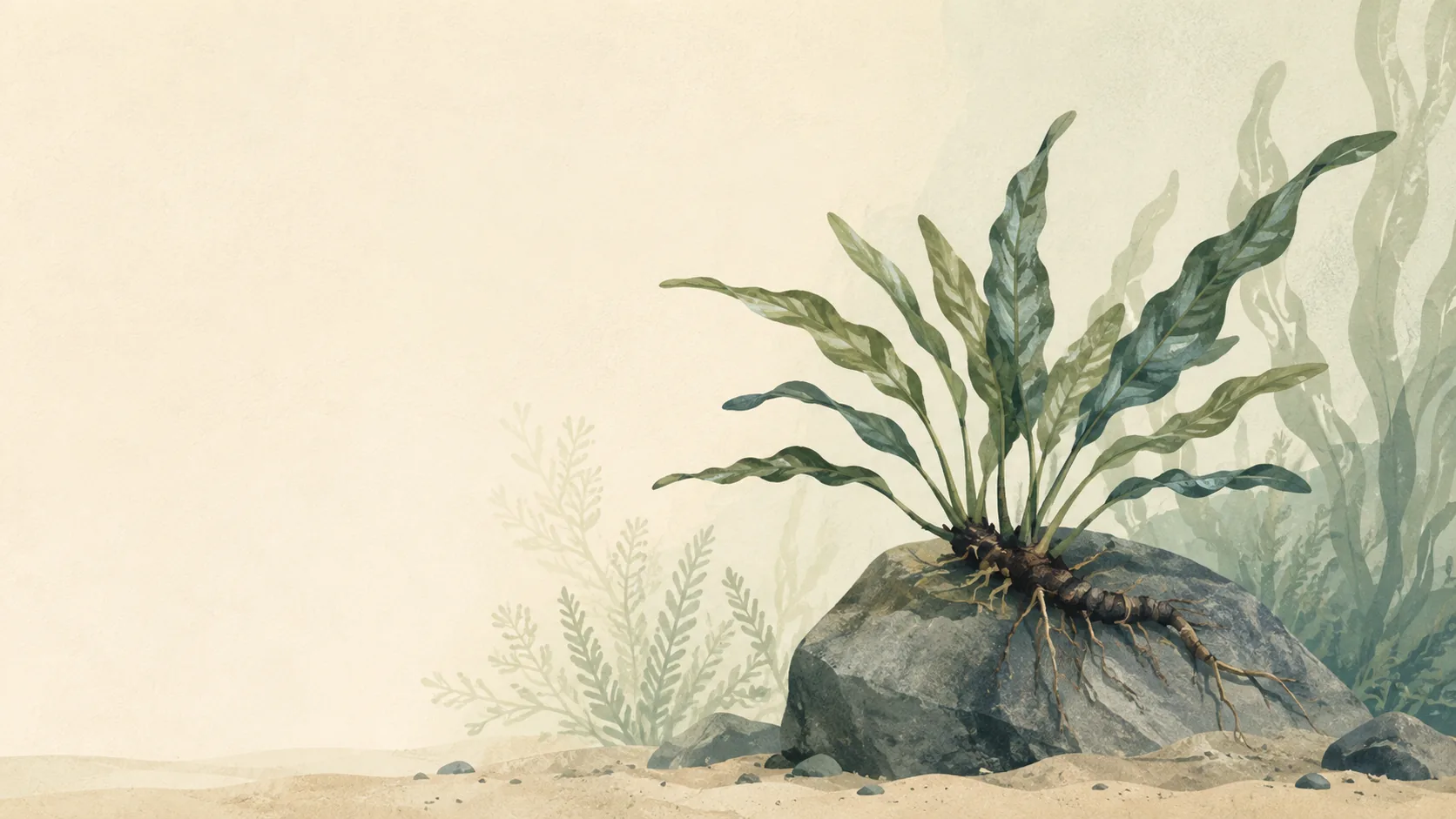
Bucephalandra is a slow-growing rhizome plant from Borneo, grown for its dark leaves, which can take on a blue metallic shade underwater. It attaches to hardscape rather than rooting in substrate, and Tropica rates it easy, with a low demand for light and CO2, once it is past the leaf loss many new plants go through.
Varieties and naming
Plants are sold as Bucephalandra sp. followed by a trade name, because the genus contains a great many forms and the naming in the hobby is not settled. Buy by appearance and by the seller’s variety name rather than expecting a stable binomial.
Expect it to melt
Aquasabi describes the first weeks in a new tank as a period of slow or stagnant growth, with possible loss of adult leaves, especially in Cryptocorynes and Bucephalandra. A plant that looks like it is dying usually is not, and new leaves adapted to life underwater follow.
The mistake is reacting to it. People pull the plant out, move it, or throw it away during the very phase it needs to be left alone. Leave the rhizome attached, keep conditions steady, and wait. This is the same behaviour Cryptocoryne wendtii shows, and there is more on it in the plant melt guide.

Light, CO₂ and attachment
| Requirement | Bucephalandra |
|---|---|
| Light demand | Low |
| CO2 demand | Low |
| Difficulty | Easy |
| Growth rate | Slow |
| Placement | Epiphyte, foreground to mid |
Attach it to rock or wood and keep the rhizome above the surface, exactly as with Anubias and Java fern. Tropica rates its CO2 demand as low, so it does not need injection.
Bucephalandra questions
Why is my Bucephalandra melting?
Losing adult leaves while it acclimatises is normal, and Aquasabi names Bucephalandra as one of the plants most prone to it. Leave it attached and new leaves adapted to submerged life will follow.
Does Bucephalandra need CO2?
No. Tropica rates its CO2 demand as low. It grows slowly either way.
Bucephalandra or Anubias?
Both are slow-growing rhizome plants for wood and rock. Tropica says Anubias thrives even in shady spots. Bucephalandra offers narrow, dark leaves with a metallic sheen, at the cost of possible leaf loss when it arrives.
Sources: Tropica, Bucephalandra diabolica 'Kedagang'; Aquasabi, Appearance of in-vitro plants.