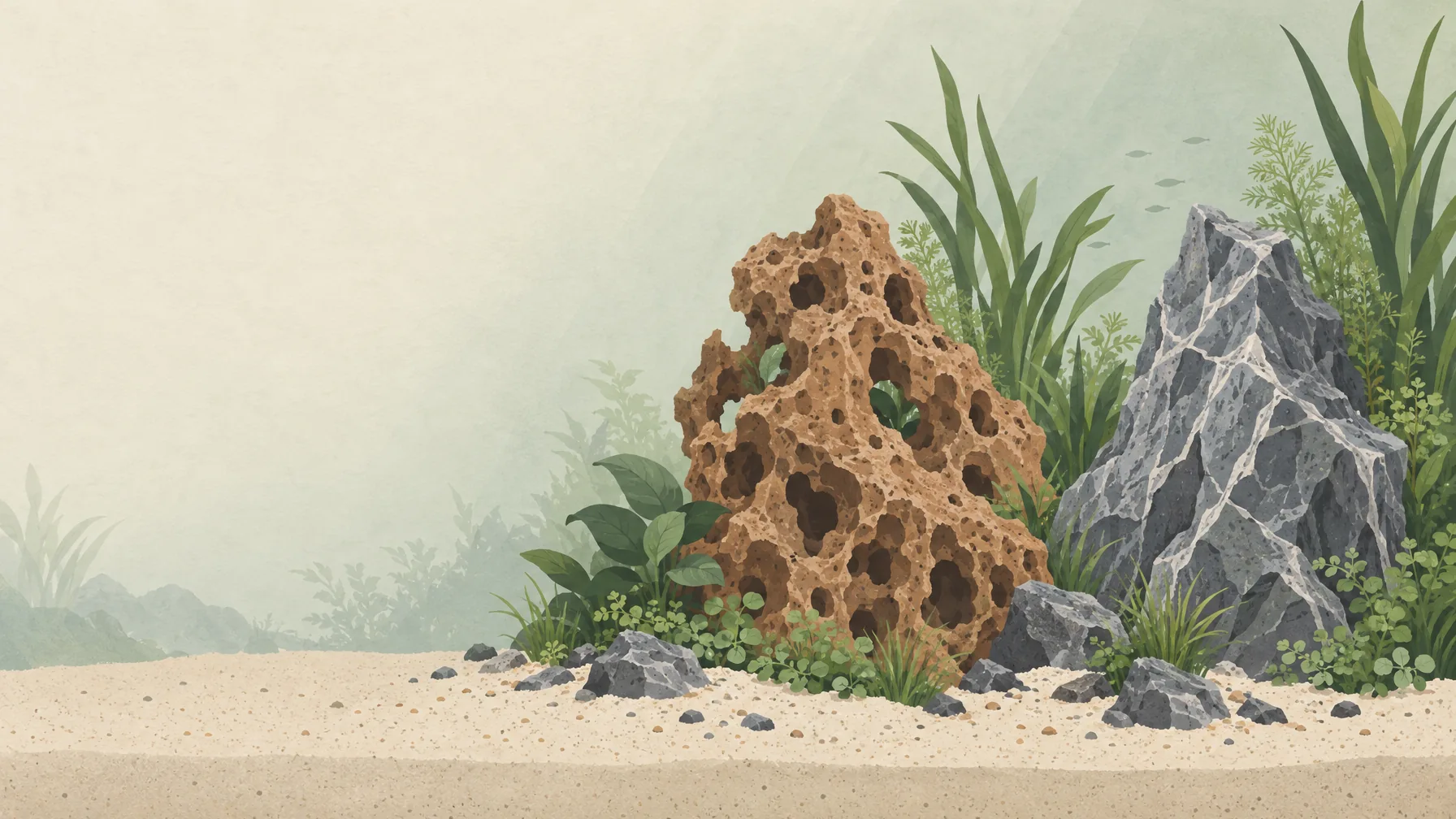
Dragon stone and Seiryu stone are the two rocks most aquascapes are built from, and your water makes the choice. Dragon stone is inert. Seiryu is limestone-based and may harden the water a bit, more so in a tank running CO2. The looks split just as clearly: warm, pitted clay against sharp grey peaks.
Side by side
| Dragon stone (Ohko) | Seiryu stone | |
|---|---|---|
| Made of | Clay-based sedimentary rock | Limestone-based rock |
| Effect on water | Water-neutral | May harden the water a bit |
| Surface | Pitted, full of holes and crevices | Sharp and angular, pale veins in grey |
| Handling | Crushes into fragments quite easily | Compact, but workable with hammer and chisel |
| Suits | Soft water, shrimp, cave-like texture | Hard-water fish, mountain-style layouts |
Water is the difference that matters
Aquasabi classes dragon stone as water-neutral, and Buce Plant says it is inert and will not influence water parameters. Seiryu is the opposite case. Aquasabi says it contains a little lime and may harden the water a bit, and Horizon Aquatics says it may slightly raise pH, KH and GH.
CO2 injection makes the gap wider. In Aquasabi’s article with aquascaper Oliver Knott, calcareous stones tend to harden the water far more when a CO2 system is running, because the carbonic acid dissolves the lime. The remedy he gives is regular, large water changes with soft water.
So the rule is simple. For soft-water fish, shrimp or a high-tech tank, dragon stone removes a variable. Seiryu suits hard-water livestock, or a keeper happy to manage a slow rise in hardness.
Look and layout
Seiryu’s jagged grey rock reads as a mountain range at tank scale, which is why it became the classic stone of the Iwagumi layout. Dragon stone’s holes and overhangs read as caves instead, and its crevices hold moss and small epiphytes, which suits a Nature Aquarium.
Whichever you pick, use one. Aquasabi warns that if you use various types of stone, the whole picture will lose its harmonious effect.
Handling and preparation
Dragon stone is the easier rock to shape and the harder one to clean. Aquasabi says it can be crushed into fragments quite easily, and Buce Plant says it breaks into smaller pieces with a chisel and hammer, though it is relatively brittle. It also holds loam in its crevices, which Aquasabi says to remove with a sharp object before a thorough rinse.
Seiryu is harder to break. Aquasabi calls it quite a compact stone, though still workable with hammer and chisel, and Terrarium Tribe describes it as extremely hard and heavy. On weight, Aquasabi’s bulk-weight table puts the two rocks in the same group, so the same size of layout takes about the same kilos of either.
Not sure which you have?
Looks can mislead. Horizon Aquatics says dark Seiryu is ordinary Seiryu that has been acid-washed, and it looks nothing like the pale original. An acid test settles it: carbonate rock fizzes and clay rock does not. The aquascaping rocks guide covers that test and the two-week soak test that confirms it.
Dragon stone vs Seiryu stone questions
Which is better for shrimp, dragon stone or Seiryu stone?
Dragon stone. It is inert, so it leaves the water stable, while Seiryu may slightly raise pH, KH and GH. Shrimp tanks are where a water-neutral rock does the most good.
Can you mix dragon stone and Seiryu stone?
You can, but Aquasabi advises against it on looks alone: mixing types of stone costs a layout its harmonious effect. Pick one and use it throughout.
Does dragon stone raise pH like Seiryu?
No. Dragon stone is clay-based and water-neutral. Seiryu is the one that may nudge pH, KH and GH upwards, and more so in a CO2-injected tank.
Sources: Aquasabi, Types of hardscape; Aquasabi, Oliver Knott on water-hardening stones; Buce Plant, Dragon Stone (Ohko); Aquasabi, Choose your hardscape by weight; Horizon Aquatics, Dark Seiryu stone vs Seiryu stone; Terrarium Tribe, Seiryu stone hardscape guide.