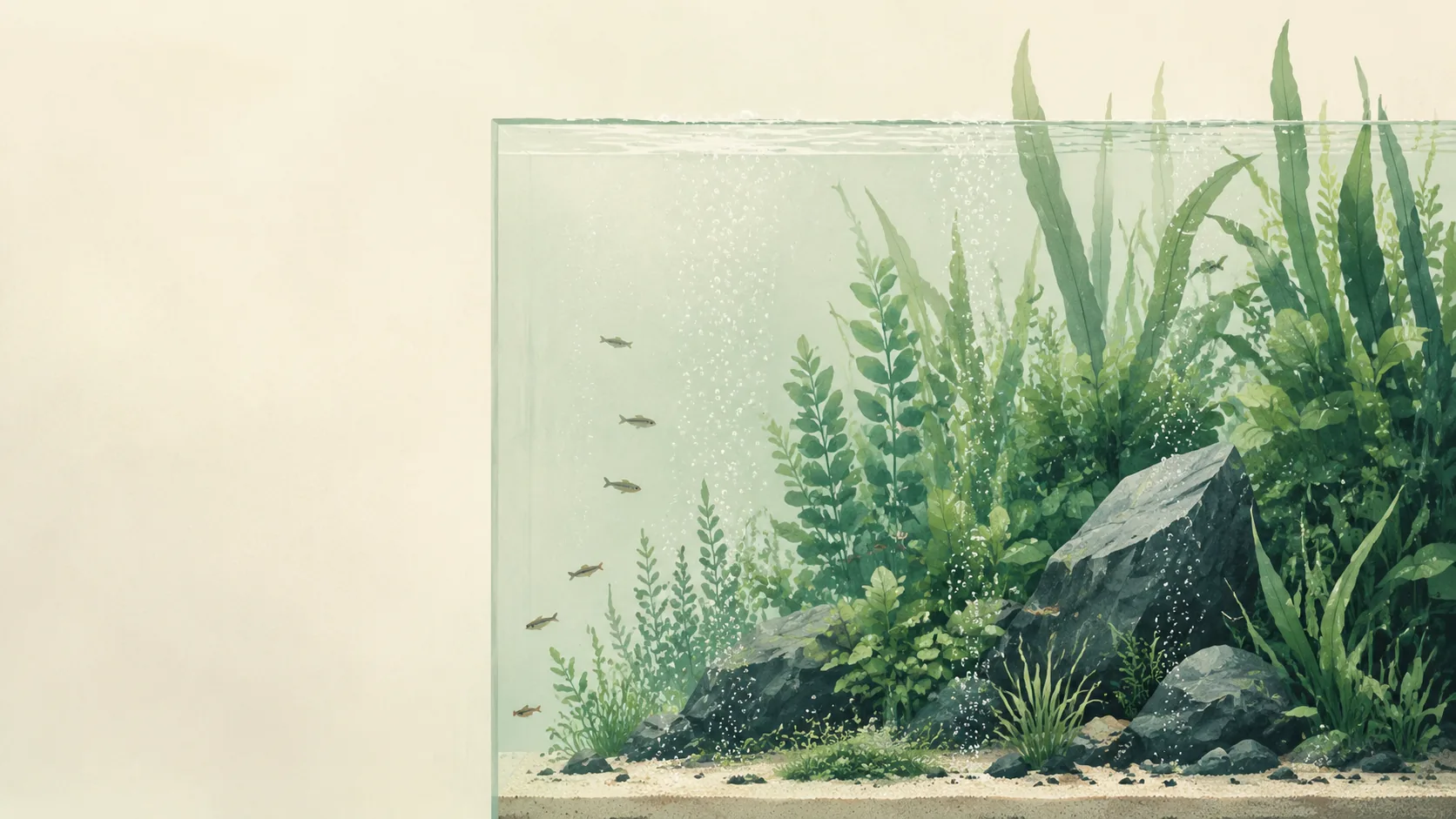
Adding CO2 to an aquarium is the biggest single upgrade available to a planted tank, and the one that separates a low-tech setup from a high-tech one. Carbon is among the most essential nutrients aquatic plants take up, and the amount your fish produce does not stretch far once you have fast-growing plants.
Why plants need added carbon
Plants take up carbon as CO2, and it is one of the nutrients they need most. The aquarium’s inhabitants do produce some, but that supply will not suffice where a higher number of fast-growing plants is present. The plants run short long before anything else in the tank does. Aquasabi adds that most deficiency symptoms, yellow leaves included, can come from a carbon shortage, which our yellowing leaves page helps you tell apart.
What happens next is the part worth understanding. Most aquarium plants do not thrive without CO2 fertilisation, but algae does. So a tank short on carbon does not simply grow its plants more slowly. It tilts the balance toward the organisms that cope better with the shortage, which is why black beard algae is so strongly associated with unstable or insufficient CO2. A CO2 shortage is also one of the causes of hair algae.
Do you actually need it?
Not for every tank. Plenty of hardy species grow perfectly well without it, and an entire approach, the Walstad method, is built on going without.
Where it stops being optional is the demanding carpet plants. Tropica rates dwarf baby tears and Glossostigma as high CO2 demand, and says Monte Carlo needs added CO2 to become really compact. Dwarf hairgrass, by contrast, is rated low. The plant ratings chart shows the CO2 rating of every plant on the site.
Measuring it with a drop checker
A drop checker is the standard way to know where you are. It holds an indicator fluid that changes colour according to the CO2 in the water, and it reads as a simple traffic light.
- Blue: too little CO2.
- Green: the level is about right.
- Yellow: too much.
Two things to know before you trust it. The fluid needs several hours to react, so the colour you are looking at reflects the recent past rather than this minute, and you cannot use it to make instant adjustments. And the fluid needs replacing every four to six weeks for the checker to keep working properly. A drop checker filled a year ago is decoration.
Kit
Pressurised systems running from refillable cylinders are the most efficient option. They cost more to set up than the alternatives and then cost very little to run, which is the usual reason people move to one after a while rather than starting there.
CO₂ questions
Do you need CO2 for a planted tank?
No, not for a low-tech tank of hardy plants. It becomes necessary for plants Tropica rates as high CO2 demand, such as HC Cuba and Glossostigma, and it matters for colour in plants like Alternanthera reineckii, where Tropica calls CO2 material for growth and colour development.
Can CO2 harm fish?
Too much can. That is exactly what the yellow reading on a drop checker is warning you about, and it is the reason to add a checker at the same time as the system rather than afterwards.
Does adding CO2 affect my hardscape?
It can. The carbonic acid that CO2 injection produces dissolves lime deposits faster, so a lime-bearing rock such as Seiryu stone will raise your water hardness more in a CO2-injected tank than in a low-tech one.
Sources: Aquasabi, Refillable CO2 injection system; Aquasabi, Measuring the CO2 level; Tropica, CO2 plant care guide; Tropica, Micranthemum callitrichoides 'Cuba'; Tropica, Glossostigma elatinoides; Tropica, Micranthemum tweediei 'Monte Carlo'; Tropica, Eleocharis acicularis; Tropica, Alternanthera reineckii 'Rosanervig'.