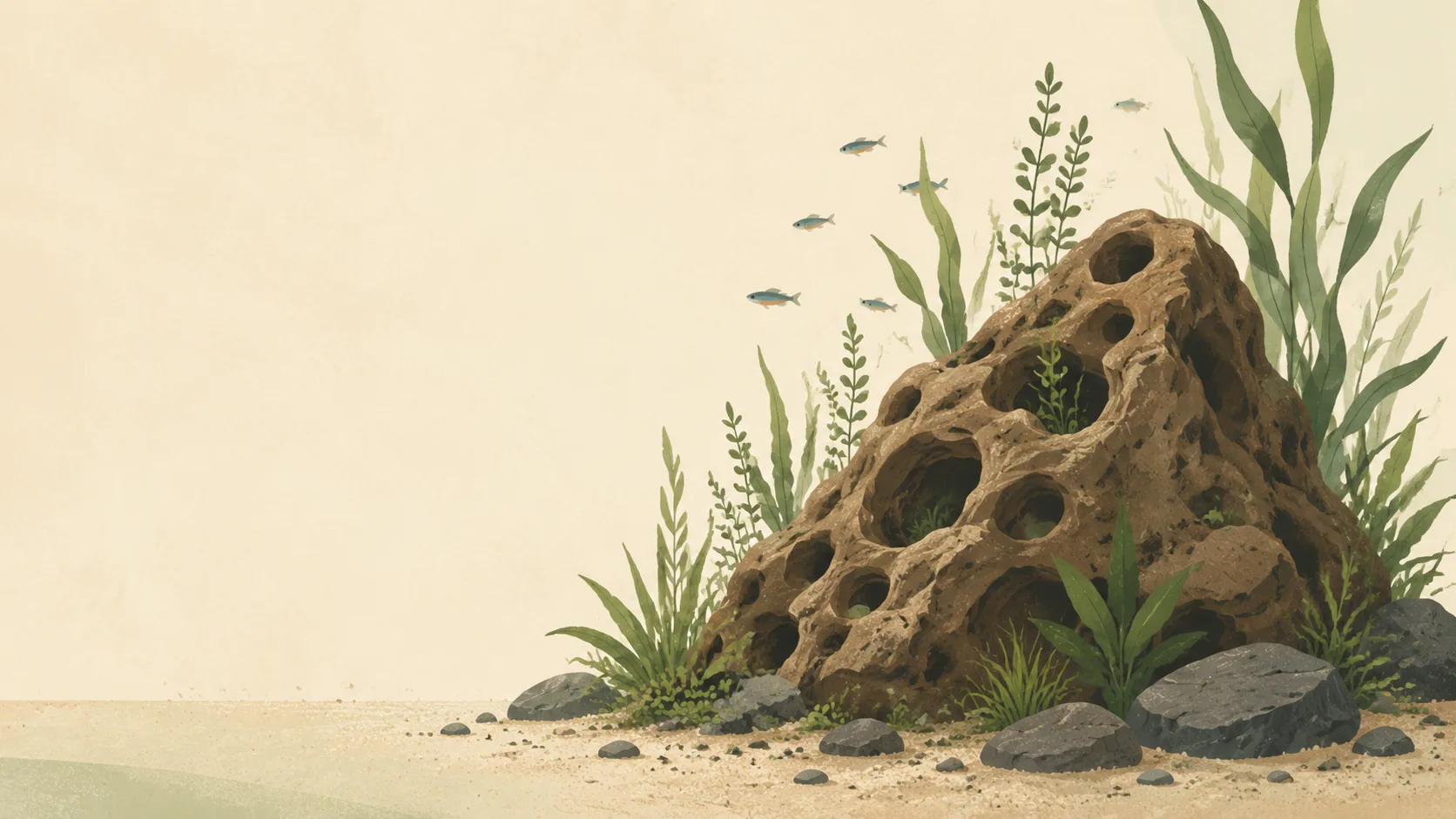
Dragon stone, also sold as Ohko stone, is the pitted, clay-based rock in warm earthen browns that turns up in a huge number of planted aquariums. It is inert, so unlike Seiryu stone it will not push your water hardness around, and it breaks to size easily with a hammer and chisel.
Ohko stone and dragon stone are the same rock
The two names cause more confusion than the rock deserves. Aquasabi lists it as dragon stone with Ohko stone as the alternative name, and Buce Plant sells it as Dragon Stone (Ohko). Same rock, two shop labels, and the spelling “Okho” you will also see is simply a common slip.
What dragon stone looks like
Tan to reddish brown, deeply pitted, and full of hollows and crevices. The name comes from that scale-like surface. Those pockets are the reason people reach for it. They hold moss and small epiphytes, they read as caves and overhangs at aquarium scale, and they catch light in a way flat rock does not.
Is dragon stone inert?
Yes. Dragon stone is an argillaceous rock, meaning clay-based, and it does not influence water hardness. Aquasabi classes it as water-neutral, and Buce Plant describes it as inert. It sits with lava rock in the water-neutral group, which makes it the straightforward choice for soft-water scapes and shrimp tanks, where stable parameters do more for you than any particular rock shape.
That is the practical difference between dragon stone and Seiryu, its usual alternative. Seiryu is limestone-based and slowly hardens the water. Dragon stone does not. If you are unsure which you have, the aquascaping rocks guide covers the acid and soak tests that tell them apart.
Dragon stone compared with Seiryu stone
| Dragon stone (Ohko) | Seiryu stone | |
|---|---|---|
| Effect on water | Water-neutral, does not influence hardness | Limestone-based, may harden the water a bit |
| Surface | Pitted and holey, full of crevices | Sharp and angular, pale veins through grey |
| Handling | Crushes into fragments quite easily | Compact, but workable with hammer and chisel |
| Suits | Soft-water scapes, shrimp, cave-like texture | Hard-water fish, mountain-style layouts |
The water and handling rows come from Aquasabi, and the reason to care is in the first row. A CO2-injected tank dissolves lime faster, so a lime-bearing rock pushes hardness up more in a high-tech setup than in a low-tech one.
Brittle and easy to break
Buce Plant says its clay-like make-up leaves it relatively brittle compared with other stones, and Aquasabi says it can be crushed into fragments quite easily. That cuts both ways. A hammer and chisel will break a large piece into smaller ones when a layout needs them, but careless handling can also break a piece you wanted whole.
Don’t expect it to be light, though. Aquasabi’s table of stones by bulk weight puts dragon stone in the same group as Seiryu, so the same size of layout takes about the same weight of either.
Where does dragon stone come from?
Retail listings are vague on this. Aquasabi and Buce Plant give no source country on their pages, and we haven’t found a reliable source that does, so treat any origin a listing gives with caution. What Aquasabi does give is the rock type: argillaceous, meaning clay-based.
How to prepare dragon stone
Dragon stone is notorious for holding loam deposits in its nooks and crannies, so cleaning is most of the job. Skip it and a new dragon stone aquarium starts life with that loam in the water.
- Soak: start with the stones in a bucket of cold water.
- Pick out the loam: work it out of the crevices with something thin and sharp. Aquasabi suggests a sharp object.
- Rinse: rinse each stone thoroughly. Aquasabi says to remove all clay residues this way, and Buce Plant says rinsing removes natural dust and sediment.
Do all of this before the stone goes into the scape, while every crevice is still easy to reach.
Planting on it
The texture suits epiphytes, which attach to surfaces rather than rooting in substrate. Anubias, Java fern, and Java moss all take to it, and the crevices give you somewhere to wedge a rhizome while it attaches. Just keep the rhizome above the surface rather than buried.
Dragon stone questions
Does dragon stone affect pH or water hardness?
No. It is an inert, clay-based rock that does not influence water hardness, which is what makes it a safe default for soft-water tanks and shrimp.
Do you need to boil dragon stone?
None of the sources behind this page call for boiling it. What they all stress is cleaning: pick the loam out of the crevices and rinse the stone thoroughly before it goes in.
Dragon stone or Seiryu stone?
Dragon stone if you want a knobbly, cave-like rock with no effect on water chemistry that breaks to size easily. Seiryu if you want compact, mountainous grey rock and you are comfortable managing a slow rise in hardness. Use one or the other throughout a scape rather than mixing them.
Sources: Aquasabi, Types of hardscape; Buce Plant, Dragon Stone (Ohko); Aquasabi, Choose your hardscape by weight; Aquasabi, Ohko Dragon Stone (shop listing); Aquarium Science, Rocks.