Author: Joe

  • Dutch Style Aquascaping

    Dutch Style Aquascaping

    The Dutch style is the oldest school of aquascaping: a dense, hardscape-free display built entirely from plants. Where other styles lean on rock and driftwood, a Dutch tank throws them out and lets tiered rows of contrasting stem plants, the famous “Dutch streets”, carry the whole composition. It’s gardening underwater, not landscaping.

    Where it comes from

    The style grew up in the Netherlands from the 1930s onward, shaped by the Dutch aquarium society, the NBAT, which still runs a competition circuit with famously strict scoring rules. That pedigree shows. A proper Dutch scape is a manicured underwater garden rather than a wild slice of nature, judged on tidiness, contrast and plant health as much as on beauty.

    What makes a tank “Dutch”

    Take away the rocks and wood, and a handful of rules do the heavy lifting:

    • Dutch streets. Diagonal rows of plants, graded low to tall, that lead the eye into the tank: planted along a sightline rather than straight across the glass.
    • Groups, not specimens. Each species sits in a defined clump, never dotted around, so colours and leaf textures read as solid blocks.
    • Colour and contrast. Reds against greens, fine leaves against broad ones. A single red group often does the job a focal rock would in another style.
    • Density. Convention keeps roughly 70% of the substrate planted, with little open space and no bare hardscape on show.
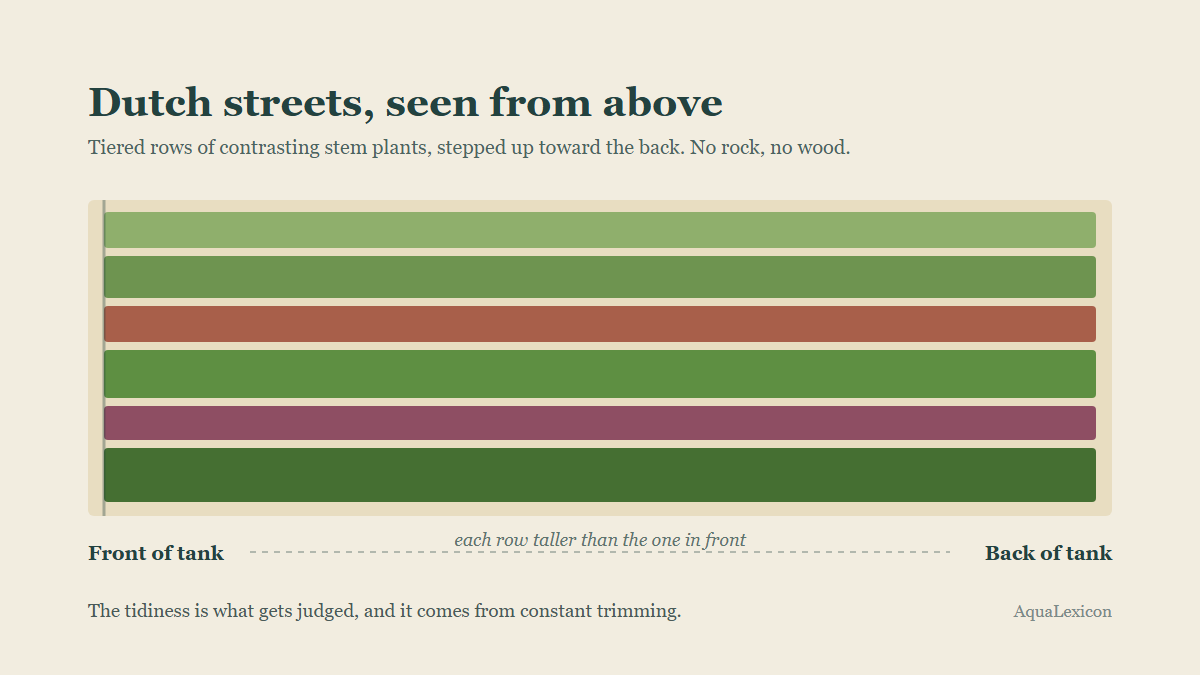
    A top-down view of a Dutch aquascape showing bands of contrasting plant colour stepped so each row sits taller than the one in front.

    The plants that do the work

    Dutch scapes live and die on stem plants, fast growers you trim, top and replant constantly to keep those streets sharp. A few workhorses turn up again and again:

    PlantLatin nameLightCO₂Difficulty
    RotalaRotala rotundifoliaMed–highBeneficialEasy–med
    Ludwigia repensLudwigia repensMediumBeneficialEasy
    Alternanthera reineckiiAlternanthera reineckiiMed–highBeneficialMedium
    BacopaBacopa carolinianaLow–medNot requiredEasy

    Notice the pattern: the colour plants want strong light, and they reward added CO₂ with tighter growth and deeper reds. Alternanthera reineckii in particular only shows its best burgundy under high light. Starve it and it drifts toward a muddy green. Bacopa caroliniana is the exception and the safety net: a hardy green backbone that doesn’t need CO₂ to behave.

    Is the Dutch style for you?

    Be honest with yourself about trimming. A Dutch tank is one of the most maintenance-heavy styles there is: those streets only look crisp because someone prunes and replants them on a schedule, often weekly once the plants take off. If you find pruning meditative, it’s deeply satisfying work. If you want set-and-forget, a low-tech Walstad tank or a simple Iwagumi will frustrate you far less.


    Dutch style questions

    Is the Dutch style harder than other aquascaping styles?

    Generally yes, though the work is in maintaining it rather than setting it up. The look depends on dense, fast-growing stem plants, and keeping them tidy means regular trimming, topping and replanting. The skill is in the upkeep, not the initial layout.

    Do you need CO₂ for a Dutch aquascape?

    In practice, almost always. The colourful stem plants Dutch scapes rely on grow denser and colour up far better with added CO₂ and strong light. You can build a greener, simpler version without it, but the classic vivid, packed Dutch look is hard to reach on a low-tech setup.

    What’s the difference between Dutch and Nature Aquarium styles?

    Hardscape. A Nature Aquarium is built around rock and driftwood arranged to evoke a landscape, with plants supporting that structure. A Dutch tank uses no hardscape at all. The plants are the design, arranged like beds in a formal garden rather than a wild scene.
  • Nature Aquarium Style

    Nature Aquarium Style

    The Nature Aquarium is the style most people picture when they imagine aquascaping: driftwood and rock arranged to evoke a real landscape such as a forest, a hillside or a riverbank, with plants softening the structure until it looks grown rather than built. It’s the style Takashi Amano made famous, and the one the others are usually measured against.

    Where it comes from

    The Nature Aquarium was developed by the Japanese photographer and designer Takashi Amano, whose company ADA still sets much of the aesthetic standard through its annual international layout contest. Amano borrowed from Japanese garden design and the idea of capturing the feeling of a natural scene in miniature, suggesting a place rather than copying one exactly. The minimalist, stone-only Iwagumi layout is really a sub-style within this broader approach.

    What defines it

    • Hardscape first. Driftwood and rock set the structure before a single plant goes in: the layout should read as a landscape even bare.
    • Asymmetry and a focal point. Built on the rule of thirds, with the eye led to one dominant feature rather than a centred, symmetrical scene.
    • Depth. Foreground carpets, midground detail and taller background planting create the illusion of distance.
    • A grown-in feel. Mosses and epiphytes soften the wood until it looks aged, not placed.

    The plants that suit it

    Because the hardscape leads, much of the planting is epiphytes and mosses lashed to wood and rock. These do not root in substrate and they age the layout well:

    PlantLatin nameLightCO₂Difficulty
    Anubias nanaAnubias barteri var. nanaLowNot requiredEasy
    Java fernLeptochilus pteropusLowNot requiredEasy
    BucephalandraBucephalandra sp.Low–medBeneficialEasy
    Christmas mossVesicularia montagneiLow–medBeneficialEasy–med

    Carpets and stem plants then fill the floor and background. Branching spider wood is a favourite for the canopy effect, with Java fern and Anubias attached along its length.

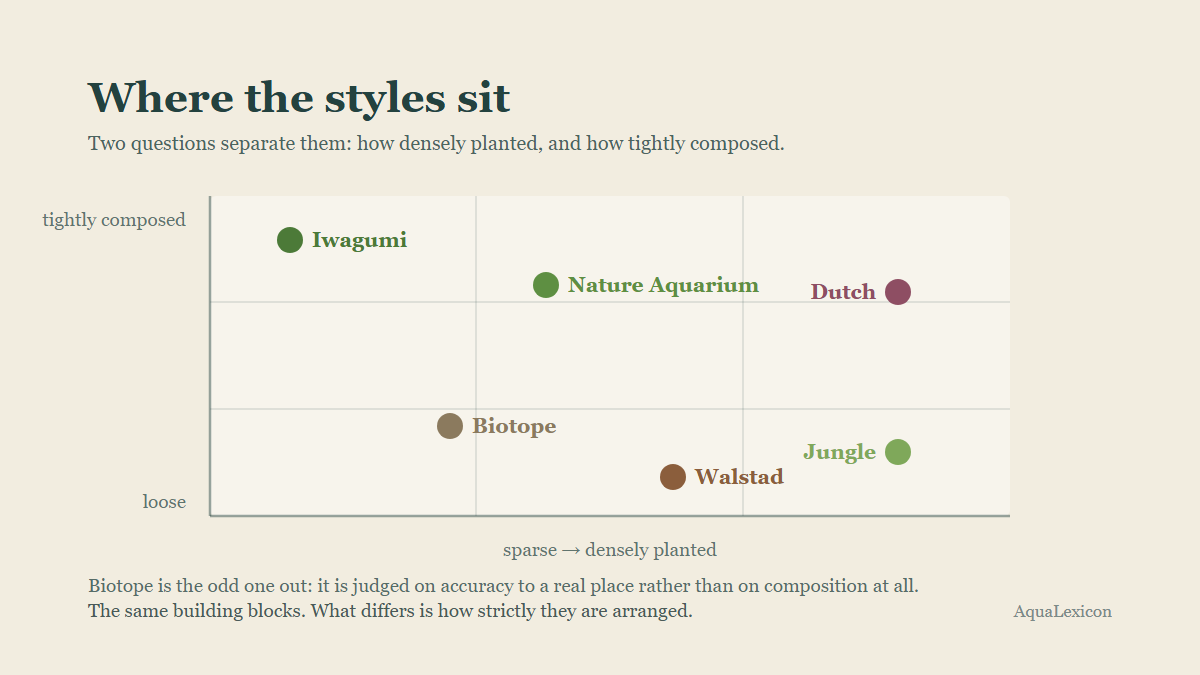
    A chart plotting six aquascaping styles by how densely planted and how tightly composed they are, from sparse and composed (Iwagumi) to dense and loose (jungle).

    Nature Aquarium vs the others

    Set it beside a Dutch tank and the contrast is stark: Dutch is a formal garden with no hardscape and tidy plant rows, while a Nature Aquarium is a wild landscape held together by wood and stone.


    Nature Aquarium questions

    Is the Nature Aquarium style good for beginners?

    It can be. The epiphytes and mosses it leans on are hardy and low-tech, so a simple version is achievable early. The harder part is the composition. Arranging hardscape that reads as a believable landscape takes practice rather than equipment.

    What’s the difference between Nature Aquarium and Iwagumi?

    Iwagumi is a minimalist, stone-only sub-style with usually a single carpet plant. The Nature Aquarium is the broader school it sits inside, and freely uses driftwood and a wider mix of plants.

    Do you need CO₂ for a Nature Aquarium?

    It depends on the planting. A moss-and-epiphyte layout can run low-tech, but the detailed, carpet-heavy contest-style tanks almost always use added CO₂ and strong light to get that lush, filled-in look.

  • Jungle Style Aquascaping

    Jungle Style Aquascaping

    The jungle style is aquascaping’s wild child: dense, overgrown and deliberately untamed. Where other styles prize clean lines, the jungle look leans into controlled chaos, with big leaves, trailing growth and a canopy of floating plants, and any hardscape long since swallowed by greenery. It’s the most forgiving style to live with, and arguably the most relaxing to look at.

    The look

    What marks a tank as jungle rather than just untidy:

    • Big, bold foliage. Large swords and broad crypts, not fine carpets.
    • Layered overgrowth. Plants allowed to grow tall and lean, filling the water column.
    • Floating cover. Surface plants throwing dappled shade, like a forest canopy.
    • Hidden structure. Rock and wood are there, but mostly concealed by growth.

    Plants for a jungle

    Reach for large, hardy plants that look good a little unruly:

    PlantLatin nameLightCO₂Difficulty
    Amazon swordEchinodorus grisebachiiMediumNot requiredEasy
    Java fernLeptochilus pteropusLowNot requiredEasy
    Cryptocoryne wendtiiCryptocoryne wendtiiLow–medNot requiredEasy
    Amazon frogbitLimnobium laevigatumAnyNot requiredEasy

    Tall Vallisneria fills the back wall, the Amazon sword anchors the midground, and floating plants like frogbit complete the canopy. Nearly all of it tolerates low light, which is what makes the style so easy-going.

    A chart plotting six aquascaping styles by how densely planted and how tightly composed they are, from sparse and composed (Iwagumi) to dense and loose (jungle).

    The forgiving upside

    Because the look is meant to be a bit wild, the jungle style hides a multitude of sins. You can skip the precise weekly trimming a Dutch tank demands, most of its plants are hardy low-tech species, and an overgrown corner reads as character rather than failure. It’s a great match for a planted-tank beginner who wants lush results without the maintenance treadmill, much like a Nature Aquarium but with less composition pressure.


    Jungle style questions

    Is the jungle style good for beginners?

    Yes. It is one of the friendliest places to start. The plants are hardy, the look forgives imperfect growth, and there’s no demand for precise trimming or a high-tech setup.

    Do you need CO₂ for a jungle aquascape?

    No. Most jungle plants are low-tech species that grow fine without it. Added CO₂ will speed growth and fill the tank faster, but it isn’t essential to the style.

    What’s the difference between jungle and Nature Aquarium styles?

    A Nature Aquarium is a deliberately composed landscape. The jungle style is intentionally wilder and less structured. Both look natural, but the jungle embraces overgrowth where the Nature Aquarium controls it.

  • The Walstad Method

    The Walstad Method

    The Walstad method is a philosophy more than a look: build a planted tank that runs itself. Named after Diana Walstad, it puts ordinary soil under the gravel and plants the tank heavily, creating a low-tech, self-balancing setup with no CO₂ injection and very few water changes once it settles.

    The idea

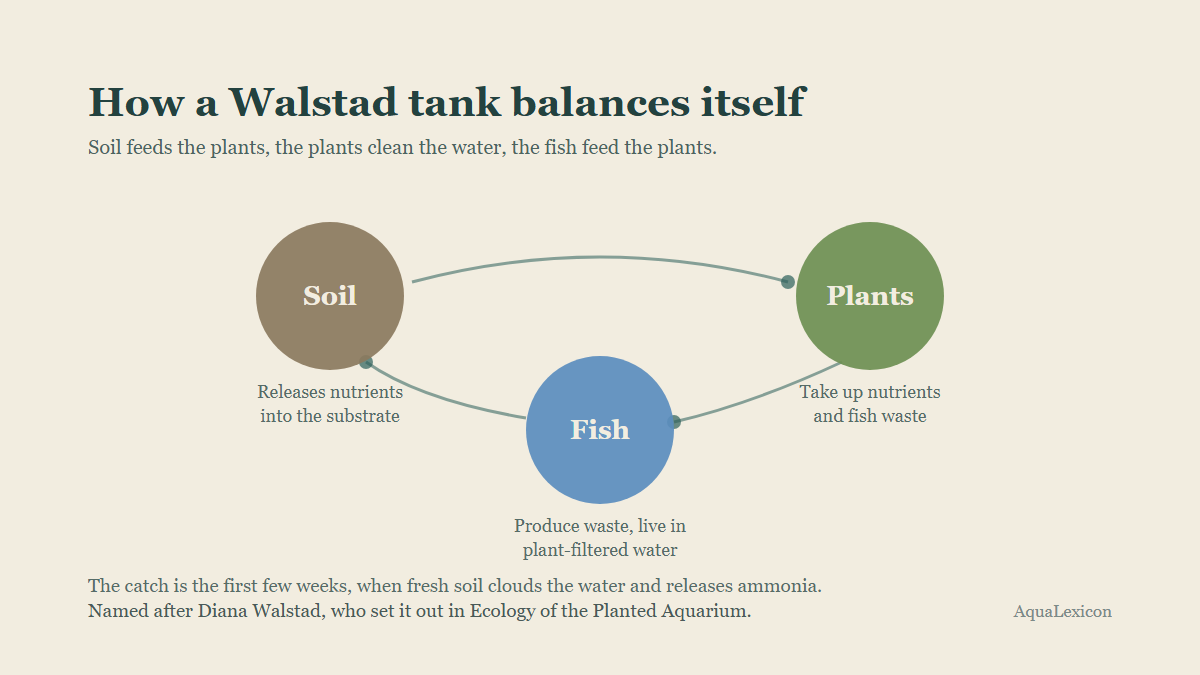
    The argument is that a densely planted tank can balance itself. The plants feed on fish waste and nutrients released by the soil, and the fish in turn live in a stable, plant-filtered environment. Get the balance right and the tank needs very little intervention, which is the entire appeal.

    How it works

    • Soil substrate. A thin layer of plain garden or potting soil, capped with gravel or sand to hold it in place.
    • Heavy planting from day one. Lots of fast-growing and floating plants to outcompete algae while the tank establishes.
    • Low tech. Modest lighting, no pressurised CO₂, minimal dosing.
    • Patience. It can look rough for the first few weeks while the soil settles and roots take hold. The balance comes later.

    Let the plants and the soil do the filtering.

    A three-way loop between soil, plants and fish showing how a Walstad tank balances itself without CO2 injection.

    Plants that thrive

    Stick to hardy, low-light species that don’t need CO₂:

    • Anubias (Anubias barteri var. nana): low light, no CO₂ needed.
    • Java fern (Leptochilus pteropus): low light, attaches to wood.
    • Cryptocoryne wendtii: an undemanding rosette. Expect some “melt” after planting before it recovers.
    • Floating plants such as Amazon frogbit (Limnobium laevigatum): fast nutrient sponges that shade out algae early on.
    • Bacopa caroliniana: a hardy green stem that grows fine without CO₂.

    The trade-offs

    It’s genuinely low-effort once established, but it isn’t magic. The soil can cause a cloudy, ammonia-heavy first few weeks, so it’s not an instant display tank. You’re trading the control and vivid colour of a high-tech Dutch layout for simplicity, and the demanding species in our carpet plants guide generally won’t thrive here without CO₂. If you want hands-off and natural, it is ideal. If you want a manicured showpiece, look elsewhere. New to planted tanks? Pair this with our beginner’s guide and the substrate rundown.


    Walstad method questions

    Do you need CO₂ for a Walstad tank?

    No. Going without CO₂ is the whole point. The method relies on soil and heavy planting rather than injected carbon, so it’s deliberately low-tech.

    Do you have to do water changes with the Walstad method?

    Fewer than a conventional tank once it’s balanced, but “none ever” is overstated. Keep an eye on parameters, especially during the early establishment phase, and change water if they drift.

    Is the Walstad method good for beginners?

    In effort, yes. It is very hands-off once running. The catch is the messy, cloudy start and the patience it demands, which is where some beginners lose their nerve before the tank finds its balance.

  • Biotope Aquariums

    Biotope Aquariums

    A biotope aquarium sets itself a stricter brief than any other style: recreate one real place. Every fish, plant, rock and piece of wood is chosen because it actually occurs together in a specific natural habitat, whether that is a particular South American stream or a Southeast Asian peat swamp. Accuracy is the point, and beauty is a by-product.

    What makes it a biotope

    The defining rule is authenticity. A biotope is a deliberate reconstruction of a named environment, down to the water chemistry, not simply a tank with some wood and tannins in it. Many true biotopes are sparsely planted: a blackwater stream is mostly leaf litter, branches and tea-stained water, with barely a green leaf in sight. Restraint is part of the discipline.

    A discipline, not a decor

    This is where it parts ways with the Nature Aquarium. A Nature Aquarium suggests nature artistically and will happily mix plants from different continents if they look right together. A biotope refuses to: if a species isn’t found in that habitat, it doesn’t go in, however good it would look. It’s the most research-led corner of the hobby, and biotope competitions are judged largely on how faithfully a tank matches the real location.

    A chart plotting six aquascaping styles by how densely planted and how tightly composed they are, from sparse and composed (Iwagumi) to dense and loose (jungle).

    Matching the region

    Plant choice follows geography. A few examples using species from our reference:

    • Southeast Asian streams: Cryptocoryne wendtii and Bucephalandra, both Asian natives.
    • South American waters: Amazon sword (Echinodorus grisebachii) and Vallisneria.
    • Blackwater habitats: often almost no plants at all, where the planting is leaf litter and submerged branches.

    Whatever the region, the test is the same: would these species actually meet in the wild? If not, what you have is a nature-style tank with good intentions. Browse the other approaches on the styles hub if strict accuracy isn’t your goal.


    Biotope questions

    What’s the difference between a biotope and a Nature Aquarium?

    A biotope faithfully reproduces a real habitat using only species that live there together. A Nature Aquarium is an artistic impression of nature and mixes plants and hardscape freely for the best look.

    Do biotope aquariums need a lot of plants?

    Not always. Many authentic biotopes are sparsely planted or have none at all. Leaf litter, wood and the right water often matter more than greenery.

    Are biotope aquariums good for beginners?

    The tank itself can be simple and low-tech. The hard part is the research. Identifying a real habitat and sourcing only species that belong there is what makes a biotope demanding.

  • What Is Aquascaping?

    What Is Aquascaping?

    Aquascaping is the craft of arranging aquatic plants, rocks and driftwood into a deliberate underwater landscape. It is gardening and design carried out inside a fish tank. The fish still matter, but they share the stage with the scenery, and the aim is a living scene that looks composed rather than a tank that happens to have plants in it.

    A quick history

    The hobby has two roots. The Dutch style came first, formalised in the Netherlands from the 1930s as a kind of underwater flower garden. Dense rows of plants, no rocks or wood. Decades later the Japanese designer Takashi Amano reframed everything with the Nature Aquarium, using stone and driftwood to evoke real landscapes. That second wave turned aquascaping into the global hobby it is today.

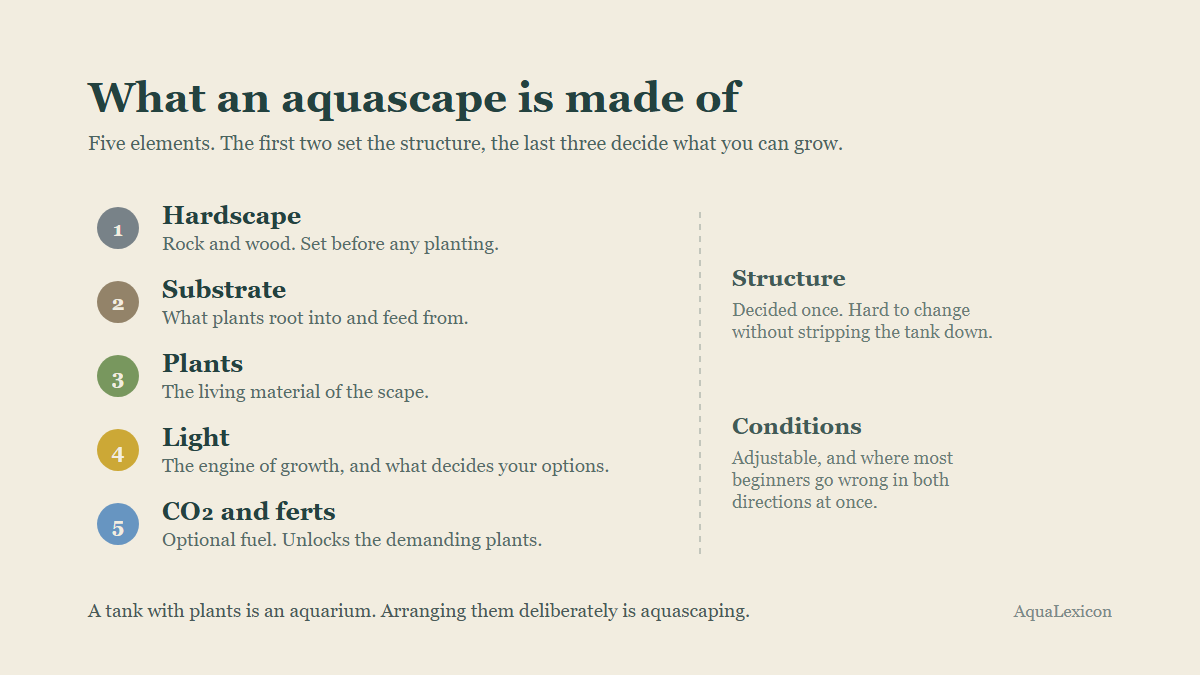
    The building blocks

    • Plants: hardy ferns through to demanding carpet plants. These are the living material of the scape.
    • Hardscape: the rocks and wood that form the structure, set before any planting.
    • Substrate: the soil or aquasoil plants root into and feed from.
    • Light: the engine of plant growth. Intensity decides what you can grow.
    • CO₂ and ferts: optional fuel. Added CO₂ unlocks the demanding plants, but a simple tank does without.

    Those five decide almost everything else, including which styles are open to you and how much maintenance the tank will need.

    The five building blocks of an aquascape: hardscape, substrate, plants, light, and CO2 with fertiliser, split into structure and conditions.

    The main styles

    Most scapes follow one of a handful of styles. The minimalist, stone-only Iwagumi and the landscape-driven Nature Aquarium are the most recognisable. The Dutch style is all plants and no hardscape. The jungle style is deliberately wild and forgiving, the Walstad method is low-tech and hands-off, and a biotope faithfully recreates one real habitat. They share the same building blocks and differ in how they use them.

    What it takes to start

    Less than people think. A modest tank, a few hardy plants, a decent light and some patience will get you a planted tank that looks good, with no pressurised gas involved. The high-tech end is optional and comes later, if at all. Our beginner’s guide walks through the choices that actually matter for a first tank.

    Is it hard?

    As hard as you make it. A low-tech jungle or Walstad tank of hardy plants is genuinely beginner-friendly. A carpeted, CO₂-driven contest layout is not. Most newcomers start at the demanding end, picking the hardest plants and styles before they have learned how plants behave day to day. The forgiving setups teach you exactly that, which is what the demanding ones assume you already know.


    Aquascaping questions

    Is aquascaping only for experts?

    No. The reputation comes from the elaborate competition tanks, but a simple low-tech planted tank using hardy plants is well within reach for a beginner. The difficulty scales with your ambition rather than with the hobby itself.

    Do you need live plants to aquascape?

    Effectively, yes. Living plants are the point. You can arrange hardscape on its own, but the craft is about growing and shaping plant life into a scene, which is what separates an aquascape from a decorated tank.

    Do you need CO₂ for aquascaping?

    Not always. Plenty of hardy plants grow without it, so a low-tech tank needs no CO₂ at all. It becomes worth the cost and the fuss only when you move to demanding carpets and dense, fast growth.

  • Aquascaping for Beginners

    Aquascaping for Beginners

    The easiest way to start aquascaping is to keep it low-tech: a modest tank, hardy plants that don’t need CO₂, and a simple light. Get a feel for how plants actually grow before chasing carpets and pressurised gas. This guide covers the choices that genuinely matter for a first planted tank, plus the beginner mistakes worth dodging.

    Start low-tech

    Resist the urge to buy everything at once. A low-tech setup (no CO₂, modest lighting, hardy plants) teaches you the fundamentals cheaply and forgives mistakes. You can always upgrade later. You can’t un-spend the money on gear you didn’t need. The jungle style and the Walstad method are both built for exactly this kind of relaxed, low-tech start.

    Pick forgiving plants

    Begin with hardy, low-light species that don’t need CO₂ and shrug off beginner errors:

    • Anubias: slow, tough, attaches to wood or rock, and almost impossible to kill.
    • Java fern: another hardy epiphyte that needs no substrate and little light.
    • Cryptocoryne wendtii: an undemanding rosette. Expect some “melt” after planting before it settles.
    • Floating plants: fast growers that mop up nutrients and starve algae while the tank finds its feet.

    Notice what’s not on that list: carpet plants. The lush green lawns that draw people in are mostly the demanding species, so save them for tank two.

    The five building blocks of an aquascape: hardscape, substrate, plants, light, and CO2 with fertiliser, split into structure and conditions.

    The basics: tank, substrate, light

    A wider tank beats a tall one, with more floor area to plant and easier lighting. A nutrient aquasoil gives root-feeders a real head start over plain gravel. And keep the light moderate at first: too much light over a new, lightly planted tank is the fastest route to an algae problem.

    Mistakes beginners make

    • Too much light, too soon. Bright light with few plants feeds algae, not your scape.
    • Demanding carpets first. Starting with HC Cuba or hairgrass without CO₂ ends in a patchy, melting mess.
    • No patience. A new tank needs to cycle and settle. Rushing fish in or judging it after a week is the classic error.
    • Overstocking. Too many fish too fast overwhelms a young tank’s balance.

    Beginner questions

    What’s the cheapest way to start aquascaping?

    A low-tech tank with hardy plants and no CO₂. Skip pressurised gas and high-end lighting at first. A modest light, some Anubias and Java fern, and patience will get you a good-looking planted tank for very little.

    Do you need CO₂ for a beginner planted tank?

    No. Many hardy plants grow perfectly well without it. CO₂ only becomes necessary once you want demanding carpets or dense, fast growth, not for a first low-tech tank.

    How long before a new aquascape looks good?

    Usually a couple of months. Plants need time to root, grow in and fill out, and the tank needs to find its balance. The patience to wait through the awkward early weeks is half the skill.

  • Aquascaping Glossary (A–Z)

    Aquascaping Glossary (A–Z)

    This aquascaping glossary is an A–Z of the terms you will meet in the hobby, covering the styles, plants, hardscape and gear, each with a plain-English definition and a link to the full explainer. Start anywhere, or follow the links through to the pages that cover a term in depth. New entries are added as the library grows.

    A–Z of aquascaping terms

    Just starting out? Begin with what aquascaping is and the beginner’s guide.


    Using this glossary

    What are the most important aquascaping terms to learn first?

    Hardscape, substrate and carpet cover most early conversations. Hardscape is the rock and wood that sets the structure, substrate is what the plants root into, and a carpet is the low, spreading planting across the floor of the tank.

    Do I need to know the Latin plant names?

    Not to get started, but they help when you buy. Trade names vary between shops and some plants are sold under more than one name, so the Latin binomial is the reliable way to check you are getting the species you meant to buy.

    Where should a complete beginner start?

    Read what aquascaping is for the overview, then the beginner’s guide for the practical choices. Come back to this glossary whenever a term turns up that you have not met before.

  • Carpet Plants

    Carpet Plants

    Carpet plants are the low, spreading species that cover an aquarium floor in green, the lawn-like foreground that makes a scape look finished. They’re also where beginners most often come unstuck, because the famous ones are the hardest to grow. The trick is choosing a carpet that matches your setup, not the one in the photo.

    What makes a plant a “carpet”

    A carpet plant stays low and spreads sideways by runners, knitting into a continuous mat across the substrate. That horizontal habit is the easy part. The hard part is that light has to reach all the way to the floor and stay strong there, which is why most true carpets want bright light and, usually, added CO₂.

    The five, side by side

    PlantLatin nameLightCO₂Difficulty
    Staurogyne repensStaurogyne repensMed–highBeneficialEasy–med
    Monte CarloMicranthemum tweedieiMed–highBeneficial→requiredMedium
    Dwarf hairgrassEleocharis acicularisHighRequiredMedium
    Dwarf baby tears (HC Cuba)Hemianthus callitrichoides ‘Cuba’HighRequiredAdvanced
    GlossostigmaGlossostigma elatinoidesHighRequiredAdvanced
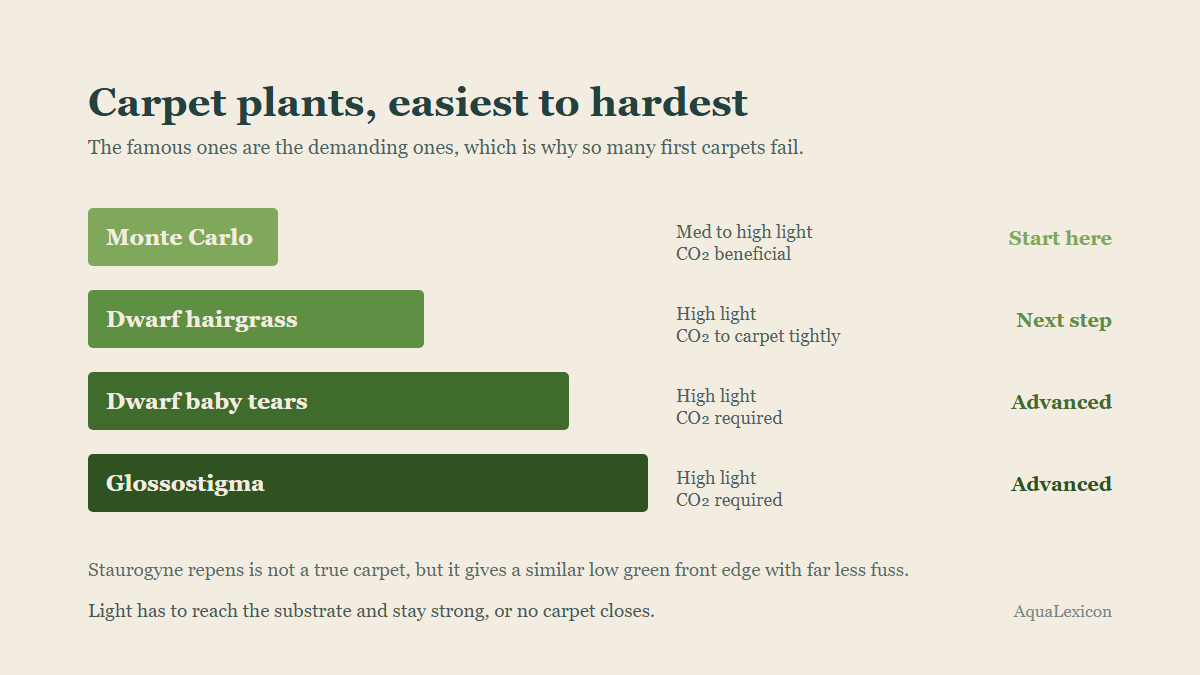
    Carpet plants ranked easiest to hardest with the light and CO2 each needs: Monte Carlo, dwarf hairgrass, dwarf baby tears and Glossostigma.

    Start here

    If you want a realistic first carpet, Monte Carlo is the one to choose. It is the most forgiving, tolerates slightly less light than the rest, and will even limp along without CO₂ (just slowly). Dwarf hairgrass is the next step: grassy rather than leafy, still very doable, but it really does want strong light to carpet tightly rather than grow tall and sparse.

    Approach with caution

    Dwarf baby tears (HC Cuba) and Glossostigma are the carpets behind most of the jaw-dropping photos, and most of the beginner failures. Both demand high light and pressurised CO₂. Without that, they grow leggy, lift off the substrate and melt. They’re rewarding once you’ve got a tank dialled in, but they’re the wrong place to begin.

    The “carpet without the difficulty” option

    Staurogyne repens is a low foreground plant rather than a true carpet, but it gives a similar low, green front edge with far less fuss, tolerating medium light and not strictly needing CO₂. If the demanding carpets feel like a step too far, it’s the sensible compromise.


    Carpet plant questions

    What’s the easiest carpet plant for beginners?

    Monte Carlo. It is the most forgiving of the true carpets and the most tolerant of less-than-perfect light and CO₂, which is why it is the usual recommendation for a first carpet.

    Can you grow carpet plants without CO₂?

    A few, barely. Monte Carlo and Staurogyne can manage without it but grow slowly and less densely. The high-light carpets like HC Cuba effectively need CO₂ to carpet at all.

    Why won’t my carpet plant spread?

    Usually not enough light reaching the floor, or no CO₂. Starved of either, carpets grow upward and leggy instead of spreading sideways, or simply stall.

  • Aquascaping Rocks

    Aquascaping Rocks

    The rocks in an aquascape do two jobs at once: they shape the layout, and some of them change your water chemistry. Choosing stone is not only about looks. A rock that raises your water’s hardness can suit one tank and sabotage another. Here are the common aquascaping rocks and how to pick the right one.

    What rock does to your water

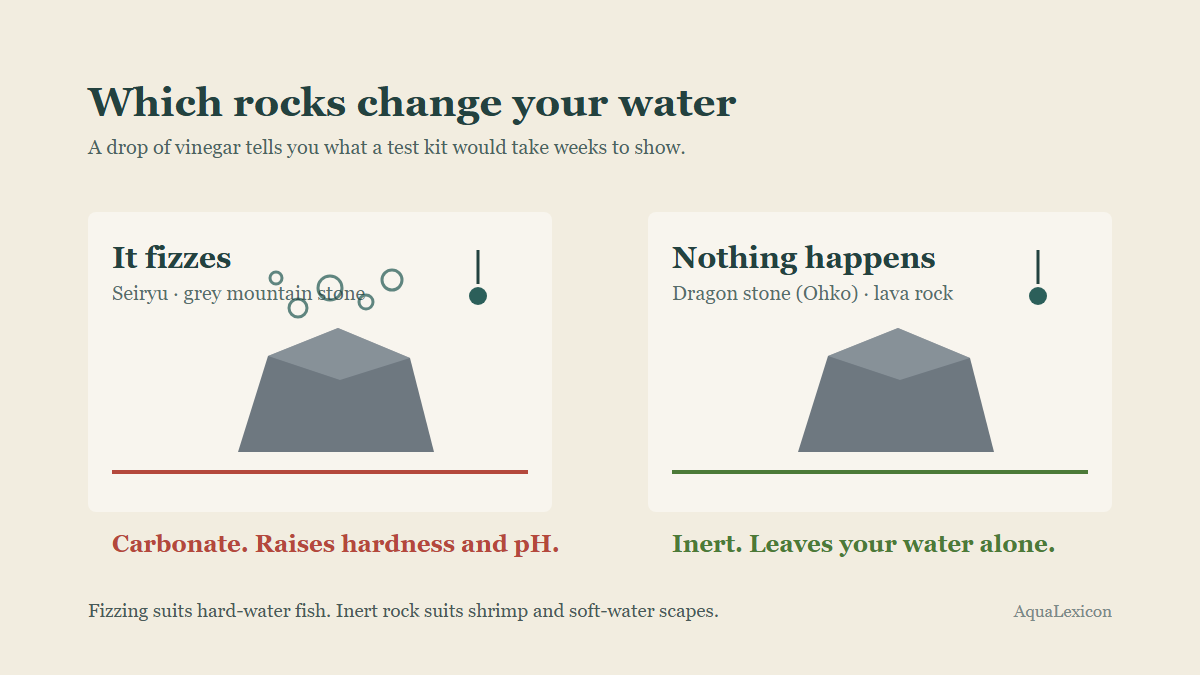
    This is the bit beginners miss. Carbonate (limestone-type) rocks slowly dissolve and raise your water’s hardness and pH, while inert rocks leave it alone. There’s a simple field test: put a drop of vinegar on the stone. If it fizzes, it contains carbonate and will harden your water. That is fine for hard-water fish and a problem for soft-water shrimp and plants.

    The vinegar test. A carbonate rock such as Seiryu fizzes and will harden the water; an inert rock such as dragon stone does nothing.

    The common types

    • Seiryu stone: dramatic jagged grey rock with white veining. It’s limestone-based, so it raises hardness and pH. The classic Iwagumi stone, but best where hard water suits your livestock.
    • Dragon stone (Ohko): tan, knobbly and full of crevices. Largely inert, so it has little effect on chemistry, which makes it forgiving and beginner-friendly.
    • Lava rock: lightweight, porous and inert. Doubles as biological filter media and a cheap base layer to build height.

    Matching rock to your tank

    For a soft-water or shrimp tank, lean on inert stone such as Dragon stone or lava rock, so you are not fighting rising hardness. If your fish are happy in harder water, or you’re buffering deliberately, Seiryu is fair game. On looks: jagged Seiryu reads as mountains for an Iwagumi, while chunky Dragon stone suits caves, overhangs and texture. Whatever you choose, rinse it well and lay your hardscape before planting.


    Questions about aquascaping rock

    Do aquascaping rocks change water parameters?

    Some do. Carbonate rocks like Seiryu raise hardness and pH as they dissolve. Inert rocks like Dragon stone and lava rock do not. The vinegar fizz test tells you which you’ve got.

    Which rock is best for beginners?

    Dragon stone. It’s inert, so it will not alter your water chemistry, and its texture is forgiving and easy to arrange into a natural-looking layout.

    Can you use rocks collected from outside?

    Cautiously. Unknown rocks can leach minerals or carry contaminants, so test with vinegar for carbonate, scrub and rinse thoroughly, and avoid anything metallic, crumbly or from a polluted area.

  • Iwagumi

    Iwagumi

    Iwagumi is a minimalist Japanese aquascaping style built around an odd number of carefully placed stones, usually three, and typically a single carpeting plant. Popularised by Takashi Amano, it prizes open space, asymmetry and one clear focal point, creating a calm, natural-looking underwater landscape rather than a densely planted display.

    Where Iwagumi comes from

    The word iwagumi means “rock formation” in Japanese, and the style grew out of the Nature Aquarium movement led by Takashi Amano. It borrows directly from Japanese garden design and Zen aesthetics: restraint, balance and the suggestion of a much larger landscape inside a small space. Where a Dutch-style tank is a lush plant showcase, Iwagumi is the opposite. Stone is the star, and the planting is deliberately simple.

    The stones and their roles

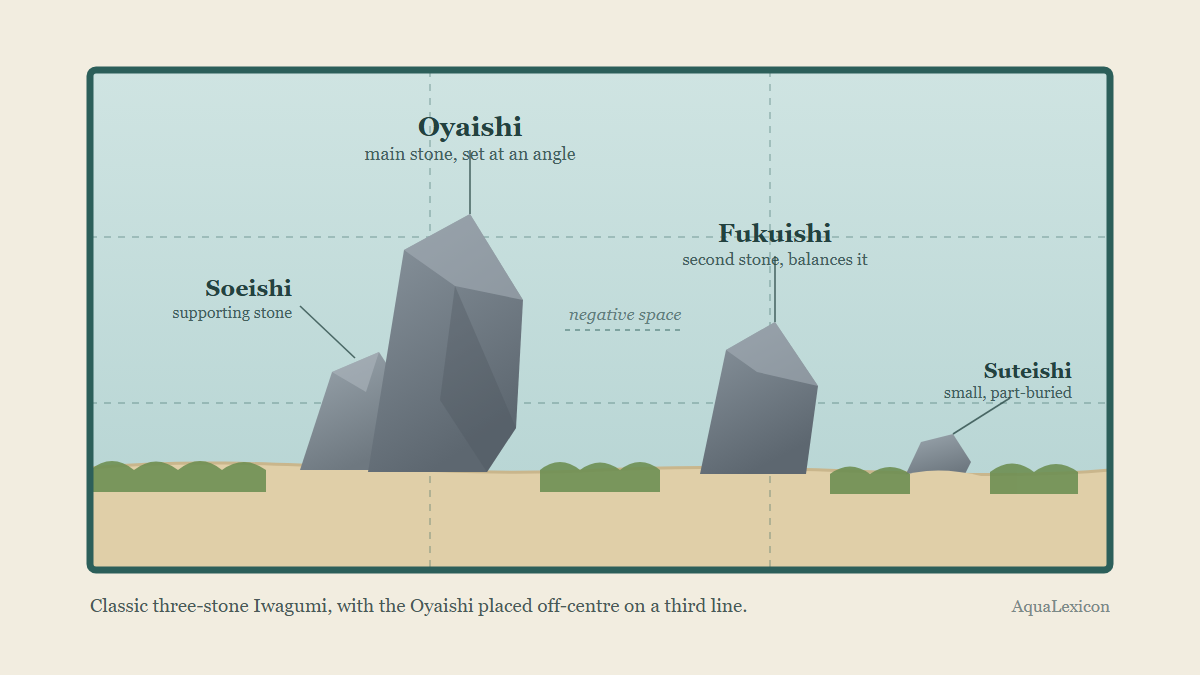
    A classic Iwagumi uses an odd number of stones (three, five or seven) so the layout never falls into symmetry. In a three-stone arrangement each rock has a defined role:

    • Oyaishi: the main stone. The largest, set at an angle and placed off-centre as the composition’s single focal point.
    • Fukuishi: the second stone. Smaller than the Oyaishi, it sits to one side and balances it.
    • Soeishi: the supporting stone. Smaller again, it complements the two main stones rather than competing with them.
    • Suteishi: the “sacrificial” stone. The smallest, often partly buried, adding naturalness without drawing the eye.

    One more rule of thumb: use a single type of stone throughout, with Seiryu stone and dragon stone the common choices, so the formation reads as one natural outcrop rather than a collection of unrelated rocks.

    Cross-section of a three-stone Iwagumi layout with the Oyaishi, Fukuishi, Soeishi and Suteishi labelled, rule-of-thirds guides marked and the negative space called out.

    Composition principles

    • The rule of thirds: the Oyaishi sits about a third of the way across, never centred.
    • A single focal point: everything guides the eye to the main stone.
    • Negative space: open substrate and open water are part of the design, not gaps to fill.

    Plants for an Iwagumi

    Iwagumi almost always uses one carpeting species, kept low so the stones dominate. Because a tight carpet generally needs strong light and added CO₂, Iwagumi tanks are usually high-tech setups. The common choices:

    Carpet plantLatin nameLightCO₂Difficulty
    Dwarf hairgrassEleocharis acicularisHighRequired for a true carpetMedium
    Monte CarloMicranthemum tweedieiMed–highBeneficial→requiredMedium
    Dwarf baby tears (HC Cuba)Hemianthus callitrichoides ‘Cuba’HighRequiredAdvanced
    GlossostigmaGlossostigma elatinoidesHighRequiredAdvanced

    Monte Carlo and dwarf hairgrass are the more forgiving starting points. HC Cuba and Glossostigma give the finest carpet but are the most demanding.

    Livestock

    The open water above the carpet suits small, peaceful schooling fish and shrimp. Ember tetra (Hyphessobrycon amandae), chili rasbora (Boraras brigittae) and Amano shrimp (Caridina multidentata), which also grazes algae, are popular. Because compatibility depends on the full combination of tank size, temperament and water parameters, run any stocking list through a stocking calculator before you buy rather than assuming individual species will get along.

    Common mistakes

    • Using an even number of stones, or a symmetrical layout.
    • Mixing different rock types, which breaks the natural look.
    • Filling the open space instead of treating it as part of the design.
    • Choosing a demanding carpet without the strong light and CO₂ it needs to grow flat.

    Iwagumi questions

    How many stones do you need for an Iwagumi?

    An odd number, classically three: the Oyaishi (main), Fukuishi (second) and Soeishi (supporting). That keeps the arrangement asymmetrical. Larger tanks may use five or seven.

    Do you need CO₂ for an Iwagumi tank?

    Usually yes. The carpeting plants Iwagumi relies on need strong light and added CO₂ to grow into a dense, flat carpet, so most Iwagumi tanks run CO₂. A lower-tech version is possible but harder to carpet well.

    What’s the difference between Iwagumi and the Nature Aquarium style?

    Iwagumi is a minimalist, stone-only sub-style within the broader Nature Aquarium approach. Nature Aquarium layouts can include driftwood and a wider variety of plants. Iwagumi is rocks plus, typically, a single carpet.

  • Monte Carlo

    Monte Carlo

    Monte Carlo (Micranthemum tweediei) is a low, spreading carpet plant with small round leaves, and the most forgiving of the popular aquarium carpets. It’s the one to choose if you want a green lawn without the demands of HC Cuba, tolerating slightly less light and even limping along without pressurised CO₂, just more slowly.

    What it needs

    • Latin name: Micranthemum tweediei
    • Type: carpet / foreground
    • Light: medium–high
    • CO₂: beneficial, and effectively required for a tight carpet
    • Difficulty: medium
    • Growth rate: medium

    Growing Monte Carlo

    Plant small portions spaced out across the substrate rather than one clump. Under good light they send out runners and knit together into a mat. A nutrient-rich substrate gives the roots something to work with. As carpets go it’s among the easier ones, slightly more forgiving than HC Cuba, which is why it’s the carpet most beginners should start with. For the full comparison, see our carpet plants guide.

    Carpet plants ranked easiest to hardest with the light and CO2 each needs: Monte Carlo, dwarf hairgrass, dwarf baby tears and Glossostigma.

    Getting it to carpet

    The two levers are light and CO₂. Strong light reaching the substrate keeps growth low and dense. Added CO₂ tightens it into a proper flat carpet. Without CO₂ it still grows, but slower and looser, and may reach upward rather than hugging the floor. If it starts growing tall, that’s the signal it wants more light down low.


    Monte Carlo questions

    Is Monte Carlo good for beginners?

    It’s the best carpet to start with. It’s the most forgiving of the popular carpets, though it still wants decent light to stay low and spread, so it is beginner-friendly by carpet standards rather than no-effort.

    Does Monte Carlo need CO₂?

    It’s beneficial and effectively required for a dense, tight carpet. The plant survives without it, but grows more slowly and less compactly, so most people running it as a true carpet add CO₂.

    Monte Carlo or dwarf baby tears?

    Monte Carlo has slightly larger leaves and is more forgiving. dwarf baby tears (HC Cuba) gives a finer carpet but is an advanced plant. For a first carpet, Monte Carlo is the safer choice. Dwarf hairgrass is the grassy alternative.

  • Dwarf Hairgrass

    Dwarf Hairgrass

    Dwarf hairgrass (Eleocharis acicularis) is a grassy carpet plant that spreads by runners into a fine, lawn-like foreground. It’s a popular Iwagumi carpet, but it comes with one firm condition: it needs strong light reaching the substrate, or it grows tall and sparse instead of carpeting flat.

    Conditions it wants

    • Latin name: Eleocharis acicularis
    • Type: carpet / foreground
    • Light: high
    • CO₂: required for a true carpet
    • Difficulty: medium
    • Growth rate: medium

    Growing dwarf hairgrass

    Split it into small clumps and plant them spaced out across the substrate, and they fill the gaps by sending out runners. A nutrient substrate helps it establish. Trimming the tips encourages it to spread sideways rather than upward. It pairs naturally with an Iwagumi layout, where a single low carpet sets off the stones.

    Carpet plants ranked easiest to hardest with the light and CO2 each needs: Monte Carlo, dwarf hairgrass, dwarf baby tears and Glossostigma.

    Getting it to carpet, not grow tall

    This is the make-or-break point. Dwarf hairgrass won’t carpet tightly without CO₂, and it needs high light reaching the floor. Give it both and it stays low and dense. Starve it of either and the blades stretch upward, thin out and the carpet never closes. If yours is growing tall and patchy, light to the substrate and CO₂ are the first things to check.


    Dwarf hairgrass questions

    Does dwarf hairgrass need CO₂?

    For a true, tight carpet, yes. It will grow without CO₂, but tends to come in taller and looser rather than forming the dense low lawn it’s grown for.

    Why is my dwarf hairgrass growing tall instead of spreading?

    Almost always too little light reaching the substrate, or no CO₂. Both push the plant to grow upward in search of light rather than spreading flat. Stronger lighting and CO₂ usually fix it.

    Dwarf hairgrass or Monte Carlo?

    Hairgrass gives a grassy texture, Monte Carlo a leafy one. Both are medium difficulty, but Monte Carlo is a touch more forgiving on light and CO₂, so it’s often the easier first carpet. See the carpet plants guide to compare.

  • Dwarf Baby Tears (HC Cuba)

    Dwarf Baby Tears (HC Cuba)

    Dwarf baby tears (Hemianthus callitrichoides ‘Cuba’), usually shortened to HC Cuba, is the smallest-leaved and finest aquarium carpet, and also the most demanding. It produces the dense, manicured green lawn behind countless contest tanks, but it needs high light and pressurised CO₂ to get there, which puts it firmly in advanced territory.

    What HC Cuba demands

    • Latin name: Hemianthus callitrichoides ‘Cuba’
    • Type: carpet / foreground
    • Light: high
    • CO₂: required
    • Difficulty: advanced
    • Growth rate: medium

    Growing HC Cuba

    Plant tiny portions across the substrate and give it bright light and pressurised CO₂ from the start. Under the right conditions it forms a remarkably fine, dense carpet. Under the wrong ones it grows leggy, lifts away from the substrate and melts. It is the classic high-tech carpet that punishes shortcuts. A nutrient substrate and stable conditions matter more here than with any other carpet.

    Carpet plants ranked easiest to hardest with the light and CO2 each needs: Monte Carlo, dwarf hairgrass, dwarf baby tears and Glossostigma.

    Is it the right carpet for you?

    Be honest about your setup. HC Cuba is an advanced, high-tech plant. Without strong light and CO₂ it will fail, and no amount of patience substitutes for those. If you’re starting out or running low-tech, Monte Carlo gives a similar look with far more forgiveness, and dwarf hairgrass is the grassy middle ground. Come to HC once your tank is dialled in. The carpet plants guide lays out the full easy-to-hard order.


    HC Cuba questions

    Is dwarf baby tears hard to grow?

    Yes. It is an advanced plant. It needs high light and pressurised CO₂ to carpet, and it melts or grows leggy without them, so it isn’t a beginner’s carpet.

    Can you grow HC Cuba without CO₂?

    Effectively no. CO₂ is required for it to form a carpet. Without it the plant struggles, detaches and typically fails rather than spreading.

    HC Cuba or Monte Carlo?

    HC Cuba gives a finer, denser carpet but is advanced. Monte Carlo is larger-leaved, more forgiving and the better starting point. Most people are happier beginning with Monte Carlo and moving to HC later.