Category: Hardscape

Rocks and driftwood — the structural bones of an aquascape — and how different materials shape a layout.

  • Dragon Stone (Ohko)

    Dragon Stone (Ohko)

    Dragon stone, also sold as Ohko stone, is the holey, eroded rock in warm earthen browns that turns up in a huge number of planted aquariums. It is a clay-based rock and it is water-neutral, so unlike Seiryu stone it will not push your water hardness around.

    What dragon stone looks like

    Tan to reddish brown, deeply pitted, and full of hollows and crevices that give it the scaled look the name comes from. Those pockets are the reason people reach for it. They hold moss and small epiphytes, they read as caves and overhangs at aquarium scale, and they catch light in a way flat rock does not.

    It leaves your water alone

    Dragon stone is an argillaceous rock, meaning clay-based, and it does not influence water hardness. It sits with lava rock in the water-neutral group, which makes it the straightforward choice for soft-water scapes and shrimp tanks where stable parameters do more for you than any particular rock shape.

    That is the practical difference between the two most popular aquascaping stones. Seiryu contains lime and slowly hardens the water. Dragon stone does not. If you are unsure which you have, the aquascaping rocks guide covers the vinegar test that tells them apart.
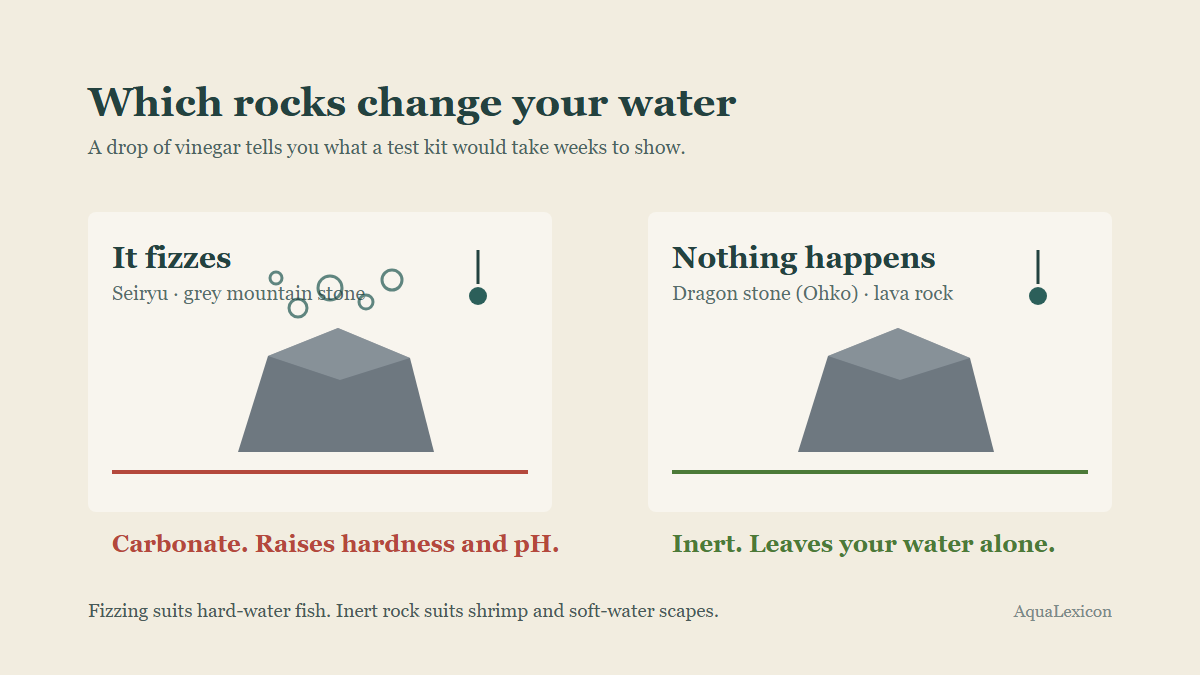
    The vinegar test. A carbonate rock such as Seiryu fizzes and will harden the water; an inert rock such as dragon stone does nothing.

    Clean it properly first

    Dragon stone is notorious for holding loam deposits in its nooks and crannies. Skip the cleaning and the first fill clouds badly, then takes days to clear.

    Rinse it hard and brush the pits out before it goes anywhere near the tank. This is the single most common complaint about the stone and it is entirely avoidable.

    Planting on it

    The texture suits epiphytes, which attach to surfaces rather than rooting in substrate. Anubias, Java fern and Java moss all take to it, and the crevices give you somewhere to wedge a rhizome while it attaches. Just keep the rhizome above the surface rather than buried.


    Dragon stone questions

    Does dragon stone affect pH or water hardness?

    No. It is classed as water-neutral and does not influence hardness, which is what makes it a safe default for soft-water tanks and shrimp.

    Do you need to boil or soak dragon stone?

    Boiling is not necessary, but thorough cleaning is. Rinse and brush the loam out of the crevices, or the tank will cloud on the first fill.

    Dragon stone or Seiryu stone?

    Dragon stone if you want a knobbly, cave-like texture and no effect on water chemistry. Seiryu if you want sharp, mountainous grey rock and you are comfortable managing a slow rise in hardness. Use one or the other throughout a scape rather than mixing them.


  • Seiryu Stone

    Seiryu Stone

    Seiryu stone is the rugged grey rock, often shot through with white veins, that defines the classic Japanese aquascape. It is the signature stone of Iwagumi layouts. The one thing to know before buying it is that it contains a little lime, so it will harden your water slightly.

    What Seiryu stone looks like

    Sharp, angular grey rock with deep crevices and pale veins running through it. Those jagged edges are why it reads as a mountain range in miniature, and why it became the default choice for the stone-led layouts Takashi Amano popularised. It is also sold as Ryuoh stone, and the two names describe the same rock.

    It hardens your water

    This is the part that catches people out. Seiryu contains a little lime, so it slowly dissolves and raises the carbonate and total hardness of your water. The effect is described as slight rather than dramatic, but it is real and it is continuous.

    Two things make it stronger. The more textured the stone, the more surface is in contact with the water and the greater the influence. And if you run CO2 injection, the carbonic acid it produces dissolves those lime deposits faster, pushing hardness up further than the same rock would in a low-tech tank.

    The standard counter is water changes. Weekly changes of around half the tank volume keep the effect in check.

    The vinegar test. A carbonate rock such as Seiryu fizzes and will harden the water; an inert rock such as dragon stone does nothing.

    When to choose it, and when not to

    • Good fit: hard-water fish, tanks where you are buffering hardness deliberately, and anyone happy to keep up regular water changes.
    • Think twice: soft-water species and shrimp tanks, where stable parameters matter more than the look of the rock.
    • The alternative: dragon stone is water-neutral and gives you a knobbly, cave-like texture instead of sharp peaks.

    Whichever you pick, use one rock type throughout the scape. Mixing a lime-bearing stone with a neutral one makes the hardness effect harder to predict, and it breaks the illusion that the stones are one natural outcrop. There is more on that in the aquascaping rocks guide.


    Seiryu stone questions

    Does Seiryu stone raise pH?

    Yes, slightly. The lime it contains dissolves over time and raises carbonate and total hardness, which pulls pH up with it. Regular water changes of around half the volume keep the effect manageable.

    Is Seiryu stone safe for shrimp?

    It can be kept with shrimp, but it is not the easy choice. Shrimp do best with stable water, and a rock that is continuously nudging hardness upward works against that. A water-neutral stone such as dragon stone or lava rock is the simpler option.

    Why is Seiryu stone used for Iwagumi?

    Its sharp, angular shape and grey colour suggest cliffs and mountains, which is exactly the effect an Iwagumi layout is after. Because the style uses only a handful of stones and one carpet plant, the character of the rock carries the whole composition.

  • Spider Wood

    Spider Wood

    Spider wood is the pale, thin, root-like driftwood that branches out into fine tendrils, and it is one of the most-used woods in modern aquascaping. It suits the Nature Aquarium look because its branching reads as tree roots or bare winter growth at tank scale.

    It will float at first

    Spider wood is lightweight, so it will almost certainly float when it first goes in. This is normal and temporary, and it is the single thing most likely to catch out someone using it for the first time.

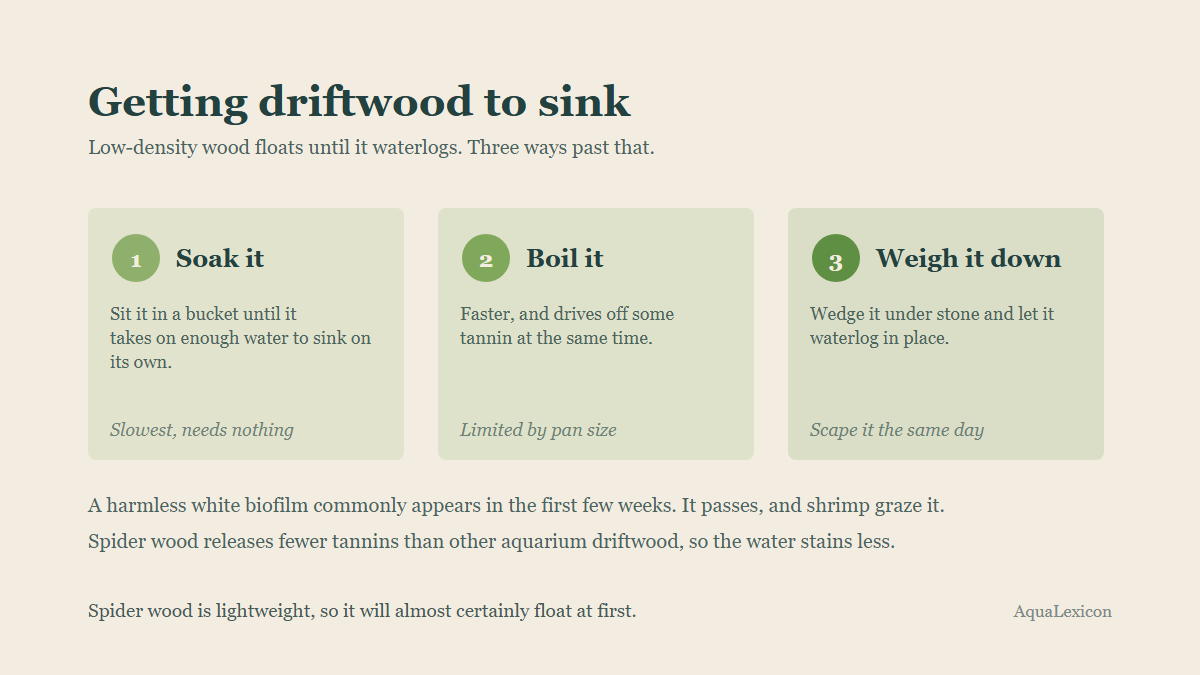
    Two ways round it. Soak it in a bucket until it takes on enough water to sink on its own, or boil it, which does the same job faster. If you would rather not wait at all, weigh it down with stone until it waterlogs, which is the same trick used with other low-density woods.

    Three ways to waterlog buoyant driftwood so it sinks: soak it, boil it, or weigh it down with stone.

    Tannins and tinted water

    All driftwood releases tannins, which tint the water an amber or tea colour. Spider wood is on the lower end for this compared with other aquarium driftwood, and a quick boil reduces it further while also helping the wood sink.

    Whether you treat the tint as a problem is up to you. Filter media such as activated resins will clear it, or you can simply sit it out, since it fades as the wood exhausts. Plenty of aquascapers want the tint, and a blackwater biotope is built around it.

    The white fuzz is normal

    A harmless white biofilm commonly develops on spider wood during the first few weeks. It looks alarming, it is not a fungus attacking your tank, and it passes on its own as the wood settles. Shrimp and some fish will graze it. Removing the wood to scrub it does more harm than leaving it be.

    Planting on it

    The fine branching is ideal for epiphytes, which attach to surfaces instead of rooting in substrate. Tie or glue Java fern, Anubias or Java moss to the branches and let them take hold over a few weeks.

    Keep the rhizome above the surface. Burying it is the most common way to kill an otherwise indestructible plant.


    Spider wood questions

    How long does spider wood take to sink?

    It varies with the size and density of the piece. Soaking in a bucket works but can take a while, and boiling speeds it up considerably. Weighing it down with stone lets you set the scape up immediately while the wood waterlogs in place.

    Should I remove the white fuzz on my spider wood?

    No need. The white biofilm is harmless, common in the first few weeks, and clears on its own. Shrimp and some fish eat it.

    Does spider wood lower pH?

    Driftwood releases tannins and humic acids that can soften and slightly acidify water, though the effect is modest in a tank with regular water changes. Spider wood releases fewer tannins than other aquarium driftwood, so its influence is at the gentler end.

  • Aquascaping Rocks

    Aquascaping Rocks

    The rocks in an aquascape do two jobs at once: they shape the layout, and some of them change your water chemistry. Choosing stone is not only about looks. A rock that raises your water’s hardness can suit one tank and sabotage another. Here are the common aquascaping rocks and how to pick the right one.

    What rock does to your water

    This is the bit beginners miss. Carbonate (limestone-type) rocks slowly dissolve and raise your water’s hardness and pH, while inert rocks leave it alone. There’s a simple field test: put a drop of vinegar on the stone. If it fizzes, it contains carbonate and will harden your water. That is fine for hard-water fish and a problem for soft-water shrimp and plants.

    The vinegar test. A carbonate rock such as Seiryu fizzes and will harden the water; an inert rock such as dragon stone does nothing.

    The common types

    • Seiryu stone: dramatic jagged grey rock with white veining. It’s limestone-based, so it raises hardness and pH. The classic Iwagumi stone, but best where hard water suits your livestock.
    • Dragon stone (Ohko): tan, knobbly and full of crevices. Largely inert, so it has little effect on chemistry, which makes it forgiving and beginner-friendly.
    • Lava rock: lightweight, porous and inert. Doubles as biological filter media and a cheap base layer to build height.

    Matching rock to your tank

    For a soft-water or shrimp tank, lean on inert stone such as Dragon stone or lava rock, so you are not fighting rising hardness. If your fish are happy in harder water, or you’re buffering deliberately, Seiryu is fair game. On looks: jagged Seiryu reads as mountains for an Iwagumi, while chunky Dragon stone suits caves, overhangs and texture. Whatever you choose, rinse it well and lay your hardscape before planting.


    Questions about aquascaping rock

    Do aquascaping rocks change water parameters?

    Some do. Carbonate rocks like Seiryu raise hardness and pH as they dissolve. Inert rocks like Dragon stone and lava rock do not. The vinegar fizz test tells you which you’ve got.

    Which rock is best for beginners?

    Dragon stone. It’s inert, so it will not alter your water chemistry, and its texture is forgiving and easy to arrange into a natural-looking layout.

    Can you use rocks collected from outside?

    Cautiously. Unknown rocks can leach minerals or carry contaminants, so test with vinegar for carbonate, scrub and rinse thoroughly, and avoid anything metallic, crumbly or from a polluted area.