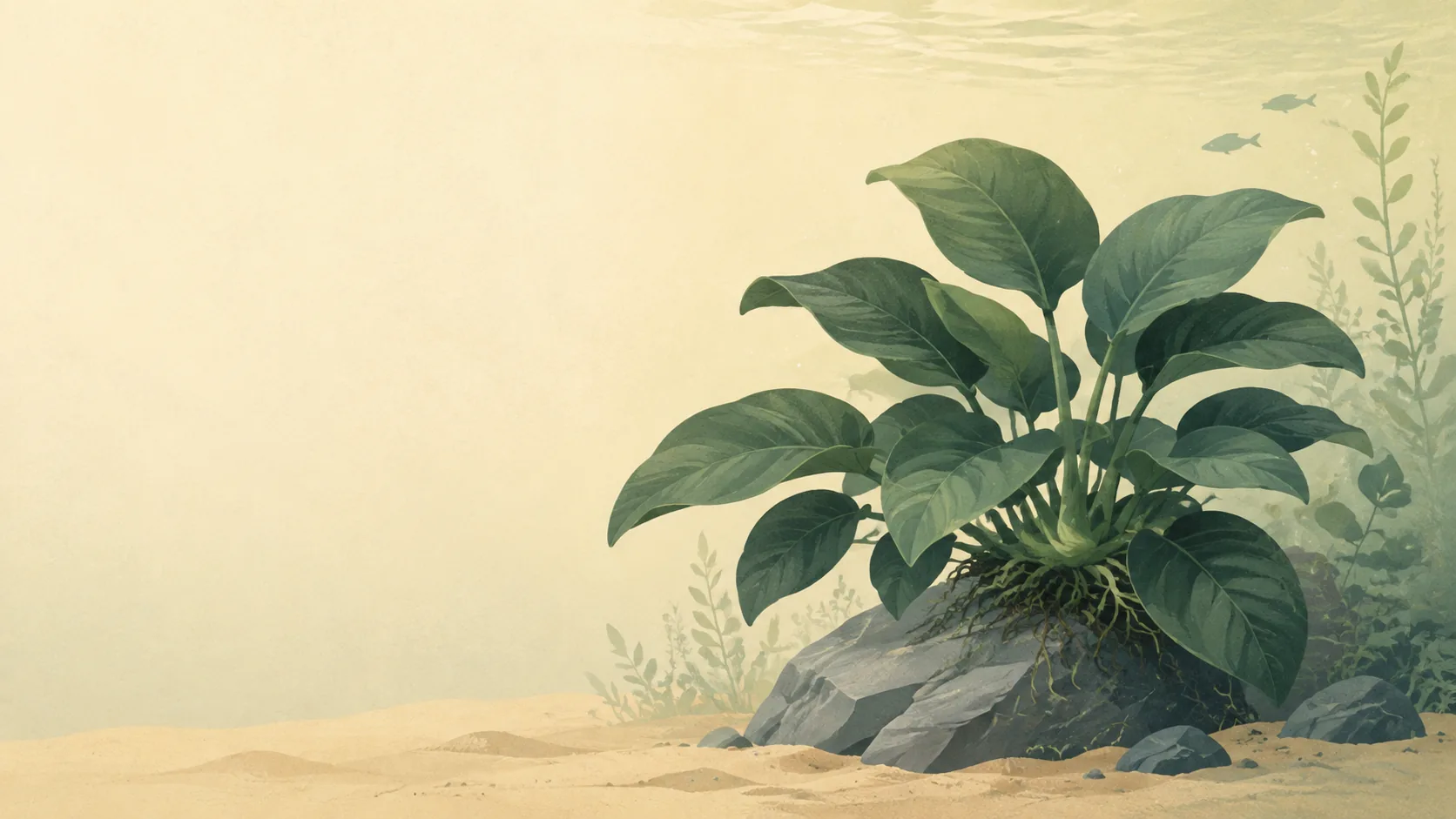
Anubias is the plant to start with if you have killed everything else. It grows in low light, needs no added CO2, attaches to wood and rock instead of rooting in substrate, and tolerates a level of neglect that would finish most aquarium plants. The trade-off is that it grows slowly.
What it is
Anubias is an epiphyte, meaning it grows attached to surfaces rather than planted in the substrate. Thick, dark, leathery leaves rise from a horizontal stem called a rhizome. The most common variety in the hobby is Anubias nana, Anubias barteri var. nana, a compact form that suits the foreground and middle of a tank.
| Requirement | Anubias nana |
|---|---|
| Light | Low |
| CO2 | Not required |
| Difficulty | Easy |
| Growth rate | Slow |
| Placement | Epiphyte, foreground to mid |
Never bury the rhizome
This is the one rule that matters, and breaking it is the most common way people kill an otherwise indestructible plant. Push the rhizome into the substrate and it rots.
Tie or glue it to rock or wood instead and let the roots find their own grip over a few weeks. Dragon stone works particularly well because its crevices give you somewhere to wedge the rhizome while it attaches.

Slow growth cuts both ways
Slow growth is why Anubias survives conditions that kill faster plants, and it is also why algae finds it. A leaf that takes months to grow has months to accumulate growth on its surface, and older Anubias leaves attract algae for exactly that reason. Its broad, dark leaves are a favourite site for black beard algae.
Removing badly affected old leaves is usually the right move. The plant will not recover a heavily colonised leaf quickly, and taking it off encourages new growth.
It pairs naturally with Java fern and Bucephalandra, which share the same rhizome habit and the same undemanding conditions.
Anubias questions
Does Anubias need CO2?
No. It grows perfectly well without added CO2, which is a large part of why it turns up in almost every low-tech planted tank.
Why are my Anubias leaves turning yellow or covered in algae?
Older leaves attract algae because the plant grows so slowly. If it is widespread rather than confined to the oldest leaves, look at light and nutrients rather than at the plant. Too much light over a slow grower is a common cause.
Can Anubias be planted in gravel?
Only if the rhizome stays above the surface. You can wedge the roots into gravel, but the rhizome itself must be exposed or it will rot. Attaching it to hardscape is simpler and more reliable.