Category: Composition

The design principles that make an aquascape look right — the rule of thirds, focal points and negative space.

  • Focal point

    Focal point

    An aquascape focal point is the one element the layout is built around, usually the largest stone or the boldest piece of wood. Without one the eye wanders and never settles, which is why a tank full of good plants can still look like nothing in particular.

    One subject, not two

    The most common failure is having two elements of roughly equal weight. Two similar stones at similar heights compete, and the eye bounces between them without resting. That is the same as having no focal point at all.

    The fix is to commit. Make one clearly dominant and let everything else support it.
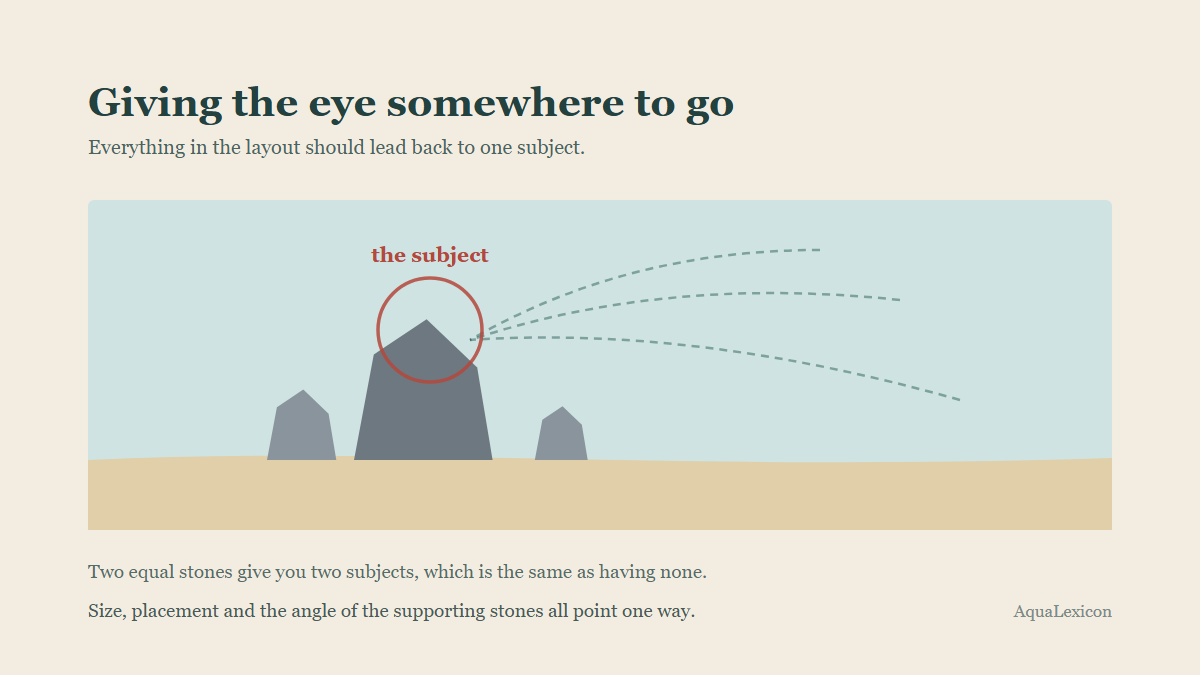
    A tank with one dominant stone circled on the left third and smaller supporting stones either side. Dashed lines sweep in from the open right-hand water toward the main stone.

    What makes something dominant

    • Size: the simplest lever. Make it noticeably bigger, not marginally.
    • Placement: off centre, on a third line. See the rule of thirds.
    • Angle: a stone set leaning rather than upright has direction, and direction points somewhere.
    • Isolation: open space around it stops it competing with anything.
    • Contrast: a red stem plant among green does the same job as a big stone.

    Supporting elements point at it

    In Iwagumi the smaller stones are named for their supporting role rather than treated as decoration. The Fukuishi balances the main stone, the Soeishi complements it, and neither is allowed to compete. Angling them so their lines run back toward the main stone is what makes a group of rocks read as one formation.

    The same applies to planting. A slope of substrate rising toward the subject, or taller plants set behind it, both push the eye where you want it.


    Questions about focal points

    Can a tank have more than one focal point?

    A large tank can carry a secondary point of interest, but it has to be clearly secondary. Two equal subjects cancel each other out.

    Can plants be the focal point instead of hardscape?

    Yes. The Dutch style uses no hardscape at all and builds its emphasis entirely from plant colour, height and texture. A single red species among greens draws the eye as firmly as any stone.

    Where should the focal point go?

    Off centre, roughly a third of the way across, and often a little above the midline. Dead centre is the one position that reliably weakens it.
  • Negative space

    Negative space

    Negative space in an aquascape is the open water and bare substrate you deliberately leave unplanted. It is not a gap waiting to be filled. Restraint is what gives the planted parts something to be measured against, and it is the hardest discipline for a beginner to accept.

    The instinct to fill

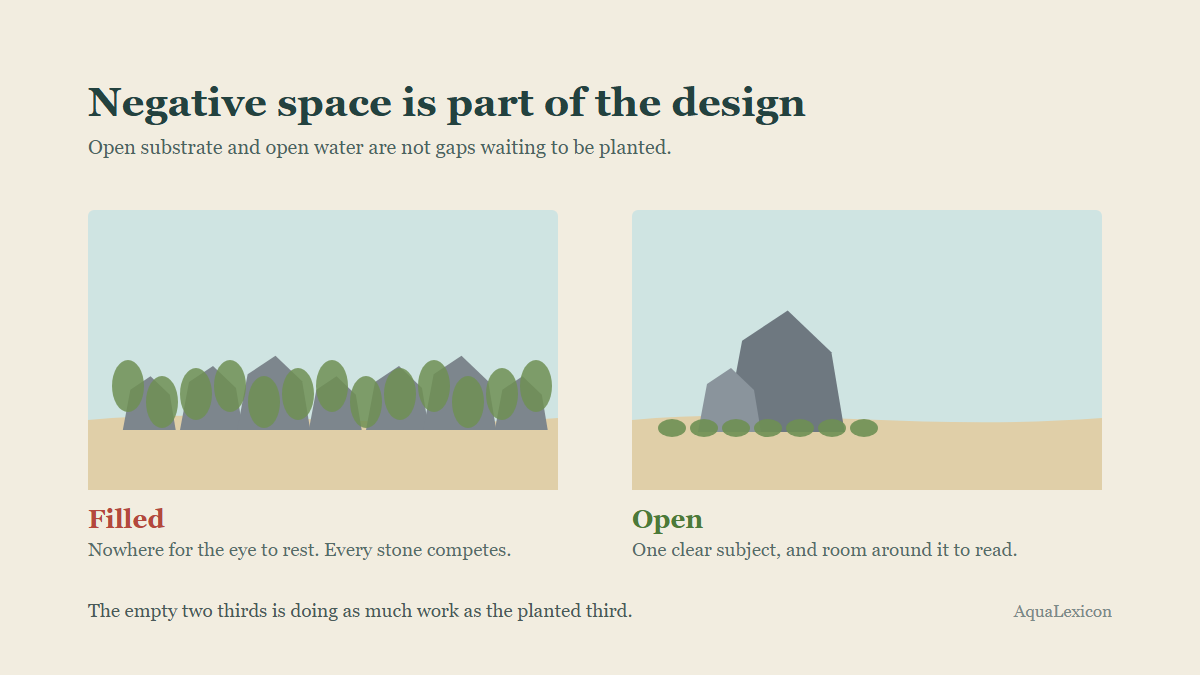
    Almost everyone plants too much at first. An empty corner looks unfinished, so it gets a plant, and then the next corner does too. The result is a tank that is full of interesting things and impossible to look at, because nothing is more important than anything else.

    Two tanks compared. The left is crowded with stones and plants across its whole width. The right has a single stone group on the left and open water and substrate to the right.

    What the empty part does

    • It creates scale. Open water above a low carpet makes a small tank read as a large landscape.
    • It isolates the subject. A focal point needs room around it, or it is just one object among many.
    • It gives fish somewhere to be. A shoal swimming through open water is part of the composition and needs the space to do it.

    The style that depends on it most

    Iwagumi is built almost entirely on this idea. A handful of stones, one carpeting plant, and a great deal of nothing. Take the empty space out of an Iwagumi and there is no style left, only some rocks.

    The opposite pole is the jungle style, which fills everything on purpose. That works because the overgrowth is the subject. What does not work is filling a tank by accident, one plant at a time, while intending something composed.

    Keeping it once you have it

    Plants grow. A layout with good open space in month one closes up by month four unless you trim it back deliberately. Maintaining negative space is an ongoing decision rather than something set at the start, and the rule of thirds is a useful check when you are deciding what to cut.


    Questions about open space

    How much of a tank should be empty?

    There is no fixed proportion, but if you cannot point at a clearly open area, there probably is not one. Minimalist styles leave most of the tank open; denser styles leave less, and the point is that it is a choice either way.

    Does an empty tank look unfinished to visitors?

    Usually the opposite. A composed layout with room to breathe reads as deliberate, where a densely filled one often reads as a collection of plants rather than a scene.

    Is bare substrate the same as negative space?

    It counts, and open water counts too. A stretch of clean sand in the foreground and an empty upper third are both doing the same job of giving the planted areas somewhere to sit against.

  • Rule of thirds

    Rule of thirds

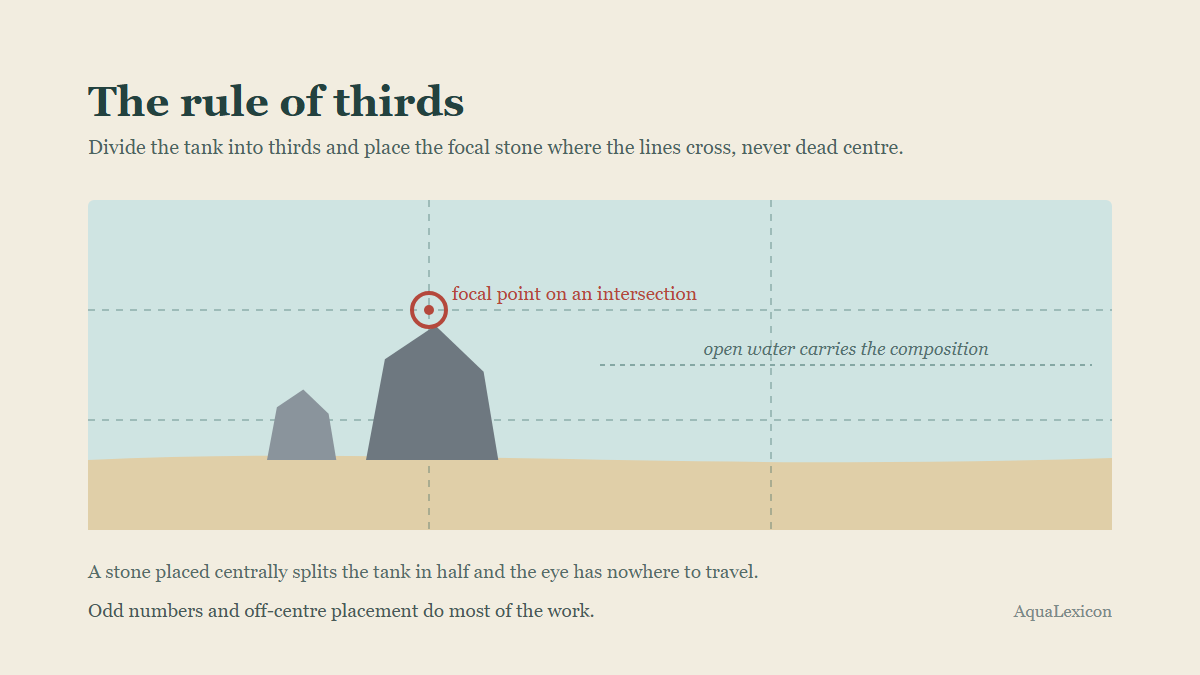
    The rule of thirds in aquascaping means dividing the tank into three parts each way and placing your main stone or wood where those lines cross, rather than in the middle. It is borrowed from photography and painting, and it is the quickest way to stop a layout looking static.

    How it works

    Picture two vertical lines and two horizontal lines across the front glass, splitting the view into nine. The four points where those lines meet are where the eye naturally settles. Put your subject on one of them.

    A tank divided into thirds by dashed guides, with the main stone placed on the left vertical line where it meets a horizontal line, and open water filling the right side.

    Why centre is the weak spot

    A stone placed dead centre splits the tank into two equal halves. Neither half is more interesting than the other, so the eye has nowhere to travel and the layout reads as a diagram rather than a landscape.

    Off-centre placement creates an imbalance the eye wants to resolve, and resolving it is what makes someone look for longer. That is the whole mechanism.

    Where you will see it

    Iwagumi is the clearest example. The style uses an odd number of stones precisely so the arrangement can never fall into symmetry, and the Oyaishi, the main stone, sits about a third of the way across rather than in the middle.

    It works alongside two related ideas. Negative space is what fills the two thirds you have not planted, and the focal point is what the placement is trying to create.

    Treat it as a starting point

    It is a rule of thumb rather than a law, and plenty of good scapes ignore it. But it is a reliable default when a layout feels wrong and you cannot say why, and moving the main stone off centre fixes more compositions than any other single change.


    Composition questions

    Does the rule of thirds apply to planting as well as hardscape?

    Yes, though hardscape matters more because it sets the structure before anything is planted. Tall plants placed on a third line rather than centrally follow the same logic.

    What is the golden ratio in aquascaping?

    A slightly different proportion used for the same job, placing the focal point at roughly 0.618 of the width rather than a clean third. In a tank the two land close enough together that the practical advice is identical: off centre, and not by a small amount.

    Can you break the rule of thirds?

    Regularly. A deliberately symmetrical layout can work when the symmetry is the point. The rule is worth knowing so that breaking it is a decision rather than an accident.